

Renormalization and Coarse Graining as Encoding
Coarse graining can be described as a noisy channel that discards short-distance information, and a chosen low-energy algebra may be approximately recoverable from its output. This makes QEC language useful for diagnosing retained information. It does not make every renormalization-group step an isometric encoding, nor does it identify scheme-dependent microscopic variables as logical degrees of freedom.
Required background. Ultraviolet and Infrared Fixed Points: Criteria and Evidence supplies physical RG flow. Coarse-Graining Channels and Recoverability supplies channel comparisons.
Helpful background. Regularization, Continuum Limits, and Code Validation supplies the uniform code criteria.
When coarse graining resembles a code
Section titled “When coarse graining resembles a code”Let map fine regulated states to a coarser description. Choose a retained algebra of long-wavelength observables and a state family . The QEC-like question is whether there exists such that
This is approximate sufficiency for a task. Bény and Osborne formulate RG in terms of statistical distinguishability Bény and Osborne 2015, §§2–4, while Furuya, Lashkari, and Ouseph analyze Petz recovery for real-space renormalization Furuya, Lashkari, and Ouseph 2022, §§2–4. The retained observables are logical only relative to , , and the error metric. Modes deliberately integrated out are not errors to be corrected unless the task demands reconstructing them.
An isometric tensor-network layer runs in the opposite orientation: it can embed coarse degrees of freedom into a larger fine space. Its adjoint or a channel derived from it may coarse grain. Specify the direction before calling it an encoder.
Gaussian block-spin example
Section titled “Gaussian block-spin example”For a free lattice scalar, form coarse variables by a normalized block average and discard orthogonal high-momentum combinations. The resulting Gaussian channel maps means and covariances linearly. Test recovery of:
- smeared fields with momenta ;
- two-point functions at separations much larger than the block scale;
- relevant coupling estimates within a matched state family.
Construct a Gaussian recovery that inserts conditional high-frequency covariances. Its success on low-momentum observables does not reconstruct arbitrary fine states. Vary the blocking kernel and demand that any claimed logical prediction is invariant after matching physical observables.
Where the analogy breaks
Section titled “Where the analogy breaks”Irreversibility is intentional. Wilsonian RG identifies theories with the same long-distance predictions; it does not seek to restore all microscopic information.
The state family is restricted. Recoverability near a fixed point or on a Gibbs family need not hold for arbitrary high-energy states.
Scheme changes move coordinates. Couplings and field variables can change under redefinitions while observables agree. A logical algebra should be identified through physical predictions, not bare parameters.
Scale evolution is not time evolution. RG depth is not elapsed physical time, and a coarse-graining channel need not be dynamically realizable with the advertised locality or energy.
Relevant directions are not automatically qubits. Linearized RG eigenoperators organize perturbations; they do not by themselves define a finite logical subsystem or recovery map.
Limits of interpretation
Section titled “Limits of interpretation”As of 10 August 2026, information-theoretic recovery provides powerful model-specific diagnostics of coarse graining, but no universal identification equates RG with QEC for all QFTs. The strongest claim states the retained algebra, state family, channel, scheme, and reconstruction error.
Exercises
Section titled “Exercises”Scheme dependence. Why is recovery of a bare coupling not a scheme-independent logical task?
Solution
Field redefinitions and subtraction schemes can change the coupling coordinate while leaving physical correlators unchanged. The task should recover matched observables or an invariant parameter combination.
Restricted family. A recovery exactly reconstructs all Gaussian states after Gaussian coarse graining. Does it correct arbitrary interacting states?
Solution
No. Exactness on the Gaussian family controls only its moments and states. Higher connected correlators in interacting states can be discarded. The state domain must remain in the claim.
Recovery and continuum maps
Section titled “Recovery and continuum maps”The first diagram follows the task from logical algebra through noise, environmental leakage, and constrained recovery; inspect which metric and recovery family support the guarantee. The second identifies the additional uniformity tests required before finite-regulator correctability becomes a continuum field-code statement.
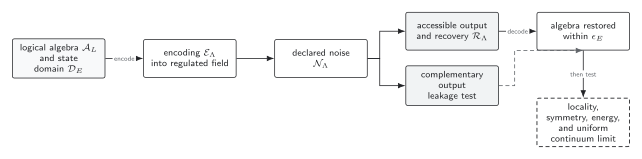
Correctability relates one logical algebra, one noise channel and complement, one state or energy domain, and one recovery class. Environmental forgetting supports recovery only in the matching metric; locality, symmetry, and continuum convergence are additional tests. The diagram is schematic and not to scale.
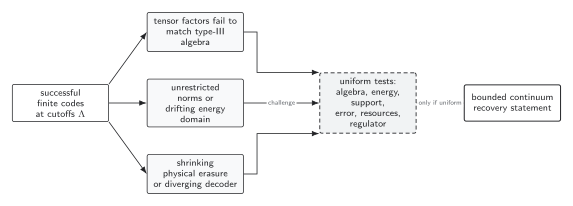
A sequence of successful finite codes does not establish a continuum code unless its logical algebra, physical erasure region, energy domain, recovery error, and locality bounds converge uniformly. Type-III structure and regulator-dependent tensor factors require an algebraic target. The diagram is schematic.
References
Section titled “References”- Bény, Cédric, and Tobias J. Osborne. “The Renormalization Group via Statistical Inference.” New Journal of Physics 17 (2015): 083005. DOI. Open PDF.
- Furuya, Kento, Nima Lashkari, and Shoy Ouseph. “Real-Space Renormalization, Error Correction and Petz Map.” Journal of High Energy Physics 01 (2022): 170. DOI. Open PDF.