

Tripartite Information and Multipartite Scrambling
Tripartite information diagnoses whether correlations between an input reference and two output regions are stored separately or only jointly. For a declared channel state, negative can reveal delocalized encoding, but it is neither universally negative in QFT nor sufficient by itself to prove scrambling: the partition, entropy definition, regulator cancellation, state, and recovery task remain essential.
Required background. Decoupling and Subsystem Information Loss supplies the reference-system test.
Helpful background. Multipartite Information and Entropy Cones supplies the entropy inequalities and sign nonuniversality.
Channel-state definition
Section titled “Channel-state definition”Let a regulated unitary map physical input factors to outputs . Introduce references and , prepare , and apply to the two input halves. The resulting pure channel state has four parties. For input reference and output split , define
Equivalently,
For a unitary channel state, unitarity gives . If , then : neither output part alone reveals the tested input, but their union does. The unshown input reference is essential. For a pure state of only three parties, tripartite information vanishes identically, so a negative value is a four-party channel-state diagnostic Hosur et al. 2016, §2.2.
The converse fails. A negative value can arise for a particular state and partition without establishing small recovery error for every encoded input. It can also mix classical, quantum, and sector correlations. Recovery must still be tested in the desired norm.
Regulator cancellation in QFT
Section titled “Regulator cancellation in QFT”Individual spatial entropies generally contain cutoff-dependent boundary terms. The seven-term combination above cancels local divergences only when the regions and regulator are arranged so that every entangling-surface contribution appears with zero net coefficient. Junctions, corners, shared boundaries, gauge centers, and zero modes can leave residual terms.
For disjoint separated regions, mutual information is often a cleaner intrinsic comparator. For adjacent tripartitions, state the regulator and verify cancellation explicitly. A numerically stable finite value at one cutoff is not a proof of a universal continuum observable.
Rényi versions are different quantities
Section titled “Rényi versions are different quantities”Replacing every by defines a Rényi tripartite combination, but ordinary Rényi entropies do not satisfy all von Neumann entropy inequalities. In particular, data-processing and strong-subadditivity arguments cannot be imported unchanged. If an OTOC identity yields a second-Rényi quantity, label it and do not silently interpret its sign as the von Neumann result.
A controlled encoding example
Section titled “A controlled encoding example”For the three-qubit repetition isometry , , each output qubit shares classical information with the input reference. Hence it does not realize the pairwise-decoupled pattern even though the logical phase is globally encoded. By contrast, a perfect-tensor channel state or a suitable secret-sharing encoding can make specified small outputs unauthorized while a larger union recovers Cleve, Gottesman, and Lo 1999, pp. 648–651. The comparison shows that “nonlocal encoding” has several inequivalent strengths.
Multipartite extensions
Section titled “Multipartite extensions”For outputs , one may examine an inclusion–exclusion information, the full pattern of mutual informations, or the access structure of all unions. The last is operationally strongest: it asks which sets admit a decoder and which are decoupled. A single scalar cannot reconstruct that Boolean pattern.
Useful controls are:
- permute output regions and test geometric dependence;
- resolve symmetry and superselection sectors;
- compare , conditional mutual information, negativity, and recovery error on the same state;
- include product, swap, integrable, noisy, and known-code null models;
- refine cutoff and volume at fixed physical regions.
Exercises
Section titled “Exercises”Assume a pure four-party channel state has , , and . Compute and explain why the fourth party matters.
Solution
The definition gives . The fourth party purifies the reduced state on ; if itself were pure, its tripartite information would instead vanish identically. The result describes this channel partition and does not alone prove a worst-case recovery theorem.
Scientific evidence cutoff: 10 August 2026. The channel-state examples and literature-sensitive comparisons on this page are current through that date.
Continue to Recovery Thresholds, Access Structures, and Side Information to replace one scalar by the full authorized-set pattern.
Diagnostic and failure maps
Section titled “Diagnostic and failure maps”The first diagram separates influence diagnostics from the decoupling and recovery test; inspect the declared output access, norm, and decoder class. The second collects mechanisms that can imitate scrambling and the controls that distinguish them.
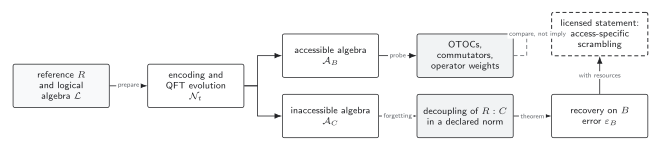
Scrambling becomes operational only after the input algebra, output access structure, side information, norm, energy restriction, and decoder class are declared. OTOCs and operator weights diagnose influence; decoupling and a recovery theorem license a statement about information access. The diagram is schematic and not to scale.
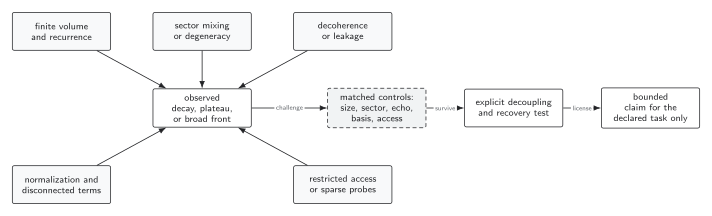
Several mechanisms can suppress a correlator or produce an entropy plateau without delocalizing recoverable quantum information. Sector resolution, recurrence windows, normalization checks, access variation, and an explicit recovery test distinguish these alternatives. The diagram is schematic.
References
Section titled “References”- Cleve, Richard, Daniel Gottesman, and Hoi-Kwong Lo. “How to Share a Quantum Secret.” Physical Review Letters 83 (1999): 648–651. DOI. Open PDF.
- Hosur, Pavan, Xiao-Liang Qi, Daniel A. Roberts, and Beni Yoshida. “Chaos in Quantum Channels.” Journal of High Energy Physics 02 (2016): 004. DOI. Open PDF.