

Finite Size, Symmetry Sectors, and Scrambling False Positives
Finite volume, unresolved symmetries, degeneracies, recurrences, disconnected correlators, noise, and estimator bias can imitate scrambling. The remedy is an adversarial control suite run on the same observable and analysis pipeline, not a verbal caveat after the fit. A scrambling interpretation survives only if alternative mechanisms are separated and a recovery-sensitive diagnostic agrees.
Required background. OTOCs, Commutators, and Information Measures supplies the regulated observables. Helpful background. Continuum Extrapolation and Finite-Time Windows supplies matched scaling-window tests.
False-positive matrix
Section titled “False-positive matrix”| Mechanism | Misleading signature | Discriminating control | Allowed conclusion before control |
|---|---|---|---|
| Disconnected piece or bad normalization | apparent OTOC decay or plateau | compute all two-point pieces and anchor | correlator changed |
| Decoherence or leakage | decay resembling internal scrambling | echo/teleportation verification and environment accounting | information left measured subsystem |
| Symmetry-sector mixing | random-matrix-like averages or plateaus | diagonalize and average within fixed irreducible sectors | mixed-sector statistic |
| Exact degeneracy | persistent plateau or anomalous recurrence | resolve degenerate blocks and conserved projectors | finite-spectrum effect |
| Finite volume | ramp, plateau, saturation, recurrence | size scaling and pre-recurrence window | behavior of one finite system |
| Sparse operator family | small averaged signal | enlarge to a complete or design-controlled family | influence in tested directions |
| Integrable dephasing | entanglement growth and local equilibration | conserved-charge-resolved recovery and spectral controls | dephasing under chosen observables |
| Estimator bias | negative or small recovery error | injection tests, resampling, blinded null data | estimator output |
Symmetry resolution
Section titled “Symmetry resolution”If , write the Hilbert space as and evaluate spectral or channel diagnostics within fixed . Combining sectors adds exact zero-frequency differences and changes level statistics. For OTOCs, project both operators and the thermal state consistently; an operator that changes charge connects different blocks and needs its own normalization.
The same issue appears in decoupling. If the reference carries a charge label and the inaccessible region can measure it, the region is not decoupled from the full logical algebra even if neutral correlators vanish. One may instead declare a sector-fixed quantum task, but that changes the claim.
Recurrences and time windows
Section titled “Recurrences and time windows”A finite isolated system has a discrete spectrum,
so quasiperiodic recurrences are unavoidable. A late-time average suppresses nondegenerate phases but retains exact and near degeneracies. Report at least:
- the microscopic relaxation time;
- the front or scrambling time under the chosen diagnostic;
- the finite-size Thouless or hydrodynamic crossover when relevant;
- the recurrence/Heisenberg scale;
- the actual fit window and its variation.
A plateau before the asymptotic volume regime can be an entropy ceiling, not a universal information-loss value. Explicit lattice comparisons show that tripartite-information conclusions can change with the Hilbert-space partition and finite-size regime Schnaack et al. 2019, §§II–IV.
Matched null models
Section titled “Matched null models”The strongest control changes one causal mechanism while preserving superficial difficulty. Useful pairs include:
- the target dynamics versus a random diagonal unitary with identical phase statistics;
- an interacting model versus an integrable point at matched bandwidth and symmetry;
- coherent evolution versus a dephasing channel with matched OTOC decay;
- a true encoding circuit versus a swap into an inaccessible register;
- full operator-basis averages versus the experimentally sampled subset.
The analysis pipeline should be frozen before labels are revealed. If it calls the null model “scrambled,” the diagnostic is not specific enough.
Recovery as a positive control
Section titled “Recovery as a positive control”An echo or verified teleportation circuit can distinguish coherent information spreading from ordinary error. The trapped-ion experiment of Landsman et al. 2019, pp. 61–65 used a teleportation-based verification signal alongside an OTOC-sensitive quantity; its finite circuit and noise model bound the conclusion. The design principle transfers broadly, while the numerical fidelity does not become a continuum-QFT result.
Exercises
Section titled “Exercises”A calculation averages level spacings across two exact symmetry sectors and finds level repulsion. Why is this not evidence of chaos?
Solution
Superposing independent spectra changes the spacing distribution and introduces crossings protected by symmetry. Random-matrix comparisons apply within irreducible sectors after degeneracies and antiunitary symmetries are treated. Moreover, level statistics concern physical chaos and still do not by themselves establish information scrambling or failed recovery.
Continue to Scrambling Evidence and Claim-Status Matrix to match a surviving result to an appropriate evidence statement.
Diagnostic and failure maps
Section titled “Diagnostic and failure maps”The first diagram separates influence diagnostics from the decoupling and recovery test; inspect the declared output access, norm, and decoder class. The second collects mechanisms that can imitate scrambling and the controls that distinguish them.
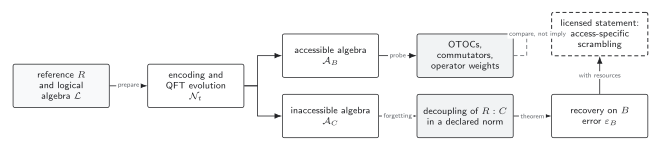
Scrambling becomes operational only after the input algebra, output access structure, side information, norm, energy restriction, and decoder class are declared. OTOCs and operator weights diagnose influence; decoupling and a recovery theorem license a statement about information access. The diagram is schematic and not to scale.
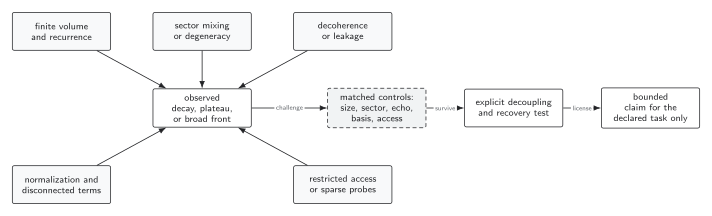
Several mechanisms can suppress a correlator or produce an entropy plateau without delocalizing recoverable quantum information. Sector resolution, recurrence windows, normalization checks, access variation, and an explicit recovery test distinguish these alternatives. The diagram is schematic.
References
Section titled “References”- Landsman, Kevin A., Caroline Figgatt, Thomas Schuster, Norbert M. Linke, Beni Yoshida, Norman Y. Yao, and Christopher Monroe. “Verified Quantum Information Scrambling.” Nature 567 (2019): 61–65. DOI. Open PDF.
- Schnaack, Oliver, Niklas Bölter, Sebastian Paeckel, Salvatore R. Manmana, Stefan Kehrein, and Markus Schmitt. “Tripartite Information, Scrambling, and the Role of Hilbert Space Partitioning in Quantum Lattice Models.” Physical Review B 100 (2019): 224302. DOI. Open PDF.