

From Field Data to Information Claims
Field data support an information claim only through an explicit chain connecting instrument or simulator records to calibrated observables, an identifiable estimator, modeling assumptions, uncertainty, regulator limits, and alternative explanations. A correlator estimate can support Gaussian reconstruction, entropy, entanglement, or recovery conclusions only to different degrees; the chain states exactly where each additional assumption enters.
Required background. Information-Measure Domain and Comparison Atlas supplies the mathematical domains of information quantities. Detector and instrument validation supplies calibrated measurement channels.
The seven-stage inference chain
Section titled “The seven-stage inference chain”For raw records , write
where is calibration and preprocessing, the estimator, the model class, the uncertainty construction, the finite-size/truncation/continuum limit, and the alternatives challenged. The output is a claim whose scope is the intersection of these validated stages.
- Acquisition: preserve timestamps, settings, random seeds, detector outcomes, and rejected events.
- Calibration: map readout to field modes or observables and propagate its covariance.
- Estimation: state the likelihood or estimating equation and identifiability domain.
- Modeling: separate observed constraints from Gaussianity, stationarity, locality, or channel-family assumptions.
- Uncertainty: combine finite samples, calibration, truncation, and correlated preprocessing.
- Limits: hold physical regions and smearings fixed while volume and cutoff are varied.
- Alternatives: test states or mechanisms that reproduce the measured observables without the target property.
Synthetic correlator-to-entropy example
Section titled “Synthetic correlator-to-entropy example”Suppose calibrated quadrature samples estimate a covariance matrix for wave-packet modes. A Gaussian pipeline projects or constrains to satisfy the uncertainty relation, computes symplectic eigenvalues , and evaluates
in a convention where the vacuum symplectic eigenvalue is one. Resample the raw observations and calibration parameters together; recompute the physicality treatment and nonlinear entropy in every replicate.
The data justify the Gaussian entropy only if Gaussianity is established or adopted as a model. An adversarial non-Gaussian state can share all first and second moments but have a different entropy. The covariance still supports statements about quadratic witnesses and the maximum-entropy Gaussian state, but the unconditional full-state entropy claim must be withdrawn or bounded.
Claim ladder
Section titled “Claim ladder”| Evidence obtained | Strongest default statement |
|---|---|
| calibrated two-point functions | values of those smeared correlators within uncertainty |
| physical covariance and Gaussian assumption | reconstructed Gaussian state on measured modes |
| higher-cumulant nulls with power analysis | bounded evidence for approximate Gaussianity in tested directions |
| direct Rényi estimator agreeing on held-out data | cross-method support for the selected invariant |
| multiple regulators and stable extrapolation | continuum statement for the fixed physical mode/region family |
| explicit recovery test | task-specific recoverability, not merely correlation |
Identifiability before precision
Section titled “Identifiability before precision”If different parameter or state families yield the same distribution of records, no estimator can identify the target without additional probes or priors. Report a ridge, equivalence class, or bound. A narrow interval produced by fixing a nonidentifiable nuisance parameter is conditional precision, not data-driven identification. Systematic biases can remain even when a standard tomography estimator reports a physical state Schwemmer et al. 2015, pp. 1–4, which is why held-out outcome prediction belongs in the chain.
As of 10 August 2026, no finite collection of field observables licenses an unconditional full-state information claim without an identifiability theorem or a declared model class. Current claims should therefore retain the calibration, model, continuum domain, and alternatives that bound them.
Exercises
Section titled “Exercises”Adversarial state. Why do vanishing measured third and fourth cumulants not prove exact Gaussianity?
Solution
Only finitely many directions and moments were tested. A non-Gaussian state can match them and differ in higher or unmeasured correlations. Report the test set and sensitivity, or state Gaussianity as a model assumption.
Selection bias. Why must rejected detector events be retained in the provenance record?
Solution
Postselection can change the inferred state and entanglement. Reproduction and bias analysis need the rule, counts, settings, and preferably the raw rejected records; otherwise the effective measurement channel is unknown.
Inference and failure-control maps
Section titled “Inference and failure-control maps”The first diagram traces the complete path from raw records to a bounded information claim; inspect the assumption attached to every arrow. The second maps shared and method-specific failure channels to held-out tests, regulator variation, replication, and correction.
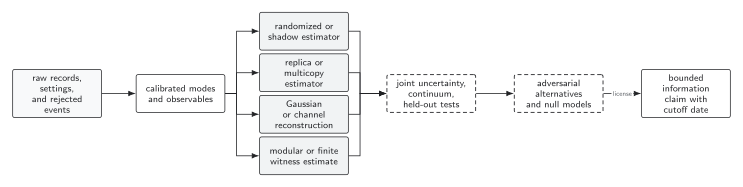
Entropy, tomography, witness, and recovery methods enter at the estimator stage, but all share calibration, uncertainty, continuum, and alternative-model tests. The final statement is no stronger than the least validated arrow. The diagram is schematic and not to scale.
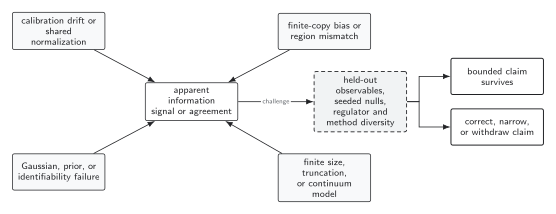
Different estimators can share the same calibration or normalization bias, so numerical agreement is not automatically independent replication. Adversarial nulls, held-out observables, regulator variation, and genuinely independent implementations set the limit on the conclusion and trigger correction when needed. The diagram is schematic.