

Operational Distinguishability and Continuity Bounds
Operational distinguishability is always relative to a task. For states, the task fixes the observable algebra; for channels, it fixes the admissible inputs, ancillas, and energy budget. Without those restrictions, two bosonic channels that are nearly identical on every practical input can nevertheless have maximal diamond distance, and trace-norm closeness alone gives no dimension-free continuity bound for field entropy.
Required background. Use probability and conditional expectation and Hypothesis Testing and Asymptotic Distinguishability. Helpful background. Fidelity, Chernoff Bounds, and State Overlap supplies complementary overlap bounds.
The chapter’s task-comparison table distinguishes state bias, asymmetric testing, and channel norms. Its structural map shows why the input resource belongs inside a channel-distance definition.
State bias on a declared algebra
Section titled “State bias on a declared algebra”For normal states and on a von Neumann algebra , their predual norm is
With equal priors, the optimal binary success probability using effects in is
For and density operators, . If the detector accesses only a subalgebra , the supremum is taken over fewer effects, so
This is an operational version of “discarding observables cannot improve discrimination.” It does not require a tensor factor or a reduced density matrix.
A chosen family smaller than an algebra can also define a detector bias, but then its closure properties must be stated. For example, bounds obtained from smeared fields with compact detector support do not automatically optimize over every bounded operator in the sharp local algebra.
Channel distance with an energy budget
Section titled “Channel distance with an energy budget”For channels and , the ordinary diamond norm optimizes over every input state and arbitrary reference system. On an infinite-dimensional bosonic input, that set contains probes of unbounded energy. Given a nonnegative input Hamiltonian with ground energy fixed to zero and a budget , define
The reference is part of the optimization; the energy constraint applies to the channel input . The norm convention above ranges from to , with no extra factor of . For equal channel priors,
The Hamiltonian, its energy origin, the allowed input algebra, the reference class, and whether the budget is mean or maximal energy are all part of the quantity’s name. Shirokov proves that suitable energy-constrained diamond norms generate the physically useful strong topology on infinite-dimensional channels; see Shirokov 2018, § 3 and Proposition 3, pp. 23–27.
Two elementary checks follow directly from the definition:
A small value at one says nothing about probes outside that energy set.
Pure-loss channel workflow
Section titled “Pure-loss channel workflow”Compare two one-mode pure-loss channels with power transmissivities
They act on a coherent probe as described by the quantum-limited attenuator model Caruso et al. 2008, § 2.3, pp. 16–17:
Use the input Hamiltonian , so the probe has . The calculation is best read as an input–procedure–output–validation chain.
Input. Choose with and no ancilla. This probe is admissible for the stated mean-energy set.
Procedure. Send the same probe through either channel and perform the optimal binary measurement on the two pure output states.
Output. Their root fidelity and trace distance are
Therefore this explicit probe certifies
It is a lower bound on the energy-constrained diamond norm, not a claim that coherent states optimize the constrained norm.
Validation. Here , so:
| Mean occupation | Output | Output | Certified norm lower bound | Coherent-probe success |
|---|---|---|---|---|
| 1 | 0.995012479 | 0.0997505201 | 0.199501040 | 0.549875260 |
| 10 | 0.951229425 | 0.308484330 | 0.616968660 | 0.654242165 |
| 100 | 0.606530660 | 0.795060098 | 1.59012020 | 0.897530049 |
| 400 | 0.135335283 | 0.990799859 | 1.98159972 | 0.995399930 |
The values are reproduced in the machine-readable operational benchmark. As , the coherent-probe lower bound tends to . Since no diamond distance exceeds ,
Thus removing the energy set makes the unconstrained norm maximal. The supremum success probability is one, but no finite-energy coherent probe attains it: the sequence above approaches perfect discrimination as . This is the manifest failure mode in an exact calculation, without inventing a finite-resource optimizer.
Entropy continuity needs spectral control
Section titled “Entropy continuity needs spectral control”In dimension , trace-distance closeness implies the sharp Fannes–Audenaert bound Audenaert 2007, Theorem 1, p. 8128:
where
is the binary entropy in nats, with . The bound holds for . The factor is not an ornament: it records the finite alphabet.
For an infinite-dimensional system, replace dimension by physical spectral data. Suppose has discrete spectrum and satisfies the Gibbs hypothesis
Let be the maximum-entropy Gibbs state among states of mean energy at most . If
then
This is Winter 2016, Gibbs Hypothesis and Lemma 15, pp. 303–306. For one oscillator with ,
The bound is uniform on one fixed energy set. Changing , its zero point, or the budget changes the statement.
Why trace distance alone is insufficient
Section titled “Why trace distance alone is insufficient”Take
For every ,
but
At :
| Excited levels | Trace distance | in nats | Mean occupation |
|---|---|---|---|
| 10 | 0.01 | 0.0790274 | 0.055 |
| 1,000 | 0.01 | 0.125079 | 5.005 |
| 1,000,000 | 0.01 | 0.194157 | 5,000.005 |
As , the entropy difference diverges while the trace distance stays fixed. The family escapes every fixed energy set, exactly identifying the missing hypothesis. A finite-dimensional Fannes bound cannot be transplanted by calling an ultraviolet cutoff “large.”
The validity figure organizes the same logic for state and channel tasks.
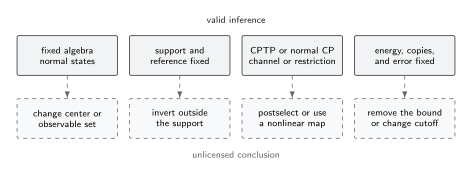
A detector-algebra norm and the full state norm answer different questions. Likewise, unconstrained and energy-constrained diamond norms optimize over different probes. Continuity statements additionally require the same Hamiltonian and spectral tail control. Schematic.
For a theorem-level continuation on channel topologies and capacities, proceed to Infinite-Dimensional and Energy-Constrained Channel Distances. The noncommutative information-measure treatment supplies the rigorous operator-space setting.
Common pitfalls
Section titled “Common pitfalls”Dropping the factor-of-two convention. This page’s channel norm ranges up to ; the associated equal-prior bias is one quarter of that norm. A half-diamond convention must be translated.
Reporting a probe value as the optimized norm. Any admissible probe gives a lower bound. Equality requires a separate optimality proof.
Hiding the vacuum-energy choice. Replacing by changes the numerical budget. State the Hamiltonian and its ground-energy normalization.
Using a finite-dimensional entropy bound at infinite dimension. The dimension factor has not disappeared; it has become an energy and spectral-growth requirement.
Exercises
Section titled “Exercises”1. Derive the state success probability
Section titled “1. Derive the state success probability”Show that for equal priors on two normal states,
Solution
For an effect that decides , the success probability is
Because is a self-adjoint functional with total value zero, the supremum over effects satisfies
Substitution gives the result. On a type-I algebra this is the usual Helstrom formula.
2. Check the attenuation limit
Section titled “2. Check the attenuation limit”Derive , , and the certified channel-norm lower bound for coherent probes. Prove that distinct transmissivities give unconstrained diamond distance .
Solution
Pure loss maps to . Coherent-state overlap gives
For pure outputs, . Their trace-norm difference is , so the constrained diamond norm is at least this value. If , then as . The unconstrained norm is at least and at most , hence equals .
3. Build the entropy counterexample
Section titled “3. Build the entropy counterexample”Verify the trace distance, entropy, and mean occupation of . Which quantity prevents the family from contradicting Winter’s bound?
Solution
The diagonal difference has eigenvalues on and on each of excited levels. Its trace norm is , so the half norm is . The spectrum of is together with copies of , giving
Finally,
The mean energy diverges with , so the states do not stay inside one fixed energy set.
4. Compare two energy budgets
Section titled “4. Compare two energy budgets”Let . Prove monotonicity of the energy-constrained diamond norm and explain why a continuity claim established at cannot automatically be applied at .
Solution
Every input satisfying also satisfies the constraint. The first supremum is therefore over a subset of the second:
The second set can contain higher-energy probes with much larger output separation. A bound proved only on the smaller set has no quantified remainder for the added inputs, so using it at requires a new estimate.
References
Section titled “References”- Audenaert, Koenraad M. R. “A Sharp Continuity Estimate for the von Neumann Entropy.” Journal of Physics A: Mathematical and Theoretical 40, no. 28 (2007): 8127–8136. DOI. Open preprint.
- Caruso, Filippo, Jens Eisert, Vittorio Giovannetti, and Alexander S. Holevo. “Multi-Mode Bosonic Gaussian Channels.” New Journal of Physics 10 (2008): 083030. DOI. Open preprint.
- Shirokov, M. E. “Energy-Constrained Diamond Norms and Their Use in Quantum Information Theory.” Problems of Information Transmission 54, no. 1 (2018): 20–33. DOI. Open preprint.
- Winter, Andreas. “Tight Uniform Continuity Bounds for Quantum Entropies: Conditional Entropy, Relative Entropy Distance and Energy Constraints.” Communications in Mathematical Physics 347 (2016): 291–313. DOI. Open preprint.