

Standard Form, Cyclic and Separating Vectors
A vector is cyclic and separating for a von Neumann algebra when is dense and implies . These two properties make the state–algebra pair faithful enough to define Tomita’s antilinear operator and place and its commutant in a common standard form. They are hypotheses, not automatic properties of every vector.
Required background. Review type-III local algebras. Helpful background. Restricted states explains why faithfulness and normality belong to a represented state–algebra pair.
Cyclicity and separatingness
Section titled “Cyclicity and separatingness”For :
The two notions are exchanged by commutants: is cyclic for exactly when it is separating for . Indeed, if annihilates , then on the dense set , hence ; the converse follows by replacing with and using the bicommutant theorem.
On the dense domain , define
Separatingness makes this definition unambiguous; cyclicity makes the domain dense. The closable operator has polar decomposition , where is antiunitary and is positive self-adjoint; see Takesaki 1970, Chapters 2–3. Domain questions are essential because and are generally unbounded.
The structural map places Standard Form, Cyclic and Separating Vectors among sharp local algebras, split inclusions, and regulated or operational substitutes.
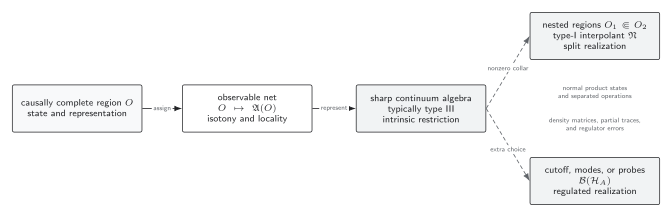
A causally complete region determines a sharp local algebra, usually type III. A nonzero split collar or an explicit cutoff, mode selection, or probe model can instead supply a type-I realization; these alternatives enable ordinary density matrices but retain different physical approximations. Schematic, not to scale.
Standard form
Section titled “Standard form”A standard form of is a quadruple with a modular conjugation and a self-dual natural cone . It realizes and represents every normal positive functional by a unique vector in . This replaces basis-dependent purifications by a canonical representation of normal states.
For a finite bipartite system with faithful density matrix , one may identify the Hilbert–Schmidt space with . The vector is cyclic and separating for left multiplication, and
This is an instructive analogue, but local QFT modular operators need not be expressible as because the local algebra need not admit or a tensor factor.
Vacuum wedge check and a failure case
Section titled “Vacuum wedge check and a failure case”For a vacuum satisfying the Reeh–Schlieder hypotheses, is cyclic for a wedge algebra and for its causal complement. Locality then makes it separating for the wedge algebra. The resulting modular data have a geometric interpretation in the Bisognano–Wichmann setting, developed later.
By contrast, take a finite-dimensional density matrix with a zero eigenvalue. Its square root is not separating for the full matrix algebra on its support-complement representation: a nonzero projector onto the kernel annihilates it. The inverse in the finite formula for is undefined there. Restricting to the support restores faithfulness, which shows exactly which hypothesis failed.
Before applying this result, use the validity map to keep the algebra, state, operation class, resources, and approximation fixed.
For a side-by-side statement of the chapter’s subsystem choices, use the subsystem comparison table.
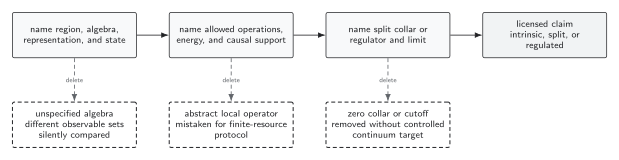
Every local-information claim must specify the represented algebra and state, the allowed operations and resource support, and any split collar or regulator. The dashed lower boxes show what fails when the algebra, protocol, or limiting prescription is left implicit. Schematic.
References
Section titled “References”- Takesaki, Masamichi. Tomita’s Theory of Modular Hilbert Algebras and Its Applications. Berlin: Springer, 1970. DOI.