

Tensor Networks as Encoding Maps: Scope and Limits
A tensor network acts as a QFT encoding only after its input legs are identified with a logical algebra, its contracted map is shown to be isometric or approximately channel preserving on a declared domain, and reconstruction errors are controlled as bond dimension and regulator are refined. Network geometry and causal cones organize computations; they do not alone prove error correction or a continuum limit.
Required background. Renormalization and Coarse Graining as Encoding supplies the coarse-graining distinction.
Helpful background. Regularization, Continuum Limits, and Code Validation supplies convergence criteria.
From tensors to a channel
Section titled “From tensors to a channel”Contract a finite network with open logical legs and physical legs to obtain a linear map , where denotes bond dimensions and truncations. If
it is an exact isometry at that regulator. If not, polar decomposition or a normalized channel may define an approximate encoder, but the deviation and its state dependence must be reported.
A MERA-like network uses isometries and disentanglers so local observables have bounded causal cones through the network, as in the constructive algorithms of Evenbly and Vidal Evenbly and Vidal 2009, §§II–IV. This can provide several physical representatives of coarse logical observables and efficient contraction. Whether erasure of a boundary region is correctable is a separate channel test involving the complementary output.
Reconstruction through a causal cone
Section titled “Reconstruction through a causal cone”For a logical operator , ascending or descending superoperators produce a physical representative satisfying
If two physical regions yield representatives and , verify their projected actions and algebraic relations on all code states. A narrow causal cone suggests locality but does not ensure bounded operator norm, finite physical energy, or exact support after the continuum limit.
Free-field network test
Section titled “Free-field network test”For a Gaussian MERA-like approximation to a free field, guided for example by the real-space cMERA construction of Haegeman and collaborators Haegeman et al. 2013, pp. 1–3:
- specify lattice dispersion, wavelet or filter tensors, and boundary conditions;
- identify the low-energy input modes and target covariance;
- compute covariance and local-correlator errors;
- erase physical legs and optimize reconstruction of selected logical observables;
- vary , depth, lattice spacing, and filter family;
- test symmetry and locality of the encoder;
- compare network-gauge transformations that leave the state invariant.
Changing tensor gauge can change intermediate legs without changing the physical state. Logical information assigned to an internal bond is representation dependent unless it is defined through invariant physical actions.
Bond dimension and continuum claims
Section titled “Bond dimension and continuum claims”At fixed , a network can reproduce a limited correlation structure. A continuum claim needs an order of limits: physical volume and observable smearing fixed, lattice spacing removed, bond dimension increased, and reconstruction error controlled uniformly. Taking depth to infinity at fixed insufficient can produce a stable but wrong fixed point.
The network can be an efficient representation even if no local physical circuit prepares it at comparable cost. Algorithmic contraction, abstract encoding, and laboratory implementation remain distinct resources.
Limits of interpretation
Section titled “Limits of interpretation”As of 10 August 2026, tensor networks provide explicit regulated encoders and compelling approximate-QEC structures in many models. Generic claims about continuum QFT require model-specific bond, cutoff, algebra, and reconstruction convergence. Holographic tensor-network codes belong to the holography volume.
Exercises
Section titled “Exercises”Isometry defect. Why is small average on basis states insufficient?
Solution
Off-diagonal overlaps can still be wrong, so superpositions are distorted. Bound in an operator or energy-domain norm and test reference-entangled inputs.
Network gauge. Can an operator placed on one internal bond be called a physical logical observable?
Solution
Only after showing that its induced physical action is invariant under tensor-gauge transformations and has the declared reconstruction properties. The internal coordinate alone is not observable.
Recovery and continuum maps
Section titled “Recovery and continuum maps”The first diagram follows the task from logical algebra through noise, environmental leakage, and constrained recovery; inspect which metric and recovery family support the guarantee. The second identifies the additional uniformity tests required before finite-regulator correctability becomes a continuum field-code statement.
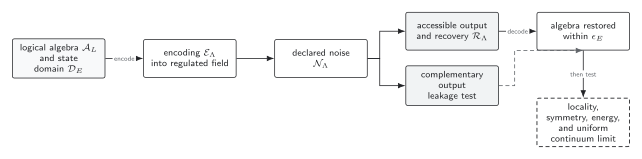
Correctability relates one logical algebra, one noise channel and complement, one state or energy domain, and one recovery class. Environmental forgetting supports recovery only in the matching metric; locality, symmetry, and continuum convergence are additional tests. The diagram is schematic and not to scale.
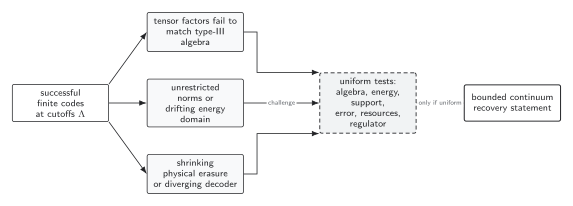
A sequence of successful finite codes does not establish a continuum code unless its logical algebra, physical erasure region, energy domain, recovery error, and locality bounds converge uniformly. Type-III structure and regulator-dependent tensor factors require an algebraic target. The diagram is schematic.
References
Section titled “References”- Evenbly, Glen, and Guifré Vidal. “Algorithms for Entanglement Renormalization.” Physical Review B 79 (2009): 144108. DOI. Open PDF.
- Haegeman, Jutho, Tobias J. Osborne, Henri Verschelde, and Frank Verstraete. “Entanglement Renormalization for Quantum Fields in Real Space.” Physical Review Letters 110 (2013): 100402. DOI. Open PDF.