

Mixed-State, Purification, and Formation Complexity
A mixed state does not select a unique preparation circuit. One may prepare it directly by a noisy channel, purify it with an ancilla and then discard the ancilla, count only the correlations beyond reference marginals, or separate spectral probabilities from eigenbasis rotations. These definitions optimize over different sets and can rank the same states differently.
Required background. State, Unitary, Channel, and Operator Complexity supplies the distinction between preparation and channel implementation.
Helpful background. Gaussian-State Complexity supplies the covariance method used for the example.
Purification complexity and its domain
Section titled “Purification complexity and its domain”Fix a pure reference , allowed gates on system plus ancilla, and a pure-state cost . The purification complexity of is
The ancilla dimension, reference, gate access, and cost of discarding must be fixed. Enlarging cannot increase the mathematical infimum if all old purifications remain admissible, but it can change the value; an unlimited pre-entangled ancilla can trivialize the task if its preparation is not charged.
For Gaussian mixed states one often restricts the infimum to Gaussian purifications. This produces a controlled Gaussian quantity, not a theorem about the unrestricted optimum. Caceres and collaborators carry out this optimization for thermal and reduced Gaussian states and emphasize the basis and cost dependence Caceres et al. 2020, §§2–5. A distinct Fisher-information geometry for mixed Gaussian states illustrates that changing the metric changes the task Di Giulio and Tonni 2020, §§2–4.
Spectrum, basis, and formation
Section titled “Spectrum, basis, and formation”Write . A preparation may be decomposed conceptually into:
- a spectrum resource that creates the probabilities , often by entangling and tracing an ancilla;
- a basis resource that implements ;
- a correlation or formation resource that compares a joint target with chosen marginal references.
This decomposition is not unique when eigenvalues are degenerate: rotations inside a degenerate subspace are stabilizers and should be quotiented. Near degeneracy makes numerical eigenvectors unstable, so basis complexity must be reported with a spectral-gap tolerance.
A formation-type difference such as
is definition dependent and need not be positive. Subtracting two ultraviolet-divergent costs is meaningful only when their references, gates, regulators, and physical tolerance are matched so the cancellation is controlled.
Thermal two-mode example
Section titled “Thermal two-mode example”A one-mode thermal state with frequency has mean occupation . A two-mode squeezed state
is a purification. It is not automatically the least-cost purification: an ancilla squeeze, a change of purification basis, or a larger admissible Gaussian family may lower the chosen cost. A reproducible calculation therefore minimizes over those free parameters and verifies the reduced covariance equals the target.
For a free field, a mode-by-mode ansatz sums or norm-combines the one-mode contributions. This assumes the cost is separable in momentum modes and that momentum-space gates are admissible. A spatially local gate model couples the optimization across modes.
Comparison table
Section titled “Comparison table”| Definition | Optimized freedom | What must be charged | Principal ambiguity |
|---|---|---|---|
| direct channel preparation | implementations of | environment and control | dilation choice |
| purification complexity | purifying state and ancilla | ancilla reference and discard | allowed purification class |
| spectrum complexity | probability-generating process | randomness or entanglement | degeneracy and encoding |
| basis complexity | eigenbasis unitary | stabilizer quotient | small spectral gaps |
| formation difference | joint versus marginal preparations | matched references and cutoffs | subtraction scheme |
Exercises
Section titled “Exercises”Ancilla monotonicity. What can be concluded when the allowed ancilla class is enlarged?
Solution
If the cost and reference extend consistently and the old purifications remain allowed, the infimum cannot increase. It may decrease. No conclusion follows if the larger class also changes what ancilla preparation is counted.
Degenerate spectrum. Why should a basis cost quotient rotations inside an exactly degenerate eigenspace?
Solution
Such rotations leave unchanged. Charging them would assign different complexities to different diagonalizations of the same density operator. They are stabilizers of the target for this task.
Task and validity maps
Section titled “Task and validity maps”The first diagram distinguishes target objects and their admissible resource models; inspect which equivalence class is being minimized over. The second shows the definition changes and physical controls that must be held fixed before two complexity values or growth laws are compared.
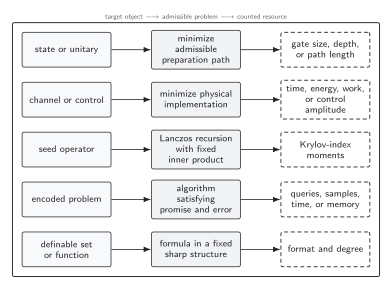
A complexity value is defined only after the target object selects an admissible family of paths or descriptions. Circuit length, physical control cost, Krylov spread, algorithmic resources, and sharp o-minimal format or degree answer different questions. The diagram is schematic and not to scale.
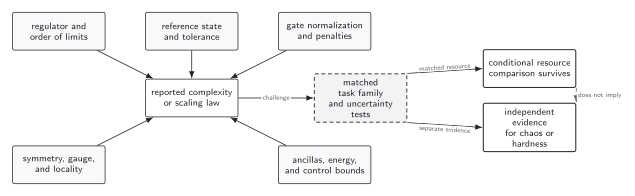
Reference sensitivity, gate nonuniqueness, regulator dependence, symmetry constraints, and unbounded controls are distinct failure modes. A link from complexity growth to chaos or computational hardness requires separate evidence after those controls. The diagram is schematic.
References
Section titled “References”- Caceres, Elena, Shira Chapman, Josiah D. Couch, Juan P. Hernandez, Robert C. Myers, and Shan-Ming Ruan. “Complexity of Mixed States in QFT and Holography.” Journal of High Energy Physics 03 (2020): 012. DOI. Open PDF.
- Di Giulio, Giuseppe, and Erik Tonni. “Complexity of Mixed Gaussian States from Fisher Information Geometry.” Journal of High Energy Physics 12 (2020): 101. DOI. Open PDF.