

Information Scrambling and Recovery Diagnostics
Information is scrambled relative to a declared observer when an initially localized logical algebra has spread so that no small allowed output region supports an accurate recovery, while suitable larger unions still do. This definition is about access and reversal, not mere operator size: it requires an encoding, an output partition, side information, a channel or algebra metric, an energy domain, and a decoder class.
Required background. Out-of-Time-Order Correlators and Contour Regularization supplies the physical correlators; Entanglement-Dynamics Diagnostic Comparison separates entanglement growth from information transport; Operator Entanglement and Channel–State Maps supplies the reference-system construction; and Operator Spreading and Scrambling supplies support growth.
Helpful background. Recovery Maps and Approximate Markovianity supplies recovery-error bounds.
The operational tuple
Section titled “The operational tuple”Start with a logical system and a reference in a purification . An encoding and time evolution produce
Here and denote output algebras or regulated tensor factors, not automatically geometric Hilbert-space factors. For an observer with access to , define a recovery error
where the infimum is over the permitted decoders and the optional subscript restricts inputs and reference-assisted states by energy. The access set is authorized at tolerance when . It is forbidden when the channel to is approximately independent of the logical input—equivalently, when decouples from uniformly over the allowed reference-assisted inputs. For an isometric global evolution, an information–disturbance theorem can then license recovery from the complementary output , provided its side information and metric match the theorem.
This tuple exposes four notions often collapsed into one:
- operator growth asks where Heisenberg operators have support;
- decoupling asks what an inaccessible algebra knows about ;
- recoverability asks whether an allowed decoder exists;
- complexity asks how costly that decoder is.
Existence of recovery does not imply an efficient or localized implementation.
A channel-state benchmark
Section titled “A channel-state benchmark”For a regulated unitary with , prepare and form . If is small, Pinsker’s inequality gives trace-norm closeness of to . A decoupling or information–disturbance theorem then bounds recovery from Hayden et al. 2008, §§II–IV.
The converse diagnostic is sharper than “ has small correlation with each output cell.” Pairwise mutual informations can all be small while the logical data remains stored in joint correlations. That is precisely the distributed encoding that scrambling is meant to describe. The channel-state analysis and its relation to OTOCs are developed by Hosur et al. 2016, §§2–4.
Why thermalization is different
Section titled “Why thermalization is different”Thermalization concerns expectation values of selected observables and ensembles. Scrambling concerns accessibility of encoded information. A channel may reproduce thermal one-point functions while retaining a simple hidden decoder; conversely, an integrable evolution can distribute some information nonlocally without satisfying a chaos criterion. The two phenomena interact, but neither definition contains the other.
Continuum and causal qualifications
Section titled “Continuum and causal qualifications”In continuum QFT, replace the maximally entangled state over all modes by one of three controlled constructions:
- a finite regulator with a stated continuum target;
- a split inclusion with a collar separating local algebras;
- an energy-constrained code or finite-dimensional logical subspace embedded in the field theory.
The evolution and decoder must respect causal support. A recovery acting on at time may use only operations whose past light cones reach the encoded disturbance, plus explicitly supplied classical or quantum side information. Microcausality can prohibit influence outside the light cone even when a finite regulator has exponentially small tails.
Failure tests
Section titled “Failure tests”Full-access inversion. If the observer receives the entire output of a unitary, recovers perfectly regardless of OTOC decay or operator size. Any claim of irreversible loss has silently restricted access or complexity.
Decohering channel. Environmental noise can suppress an OTOC while leaking the logical state to an environment. Without distinguishing inaccessible internal modes from an uncontrolled bath, decay does not diagnose scrambling.
Symmetry sector. A conserved charge can remain locally detectable even when neutral operators spread. The input algebra and decoder must be resolved by sector.
Scientific evidence cutoff: 10 August 2026. The literature-sensitive examples and diagnostic comparisons on this page are current through that date; the finite-dimensional identities themselves are not cutoff dependent.
Exercises
Section titled “Exercises”Let be a unitary encoding one qubit into qubits. Explain why large Pauli weight of does not by itself lower the full-output recovery fidelity.
Solution
The inverse unitary maps both and back to the logical Pauli operators, so recovery from all outputs is exact. Pauli weight constrains observers restricted to small supports; it says nothing about an unrestricted decoder unless a cost or locality class is added.
Continue to Decoupling and Subsystem Information Loss for the quantitative forgetting condition and to Operator Growth versus Recoverability for the support-versus-access comparison.
Diagnostic and failure maps
Section titled “Diagnostic and failure maps”The first diagram separates influence diagnostics from the decoupling and recovery test; inspect the declared output access, norm, and decoder class. The second collects mechanisms that can imitate scrambling and the controls that distinguish them.
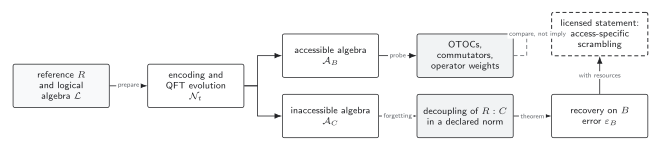
Scrambling becomes operational only after the input algebra, output access structure, side information, norm, energy restriction, and decoder class are declared. OTOCs and operator weights diagnose influence; decoupling and a recovery theorem license a statement about information access. The diagram is schematic and not to scale.
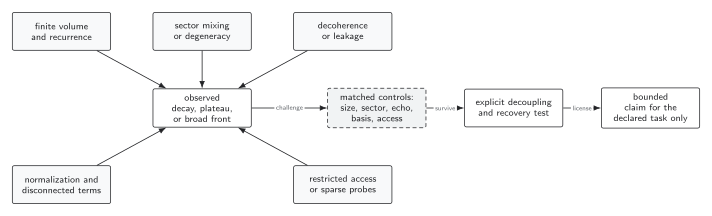
Several mechanisms can suppress a correlator or produce an entropy plateau without delocalizing recoverable quantum information. Sector resolution, recurrence windows, normalization checks, access variation, and an explicit recovery test distinguish these alternatives. The diagram is schematic.
References
Section titled “References”- Hayden, Patrick, Michał Horodecki, Andreas Winter, and Jon Yard. “A Decoupling Approach to the Quantum Capacity.” Open Systems & Information Dynamics 15 (2008): 7–19. DOI. Open PDF.
- Hosur, Pavan, Xiao-Liang Qi, Daniel A. Roberts, and Beni Yoshida. “Chaos in Quantum Channels.” Journal of High Energy Physics 02 (2016): 004. DOI. Open PDF.