

Operator Growth versus Recoverability
Operator growth constrains recoverability only relative to an accessible algebra. If every representative of a logical operator has negligible projection onto that algebra, local decoding must fail; the reverse implication is not automatic because operator weight is basis dependent, conserved components and side information can survive, and an unrestricted observer may invert the full evolution exactly.
Required background. OTOCs, Commutators, and Information Measures supplies influence diagnostics, and Information Scrambling and Recovery Diagnostics fixes the decoder task. Helpful background. Recovery Maps and Approximate Markovianity supplies information–disturbance bounds.
Operator weights in a regulator
Section titled “Operator weights in a regulator”Choose an orthonormal operator basis for a finite regulated algebra with
Expand a normalized Heisenberg operator as
For an accessible region , the Hilbert–Schmidt projection onto its operator algebra has weight
Small means this representative is difficult to approximate by an operator supported on in the chosen inner product. It does not yet bound recovery in trace or diamond norm, and it changes with the basis, thermal weighting, truncation, and algebra center.
Random-circuit calculations make operator fronts and their broadening explicit Nahum, Vijay, and Haah 2018, §§II–IV, but a continuum-QFT application must independently control the regulator and energy domain.
From complementary leakage to recovery
Section titled “From complementary leakage to recovery”Let encode the logical system. Exact erasure correction of requires every logical operator to have an equivalent representative on when restricted to the code:
Equivalently, the complementary channel to must be independent of the logical input. Approximate information–disturbance theorems replace these equalities by norm bounds Kretschmann, Schlingemann, and Werner 2008, Theorem 1. This establishes the logical chain
up to metric-dependent constants. Operator growth enters only after showing that the tested operator family controls the complementary channel on the code domain.
Conserved components
Section titled “Conserved components”Decompose
A small conserved projection can dominate late-time OTOCs or local recovery of a classical charge while the remaining quantum information is delocalized. Sector-resolved diagnostics should either remove that component with a declared projection or treat it as part of the protected logical algebra.
Two decisive counterexamples
Section titled “Two decisive counterexamples”Known encoding circuit. A deep unitary can map a single-site Pauli operator to a high-weight string. Full output access plus the inverse circuit gives zero recovery error. Growth restricts small-region access, not global reversibility.
Swap into an inaccessible mode. A simple swap can move a qubit into without producing a broad operator. Recovery from fails perfectly even though operator size remains one. Delocalization and inaccessibility are different mechanisms.
These examples prove that neither large nor small operator size determines recoverability without the access split.
Continuum comparison
Section titled “Continuum comparison”Local QFT algebras do not come with a canonical Pauli basis or normalized trace. Replace basis weight by one of the following, stating the choice:
- commutators with a norm-bounded family in the accessible algebra;
- conditional expectations or projections available for a regulated/split inclusion;
- relative-entropy distinguishability restricted to the algebra;
- energy-constrained complementary-channel distance.
The continuum result is the algebraic or operational bound obtained after regulator removal, not the intermediate operator-count histogram.
Scientific evidence cutoff: 10 August 2026. The operator-growth comparisons and literature-sensitive limitations on this page are current through that date.
Exercises
Section titled “Exercises”Construct a unitary for which operator weight remains one but recovery from fails.
Solution
Let hold the logical qubit, start in , and let be inaccessible. Swap with and leave unchanged. Every logical Pauli becomes a single-site Pauli on , so its weight is one, yet the channel to is constant and cannot recover any logical state.
Continue to Channel Capacities During Scrambling when repeated uses are part of the task, or to Information Velocities and Causal Bounds when the focus is an arrival front.
Diagnostic and failure maps
Section titled “Diagnostic and failure maps”The first diagram separates influence diagnostics from the decoupling and recovery test; inspect the declared output access, norm, and decoder class. The second collects mechanisms that can imitate scrambling and the controls that distinguish them.
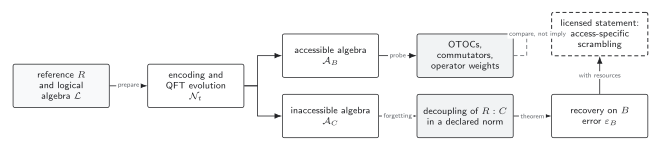
Scrambling becomes operational only after the input algebra, output access structure, side information, norm, energy restriction, and decoder class are declared. OTOCs and operator weights diagnose influence; decoupling and a recovery theorem license a statement about information access. The diagram is schematic and not to scale.
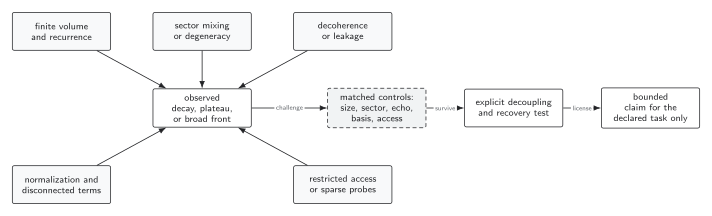
Several mechanisms can suppress a correlator or produce an entropy plateau without delocalizing recoverable quantum information. Sector resolution, recurrence windows, normalization checks, access variation, and an explicit recovery test distinguish these alternatives. The diagram is schematic.
References
Section titled “References”- Kretschmann, Dennis, Dirk Schlingemann, and Reinhard F. Werner. “A Continuity Theorem for Stinespring’s Dilation.” Journal of Functional Analysis 255 (2008): 1889–1904. DOI. Open PDF.
- Nahum, Adam, Sagar Vijay, and Jeongwan Haah. “Operator Spreading in Random Unitary Circuits.” Physical Review X 8 (2018): 021014. DOI. Open PDF.