

Replica, Swap, and Multi-Copy Measurement Protocols
Swap and cyclic-permutation measurements access Rényi invariants because the expectation of a permutation across matched copies equals a power trace of the regional state. The identity assumes the copies, region maps, and regulators are identical and uncorrelated except through the measurement. Copy drift or a one-site region mismatch produces a systematic entropy bias that more shots do not remove.
Required background. Entropy and Rényi Estimation Protocols supplies the power-trace target.
Helpful background. Numerical Replica and Thermodynamic-Integration Estimators supplies the computational analogue and regulator checks.
Permutation identity
Section titled “Permutation identity”For copies of the same regional state , let cyclically permute the copies on . Then
For , is the swap and its expectation is the purity. The proof follows by inserting a basis and contracting indices cyclically. The permutation must act as identity outside the same physical region in every copy.
If copies differ, the expectation becomes
which is a cross-overlap, not the Rényi invariant of any one copy in general. This formula is the most direct drift diagnostic.
Measurement implementations and calibration
Section titled “Measurement implementations and calibration”In a lattice or mode regulator, a beam-splitter transformation followed by parity or occupation-resolved measurement can implement a two-copy swap protocol. More general cyclic permutations require coherent multicopy controls or randomized identities. Daley and collaborators proposed direct Rényi measurements for bosonic lattice systems Daley et al. 2012, pp. 1–3, and Islam and collaborators realized a second-Rényi protocol with two copies Islam et al. 2015, pp. 77–83.
Calibrate on product states, identical known entangled states, and deliberately mismatched copies. Track beam-splitter angle, detector parity errors, loss, and cross-talk. A calibration matrix can be inverted only if it is well conditioned and its uncertainty is propagated.
Free-field interval benchmark
Section titled “Free-field interval benchmark”Discretize a free field, prepare two Gaussian copies, and select an interval of fixed physical length. Compute the exact covariance purity and simulate the swap outcomes. Then introduce:
- small temperature or squeeze drift between copies;
- a one-site boundary mismatch;
- correlated detector loss;
- finite shot noise.
Include per-copy energy, number, and selected correlators as calibration observables. The drift tests should flag a change before the entropy shift exceeds the quoted interval. Refine the lattice while keeping the interval endpoints physically matched.
Exercises
Section titled “Exercises”Nonidentical copies. For two commuting states diagonal with probabilities and , what does the swap measure?
Solution
It measures , not or . Interpreting it as purity biases the Rényi entropy unless .
Region mismatch. Why is one extra ultraviolet site potentially serious?
Solution
Regional purity contains strong boundary and cutoff dependence. Changing the region by one site changes the permutation operator and can produce a systematic shift comparable to the targeted signal. Match physical boundaries and include the mismatch in the continuum study.
Inference and failure-control maps
Section titled “Inference and failure-control maps”The first diagram traces the complete path from raw records to a bounded information claim; inspect the assumption attached to every arrow. The second maps shared and method-specific failure channels to held-out tests, regulator variation, replication, and correction.
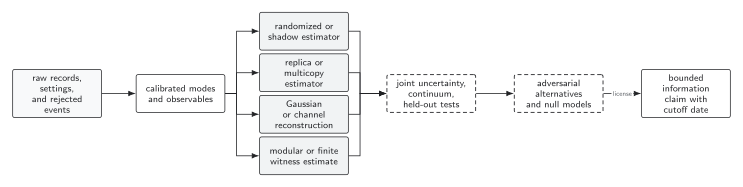
Entropy, tomography, witness, and recovery methods enter at the estimator stage, but all share calibration, uncertainty, continuum, and alternative-model tests. The final statement is no stronger than the least validated arrow. The diagram is schematic and not to scale.
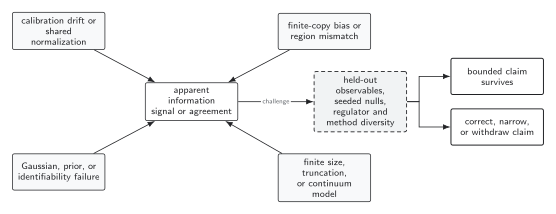
Different estimators can share the same calibration or normalization bias, so numerical agreement is not automatically independent replication. Adversarial nulls, held-out observables, regulator variation, and genuinely independent implementations set the limit on the conclusion and trigger correction when needed. The diagram is schematic.
References
Section titled “References”- Daley, Andrew J., Hannes Pichler, Johannes Schachenmayer, and Peter Zoller. “Measuring Entanglement Growth in Quench Dynamics of Bosons in an Optical Lattice.” Physical Review Letters 109 (2012): 020505. DOI. Open PDF.
- Islam, Rajibul, Ruichao Ma, Philipp M. Preiss, M. Eric Tai, Alexander Lukin, Matthew Rispoli, and Markus Greiner. “Measuring Entanglement Entropy in a Quantum Many-Body System.” Nature 528 (2015): 77–83. DOI. Open PDF.