

Local Preparation, State Dependence, and Operational Independence
Two spacelike algebras are operationally independent only when independently selected local preparations extend to an admissible global state or operation. Commutativity prevents direct algebraic conflict, but normality, positivity, energy, state dependence, and the split distance determine whether the preparation is physically realizable.
Required background. Review the split property. Helpful background. Restricted states fixes the observable content of each target marginal.
Independence as an extension problem
Section titled “Independence as an extension problem”Let and be commuting von Neumann algebras. A strong statistical-independence condition asks that every pair of normal states admit a normal joint state on satisfying
This is stronger than . Commutativity makes joint products unambiguous; it does not guarantee a normal product extension. A split inclusion supplies such extensions by representing the pair as a spatial tensor product, as developed by Doplicher and Longo 1984, pp. 493–536.
Operational independence can also be formulated for channels. If and are normal unital completely positive maps localized in the two algebras, an admissible joint map must reduce to each local action on its own algebra and respect causal composition. Which maps count as local—inner operations, finite Kraus maps, detector-induced instruments, or a larger class—must be declared.
The structural map places Local Preparation, State Dependence, and Operational Independence among sharp local algebras, split inclusions, and regulated or operational substitutes.
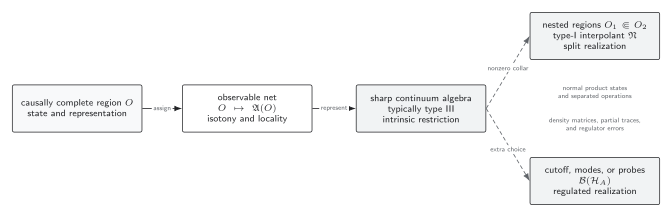
A causally complete region determines a sharp local algebra, usually type III. A nonzero split collar or an explicit cutoff, mode selection, or probe model can instead supply a type-I realization; these alternatives enable ordinary density matrices but retain different physical approximations. Schematic, not to scale.
Gaussian preparation with a collar
Section titled “Gaussian preparation with a collar”In a regulated scalar field, choose two separated mode sets and target Gaussian marginals with covariance matrices and . The product target has
It is physical only if it satisfies the uncertainty relation . A localized preparation protocol replaces the vacuum cross-covariance by a smaller residual block . Report independence in an operational norm, for example
for a bounded, energy-controlled observable set . The collar width, switching time, and energy injected by the preparation are part of the result.
State and energy dependence
Section titled “State and energy dependence”The split property is algebraic, but a good product approximation can depend strongly on the reference state. Vacuum clustering in a massive theory helps separated preparations; critical or thermal correlations may decay more slowly. Exact decorrelation at fixed energy and vanishing separation is generally too strong.
A deterministic operation cannot exploit postselected small-probability branches without including their success probability. Similarly, an unbounded local operator that approximates a target state does not define a bounded-energy laboratory protocol merely because the approximation is norm-dense.
Adversarial checks
Section titled “Adversarial checks”- Send the collar width to zero while holding the energy budget fixed.
- Demand normal product extensions after removing the split hypothesis.
- Compare selective and nonselective operations so that postselection cannot hide disturbance.
- Verify positivity and complete positivity, not only agreement of low moments.
Failure of one test does not invalidate locality. It narrows the licensed claim from independent preparation to commuting observables, approximate preparation on a bounded class, or a regulator-specific construction.
Before applying this result, use the validity map to keep the algebra, state, operation class, resources, and approximation fixed.
For a side-by-side statement of the chapter’s subsystem choices, use the subsystem comparison table.
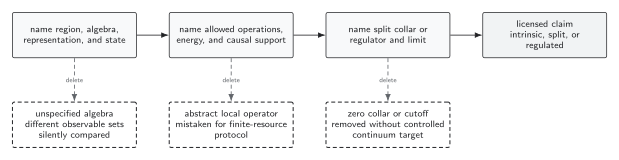
Every local-information claim must specify the represented algebra and state, the allowed operations and resource support, and any split collar or regulator. The dashed lower boxes show what fails when the algebra, protocol, or limiting prescription is left implicit. Schematic.
References
Section titled “References”- Doplicher, Sergio, and Roberto Longo. “Standard and Split Inclusions of von Neumann Algebras.” Inventiones Mathematicae 75 (1984): 493–536. DOI.
Further reading
Section titled “Further reading”- Buchholz, Detlev, and Eyvind H. Wichmann. “Causal Independence and the Energy-Level Density of States in Local Quantum Field Theory.” Communications in Mathematical Physics 106 (1986): 321–344. DOI.