

Out-of-Time-Order Correlators and Contour Regularization
An out-of-time-order correlator (OTOC) measures a particular nonstandard operator ordering, usually chosen so that its deviation from a disconnected value tracks the growth of a commutator. At finite temperature there is no unique OTOC: density-matrix factors can be placed at different points on the thermal contour, and these regularizations can have different transients. A chaos claim must therefore name the contour, operators, normalization, connected subtraction, and resolved time window.
Required background. Closed-time-path generating functionals supply contour ordering, while equilibration and dephasing separates operator growth from thermalization. Helpful background. Operator spreading turns the same commutator into a spatial front.
Squared commutators and four-point functions
Section titled “Squared commutators and four-point functions”For Hermitian operators and , define
Because is anti-Hermitian, when the products lie in the domain of the thermal trace. If , expansion gives
with the unregularized OTOC
Without the unitary-operator assumptions, the two norm terms are time-dependent correlators and the shortcut is wrong.
The squared commutator answers a concrete question: how noncommuting have the evolved and unevolved operators become in the chosen state? It does not by itself distinguish classical sensitivity, ballistic propagation, a large number of degrees of freedom, or generic quantum chaos.
Thermal regularization fixes a contour
Section titled “Thermal regularization fixes a contour”Let
A commonly used symmetric regularization is
The four factors separate neighboring operators by in imaginary time. The unregularized places the full thermal weight at one end. Cyclicity of the trace relates some placements but not all; moving an operator through shifts it in imaginary time and can cross singularities.
A one-parameter family can be written schematically as
with the exact placement and normalization stated before comparison. Tsuji, Shitara, and Ueda 2018 show that regularization-independent transient exponential growth, under their hypotheses, obeys the thermal rate bound. That result does not imply that every member of the family has the same prefactor or early-time behavior.
Real-time path integrals require a contour with enough folds to reproduce the ordering. A two-branch Schwinger–Keldysh contour is sufficient for ordinary time-ordered and anti-time-ordered products but not for every OTOC. Folding number, imaginary separations, source signs, and the state insertion must be preserved when changing basis.
Connected normalization and a growth window
Section titled “Connected normalization and a growth window”In a factorizing regime, write
where is the appropriate disconnected contribution. An exponential ansatz
is meaningful only in a window
is a dissipation or local-relaxation scale; is the scrambling or saturation scale at which is no longer small. A few points near either boundary can fit an exponential even when the true behavior is a power law, stretched exponential, front crossover, or sum of modes.
The fit record should include the disconnected subtraction, covariance, alternative functional forms, operator pair, regularization, size, spatial separation, and stability under moving both endpoints. The thermalization and chaos evidence matrix states the resulting limit on the conclusion.
A harmonic oscillator is an exact negative control
Section titled “A harmonic oscillator is an exact negative control”For
Heisenberg evolution gives
Therefore
and
The result is state-independent, bounded, and recurrent. It verifies the commutator sign and normalization while demonstrating that operator noncommutativity and early growth do not imply chaos. Any numerical pipeline that extracts a stable positive Lyapunov exponent from this fixture has confused a short Taylor interval, periodic segment, or fitting artifact with exponential growth.
What an OTOC can and cannot establish
Section titled “What an OTOC can and cannot establish”An OTOC can locate operator support, compare front velocities, test a proposed exponential regime, or probe a large-parameter factorization structure. It cannot alone prove ETH, Wigner–Dyson statistics, loss of recoverable information, or thermalization of a chosen initial state. Those statements have different observables and failure modes.
In a relativistic QFT, unsmeared local products may be distributions with ultraviolet contact singularities. Use regulated operators, separated insertions, or smearing and state the order of removing the regulator. A lattice OTOC is a legitimate regulated observable, but its microscopic front and velocity are not automatically continuum quantities.
Common failure modes
Section titled “Common failure modes”Leaving the contour implicit. Two formulas called can differ by imaginary-time shifts and have different transients.
Using for nonunitary operators. Retain all norm terms unless .
Fitting through saturation. The exponential approximation presumes a small connected correction.
Equating growth with chaos. Triangulate with operator fronts, symmetry-resolved spectra, size scaling, and counterexamples.
Use the lower row to locate the regularized OTOC between operator-front kinematics and any Lyapunov fit. The crucial page-local question is which contour, normalization, operator pair, and time window define the plotted correlator.
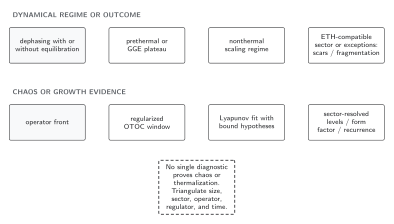
An OTOC is not specified until the contour placement and normalization are fixed. Growth, a Lyapunov fit, the thermal bound, and spectral evidence are distinct checks with separate hypotheses. The diagram is schematic and contains no implication arrows among them; no single diagnostic establishes chaos by itself.
In text-equivalent form, compare regularizations at identical temperature and operators, remove disconnected pieces consistently, and fit only between the dissipation and saturation times. Then vary size, sector, spatial separation, and fit window before quoting a rate.
Exercises
Section titled “Exercises”Derive for Hermitian unitary .
Solution
Expand . The middle terms equal . The first and last thermal expectations are complex conjugates, giving .
Why does the oscillator result behave as at small time without defining a Lyapunov exponent?
Solution
. This algebraic Taylor growth occurs before any parametrically separated exponential window and is followed by bounded oscillation. A log-linear fit over a short interval has no chaos interpretation.
Continue to bounds and fronts
Section titled “Continue to bounds and fronts”Lyapunov growth and chaos bounds states the analytic theorem for a normalized thermal correlator. Operator spreading resolves spatial fronts and broadening. Information-theoretic meanings of commutators continue in Volume XIII.
References
Section titled “References”- Aleiner, Igor L., Lara Faoro, and Lev B. Ioffe. “Microscopic Model of Quantum Butterfly Effect: Out-of-Time-Order Correlators and Traveling Combustion Waves.” Annals of Physics 375 (2016): 378–406. doi:10.1016/j.aop.2016.09.006. Open preprint.
- Maldacena, Juan, Stephen H. Shenker, and Douglas Stanford. “A Bound on Chaos.” Journal of High Energy Physics 2016, no. 8 (2016): 106. doi:10.1007/JHEP08(2016)106. Open preprint.
- Tsuji, Naoto, Tomohiro Shitara, and Masahito Ueda. “Bound on the Exponential Growth Rate of Out-of-Time-Ordered Correlators.” Physical Review E 98 (2018): 012216. doi:10.1103/PhysRevE.98.012216. Open preprint.