

Operator Mixing and Renormalization Matrices
Operator mixing is the statement that ultraviolet subtraction acts on a vector space of local insertions, not necessarily on each monomial separately. The space must be closed under the regulator, subtraction scheme, and class of matrix elements being renormalized. Exact quantum numbers make the matrix block diagonal; dimension bounds can make it triangular; equation-of-motion, total-derivative, BRST-exact, identity, and evanescent directions can enlarge it beyond the operators that survive in a final observable.
This page constructs the renormalization matrix with the convention , explains how to extract it from projected insertion vertices, and works a two-operator scalar sector containing a physical interaction operator and an equation-of-motion operator. The example is deliberately off shell until the final quotient, because an on-shell calculation cannot determine the redundant part of the matrix.
Required background. Renormalized Composite-Operator Insertions supplies source-defined insertion vertices. Local versus Integrated Operator Redundancies distinguishes a local equation-of-motion or total-derivative relation from an equality of integrated observables.
Helpful background. Multiplets, Invariants, and Selection Rules supplies symmetry blocks. BRST Cohomology and Physical Observables supplies the physical quotient in a gauge-fixed theory.
Closing a sector before computing a matrix
Section titled “Closing a sector before computing a matrix”Start with local operators sharing all exact labels relevant to the calculation:
- Lorentz or rotation representation and tensor symmetries;
- internal representation, charge, parity, and charge conjugation when exact;
- ghost number and BRST class in a gauge-fixed formulation;
- engineering dimension or EFT order;
- flavor, derivative, and momentum-transfer labels;
- regulator-specific structures, including evanescent tensors in .
Insert every candidate into a complete set of off-shell 1PI Green functions. After ordinary action subdivergences are removed, expand every remaining ultraviolet pole in the same local basis. The sector is closed only if all projections land inside it. If a pole has a new tensor, field content, derivative pattern, or redundant structure, enlarge the basis and repeat.
For an operator of engineering dimension , locality and power counting permit counterterms of the same exact quantum numbers with
where masses or superrenormalizable couplings supply any dimension difference. If the basis is ordered from larger to smaller dimension, this condition tends to give an upper-triangular matrix. Reversing the order reverses the triangle. A hard cutoff can generate power-divergent lower-dimensional entries; a mass-independent dimensional scheme often removes those power terms. “The matrix is triangular” is therefore incomplete without the ordering, regulator, and dimensional assumptions.
Exact symmetries produce blocks. If and lie in inequivalent irreducible representations and the regulator plus subtraction preserves that symmetry, then
If the regulator breaks the symmetry, a nonzero entry can be a removable local breaking rather than physical mixing. The renormalized functional identity, not the bare appearance of a matrix, decides whether restoration is possible.
Matrix direction and projector extraction
Section titled “Matrix direction and projector extraction”Collect bare and renormalized operators into columns:
Let be an amputated 1PI vertex with one insertion of the bare operator . Choose linear projectors that distinguish every basis tensor, and normalize them so that the tree matrix is the identity:
After ordinary field and parameter counterterms are included, form
Because a renormalized insertion is ,
In minimal subtraction, the pole matrix is cancelled by
order by order, including the products of lower-order poles required by subdivergences. If the tree matrix is not the identity, it must be inverted before reading off ; comparing raw graph coefficients with a matrix entry is otherwise basis dependent.
The number of projectors must be at least the dimension of the enlarged sector. A physical on-shell projector annihilates equation-of-motion operators, so it cannot determine columns or rows that point into that sector. Off-shell, nonexceptional kinematics are often used precisely because they expose all local tensors, although the resulting matrix can depend on gauge and kinematic scheme.
The figure’s first panel fixes the direction and the inverse-transpose source map. Its second panel previews why a coefficient vector cannot transform with the same matrix as the operator column.
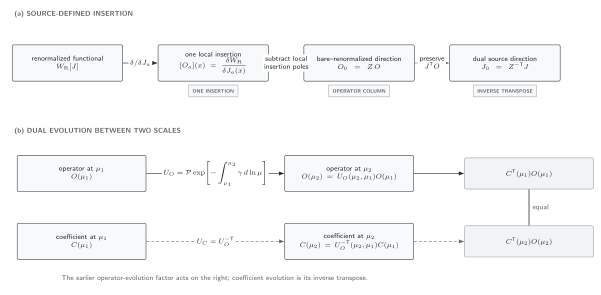
With , a source or Wilson-coefficient coordinate belongs to the dual space. The ordered operator map is paired with so that is invariant. The original diagram is schematic and not to scale.
Physical and redundant directions
Section titled “Physical and redundant directions”An equation-of-motion operator has the local form
Inside a time-ordered product, functional integration by parts turns its insertion into contact variations of the other fields. Its integrated on-shell S-matrix element vanishes under the usual equivalence-theorem hypotheses, but its off-shell insertion does not. Therefore it is redundant in a specified physical quotient while remaining necessary for off-shell closure.
Let the basis be ordered as
where represents a physical class and is equation-of-motion exact. Renormalization must preserve the redundant subspace: a bare equation-of-motion insertion cannot acquire a physical component after an allowed local change of variables. With this ordering,
The physical representative may shift by , so need not vanish. The lower-left zero is the consequential statement: the redundant operator remains redundant. After projection to physical on-shell matrix elements,
and only the physical block contributes. Off shell, deleting the second row and column before subtraction generally leaves uncancelled poles.
Total derivatives behave differently. An integrated total derivative can vanish with suitable boundary conditions, but a local or nonforward matrix element obeys
It disappears only at zero momentum transfer. Thus the kinematics belongs in the sector declaration.
Scalar two-operator benchmark
Section titled “Scalar two-operator benchmark”Consider massless theory in and restrict attention to integrated, vacuum-subtracted, -even scalar operators of dimension four, modulo total derivatives. Define
The kinetic scalar is not missing: modulo a total derivative,
Hence and span the bounded integrated sector. For a local nonforward problem, must be restored as a third direction.
Write
Differentiate the bare action with respect to the renormalized coupling while holding the renormalized field fixed. The chain rule gives a finite parameter-conjugate insertion:
with
Normalize the renormalized redundant operator by the field-rescaling identity,
Solving for the bare column gives
This is an explicit closed two-operator renormalization matrix. The physical–EOM block is upper triangular without setting the off-diagonal entry to zero by assumption. It also reveals the origin of : coupling differentiation changes both the bare coupling and, through , the bare field coordinate.
At the first nontrivial four-point order,
so
The field factor starts with two-loop self-energy graphs in this theory. Its derivative supplies the first term and must be retained whenever the calculation includes the corresponding insertion graphs. Setting is justified only at an explicitly lower graph order, not because equation-of-motion mixing is forbidden.
Two independent checks accompany the matrix:
- Insert into an -point function. Functional integration by parts must reproduce the sum of field-rescaling contact terms rather than a new physical amplitude.
- Insert by differentiating the renormalized -point function with respect to . The result must agree with the matrix insertion, including the contribution and vacuum subtraction.
Collins proves the parameter-differentiation identities and their relation to equations of motion in minimal subtraction Collins 1984/2023, §§ 6.6–6.8, pp. 152–167.
Finite basis changes
Section titled “Finite basis changes”Choose another renormalized representative while holding the bare basis fixed:
Then
The off-diagonal entry changes, but the physical quotient does not:
for states and kinematics on which the insertion vanishes. A Wilson coefficient must transform as ; otherwise the effective interaction changes. This round trip is the quickest way to expose a basis map applied to operators but not coefficients.
If the bare and renormalized bases are both transformed by the same constant , then transforms by similarity, . These are different operations. A paper that says only “change basis by ” has not specified enough information to compare matrices.
The complete convention fields and redundant sectors are recorded in the mixing convention record. A reproducible calculation provides an exact matrix round trip after the anomalous-dimension and coefficient equations are derived.
Gauge-theory enlargement
Section titled “Gauge-theory enlargement”In a gauge-fixed theory, a gauge-invariant operator can require a larger off-shell sector containing BRST-exact and equation-of-motion operators. In a basis ordered as physical cohomology, BRST-exact, and EOM directions, the matrix can be chosen block triangular under the hypotheses of algebraic renormalization. Physical matrix elements depend on the cohomology block, but the full off-shell subtraction problem does not.
Joglekar and Lee establish all-orders closure of gauge-invariant operators together with the necessary gauge-noninvariant and ghost sectors and exhibit a basis in which unphysical directions decouple from the physical eigenvalue problem Joglekar and Lee 1976, pp. 160–215. This structural result does not license deleting those sectors from an off-shell computation before their triangular form has been shown.
Dimensional continuation adds another enlargement. A tensor or spinor identity that holds only at can define an evanescent operator that is proportional to at tree level. A pole mixing into can multiply that and feed a finite physical term. Projecting to four dimensions before subtraction can therefore change the physical block at the next order.
Common pitfalls
Section titled “Common pitfalls”Starting from a preferred list rather than a closed sector. Phenomenologically interesting operators need not close off shell. Apply every symmetry and dimension filter, then test divergent projections before reducing to a physical quotient.
Reading from unnormalized graphs. Projector normalization, external-field factors, ordinary counterterms, and lower-order subdivergences all enter before the pole matrix equals .
Using on-shell matrix elements to determine redundant entries. An on-shell projector annihilates equation-of-motion operators by design. It cannot establish that their mixing coefficients vanish.
Dropping total derivatives without checking momentum transfer. Forward integrated matrix elements and local nonforward insertions are different problems.
Comparing matrices without translating conventions. The direction of , operator orientation, finite basis map, and whether the bare basis also changes must all be stated.
Exercises
Section titled “Exercises”- Let a normalized projected bare insertion matrix be
Find in minimal subtraction and verify finiteness through order .
Solution
Choose
Then
and multiplication gives . The lower-left zero preserves the redundant subspace.
- For and , derive the coefficient transformation that preserves .
Solution
Here
Thus
Substitution gives exactly.
- Explain why the scalar benchmark is two-dimensional only after its kinematic quotient is declared.
Solution
The identity removes only after integration with boundary conditions or in forward matrix elements with zero insertion momentum. A local nonforward matrix element receives a factor of the momentum transfer from , so that total-derivative operator must be restored. Vacuum subtraction and the massless mass-independent scheme also exclude lower-dimensional identity terms from this bounded example.
Continue to Operator Anomalous-Dimension Matrices to differentiate and determine scaling eigenoperators. Continue to Dual Evolution of Operators and Wilson Coefficients only after the sign and basis convention for has been fixed.
References
Section titled “References”-
Collins, John C. 1984; open-access reissue 2023. Renormalization: An Introduction to Renormalization, the Renormalization Group and the Operator-Product Expansion. Cambridge Monographs on Mathematical Physics. Cambridge University Press. DOI and Open PDF.
-
Joglekar, Satish D., and Benjamin W. Lee. 1976. “General Theory of Renormalization of Gauge Invariant Operators.” Annals of Physics 97 (1): 160–215. DOI.