

Hilbert-Series Counting and Completeness Diagnostics
A Hilbert series is a multigraded generating function for the dimension of an operator quotient. Once the field content, spacetime dimension, symmetry group, grading, equations of motion, and integration-by-parts treatment are fixed, its coefficients answer a precise question: how many independent classes occur at each grade? They do not by themselves provide normalized contractions, a relation matrix, a coefficient map, or a sector closed under renormalization.
This page builds the counting function from single-particle letters and symmetry projection, then tests one coefficient against an exact scalar quotient. The distinction is consequential: a correct count is a stringent completeness target, while an explicit basis requires separate spanning, independence, convention, and closure checks.
Required background. Representation and Spurion Constraints on Operator Bases supplies invariant projection and symmetry refinements. Integration by Parts and Equation-of-Motion Redundancy fixes the quotient whose dimension is being counted.
Helpful background. Representations, Intertwiners, Invariants, and Tensor Decomposition supplies characters and Haar projection. Characteristic Functions, Moments, Cumulants, and Generating Functionals supplies the general idea of packaging a graded family in one generating object.
What a Hilbert-series coefficient means
Section titled “What a Hilbert-series coefficient means”Let be the vector space of local operators of canonical dimension and additional grades , quotiented by the declared redundancy subspace. Its Hilbert series is
The variables can resolve field multiplicities, derivative order, flavor representations, charges, CP parity, or EFT weights. Setting all loses that information. Therefore the statement “there are operators at dimension eight” is reproducible only if the coefficient extraction and every suppressed grade are stated.
For bosonic letters with character , symmetrized products are generated by the plethystic exponential
For fermionic letters, the corresponding exponent contains . A Haar integral extracts singlets of the Lorentz and internal groups. Schematically,
Here each short single-particle character contains the field and its symmetric traceless derivatives modulo the free equations of motion. The factor removes total-derivative descendants. In the conformal-character construction the full answer is
where the finite correction accounts for exceptional cohomology, especially among relevant and marginal terms. The matrix-integral derivation, the correction, and the separation between counting and construction are developed in Henning, Lu, Melia, and Murayama 2017, §§ 2.1–2.2 and 4, preprint pp. 6–14 and 23–35, Open PDF.
For a real scalar in four dimensions,
where the factor removes the descendant. A -even projection is the average
This already shows why the input declaration matters. Removing the undifferentiated scalar to impose a shift symmetry, changing to to distinguish pseudoscalars, or using a different EOM module defines a different series.
A bounded scalar count through dimension eight
Section titled “A bounded scalar count through dimension eight”Take one real scalar with , impose , include parity-even Lorentz scalars, and quotient by total derivatives and the massless free EOM . Let count canonical dimension and count fields. Including the vacuum term and relevant deformations, the bounded series is
The corresponding representatives are:
| Dimension | Field grade | Coefficient | One representative |
|---|---|---|---|
No two-derivative four-field class appears: it is removed by IBP and the free EOM. For four identical scalars the fixed-field Hilbert series begins with one zero-derivative class and one four-derivative class, while the two- and three-field derivative sectors are trivial. These fixed-multiplicity results give the displayed bounded expansion Henning, Lu, Melia, and Murayama 2017, § 6.1, preprint pp. 55–58, Open PDF.
The coefficient of is two only after field multiplicity has been summed. Comparing that number with a four-particle construction would be wrong: its matching coefficient is , not . The second class has eight fields and cannot contribute to a four-field contact vertex at tree level.
First application: count versus an exact quotient
Section titled “First application: count versus an exact quotient”Test the dimension-six coefficient using the same scalar sector as the earlier quotient pages. After removing purely bilinear EOM and total-derivative structures, take the ordered candidate list
With the free EOM, the exact relations are
Their row matrix is
Therefore
in agreement with . The row selects . Spanning and independence are certified together by
The Hilbert coefficient predicted one class. It did not choose , display the two relation rows, or fix their normalization.
Now use the interacting lower-order EOM
The second relation becomes . The quotient dimension remains one, but reducing a general coefficient vector gives
Thus equal counts can accompany different representative and coefficient maps. A series computed with free single-particle modules is a valid count for field-redefinition classes; it is not a substitute for declaring the lower-order action used in a concrete Lagrangian reduction.
Count, construct, normalize, and close
Section titled “Count, construct, normalize, and close”The figure separates the five stages. The Hilbert series controls the first box and supplies a target for the second; the remaining boxes need independent checks.
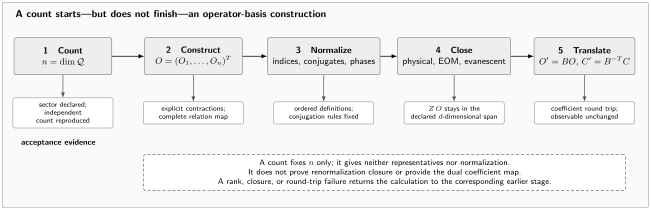
An operator-basis result is a five-stage package. Counting fixes ; construction supplies explicit contractions and relations; normalization fixes ordering, conjugation, and phases; closure enlarges the -dimensional renormalization space when EOM or evanescent operators are required; and translation applies with the dual coefficient map . The lower row states the required checks at each stage. A count alone is neither an explicit basis nor proof of RG closure. The diagram is schematic and not to scale.
A complete diagnostic sequence is:
- Extract the multigraded coefficient with no relevant fugacity silently set to one.
- Generate an ordered ambient list with explicit Lorentz, gauge, flavor, and derivative contractions.
- Build the IBP, EOM, algebraic-identity, and finite- relation matrix with exact arithmetic.
- Verify and that the chosen representatives complete to full rank.
- Check conjugate completion, Hermiticity, CP conventions, and the real parameter count.
- Enlarge to any EOM, BRST-exact, or evanescent directions required for the declared renormalization problem.
Modern applications refine Hilbert series by shift symmetry, flavor, and CP and then construct explicit operator lists separately. The ALP analysis of Grojean, Kley, and Yao provides a current example, including the corrections and special current relations that must be handled beyond a raw singlet count Grojean, Kley, and Yao 2023, § 2, preprint pp. 4–11, and Apps. A–B, pp. 34–42, Open PDF.
Failure diagnostics
Section titled “Failure diagnostics”Finite- identities. Stable-rank character formulae can miss Cayley–Hamilton or trace relations at small group rank. Evaluate the characters and Haar integral for the actual group and compare with exact tensor identities.
Dimension-specific relations. Schouten, Gram-determinant, epsilon-tensor, self-duality, and Fierz identities depend on dimension and on whether the group is or . The series and explicit construction must use the same choice.
IBP cohomology. Multiplying a singlet series by a naive power of does not generally remove total derivatives correctly. Use the conformal or differential-form construction and include its exceptional correction.
Syzygies and rational presentations. A rational expression for is not a canonical list of generators and relations. Denominator choices can change, and numerator terms encode aggregate module structure rather than a uniquely normalized relation matrix.
Renormalization closure. The Hilbert series of four-dimensional physical classes does not count evanescent counterterms in . Closure belongs to the regulator dimension and target Green functions.
A reproducible calculation should cover the full -even scalar count through dimension eight, resolved by field multiplicity. Its manual and Hilbert counts must agree, and every quotient rank and map must be computed over exact rationals.
The operator-basis reproducibility record
Section titled “The operator-basis reproducibility record”For Hilbert-series work, the field-content, dimensional-identity, basis-map, and implementation rows prevent a plausible coefficient from being mistaken for a complete basis.
| Record | Declare before reduction | Verification retained with the result |
|---|---|---|
| Field content and order | Spacetime dimension, dynamical fields, exact symmetries, charges, EFT grading, and truncation | Every candidate and relation has the declared labels and order |
| Flavor, Hermiticity, and CP | Flavor-index ranges, conjugation rule, coefficient reality conditions, and CP convention | Conjugate completion and independent real parameter count agree |
| Operator definition | Ordered names, explicit index contractions, derivative placement, signs, and normalization factors | Each symbolic or numerical column maps to one unambiguous operator |
| Renormalization data | Regulator, subtraction scheme, gauge convention when relevant, renormalization scale , and coupling definitions | Coefficients and matrix elements use the same scheme and scale |
| Dimensional identities | Dimension used for Lorentz and spinor algebra, prescription when present, and evanescent-operator definitions | The renormalized basis closes before any four-dimensional projection |
| Redundancy generators | IBP currents and boundary conditions, lower-order EOM, field maps, and algebraic identities | Every relation row is reproducible from a displayed generator |
| Basis map | Candidate and reduced dimensions, matrix orientation, exact rank, pivots, and representative ordering | Nullities and ranks satisfy the quotient dimension and no pivot is tolerance-dependent |
| Coefficient map | Dual transformation, transpose convention, finite shifts, and perturbative order | is unchanged through the retained order |
| Implementation identity | Source or notebook version, dependency versions, input hash, and output checksum | A clean rerun reproduces the ordered map and checksum |
| Round trip and physics | Forward and inverse maps on the common subspace plus one amplitude, correlator, or counting benchmark | The round trip is the identity and the benchmark is basis independent to the stated tolerance |
For the scalar benchmark, retain the series variables , the free-EOM choice, the coefficient , the ordered list , the exact matrix , its rank, and the representative row .
Common pitfalls
Section titled “Common pitfalls”Reporting only an unrefined total. Summing over field multiplicities can compare unlike sectors. Retain the fugacities needed by the construction and any later amplitude check.
Reading a count as an operator list. A coefficient fixes a dimension, not contractions, signs, normalizations, or a translation matrix.
Changing EOM or symmetry assumptions midway. A free-EOM Hilbert series cannot be compared directly with a list reduced using undeclared masses, spurions, or dimension-specific identities.
Using floating rank to certify completeness. Near-dependent numerical rows can change rank with tolerance. Use exact arithmetic for rational or symbolic relations and expose any specialization of parameters.
Exercises
Section titled “Exercises”Extract the total dimension-eight count and its field-multiplicity-resolved counts from the bounded scalar series.
Solution
The coefficient of is . Setting gives two classes in total. Keeping the grade shows one four-field class and one eight-field class; neither coefficient may be used as the count for the other sector.
For
show that is a quotient basis for generic and derive the coefficient map.
Solution
The two rows of are independent and
Thus the relation rows together with span the three-dimensional candidate space, so represents the one-dimensional quotient. The relations give and , hence
References
Section titled “References”-
Grojean, Christophe, Jonathan Kley, and Chang-Yuan Yao. 2023. “Hilbert Series for ALP EFTs.” Journal of High Energy Physics 2023: 196. DOI. Open PDF.
-
Henning, Brian, Xiaochuan Lu, Tom Melia, and Hitoshi Murayama. 2017. “Operator Bases, S-Matrices, and Their Partition Functions.” Journal of High Energy Physics 2017: 199. DOI. Open PDF.