

From Operator Lists to Independent Bases
A symmetry-allowed operator list is only the input to a basis construction. At fixed EFT order and fixed quantum numbers, the physical information is carried by equivalence classes of local operators: total derivatives, terms proportional to the lower-order equations of motion, and exact algebraic identities do not label distinct on-shell interactions. An independent basis is a normalized set of representatives that spans this quotient without retaining a hidden relation.
Required background. Degrees of Freedom, Symmetry, and the Local Operator Expansion explains how the low-energy fields and symmetries define the candidate interactions. Representations, Intertwiners, and Invariants supplies the singlet-construction language. Helpful background. Local versus Integrated Operator Redundancies distinguishes a local insertion from an interaction integrated over spacetime.
The ambient operator space
Section titled “The ambient operator space”First declare the spacetime dimension, light field species, exact and spurionic symmetries, conserved charges, and EFT grading. For a canonical dimension and a collection of quantum numbers , let
be the vector space spanned by local Lorentz scalars that are internal-symmetry singlets and have the declared grading. Covariant derivatives and field strengths are allowed building blocks; statistics and exact tensor identities are already imposed. The coefficient field may contain the lower-order couplings, but not inverse powers that are singular in the regime being described.
The qualifiers matter. Without a fixed order there are generally infinitely many monomials. Without fixed charges, operators from sectors that never mix are needlessly combined. Without a declared field content and dimension, a relation that is valid in one theory can be false in another. Enumeration of is therefore a representation-theory problem with a sharply bounded target, not an invitation to write every plausible interaction.
There are then two different completeness questions:
- Candidate completeness: has every invariant monomial in the declared sector been included in ?
- Relation completeness: have all linear relations among those candidates been generated?
A count can answer the dimension of the final space, but a useful basis also needs explicit representatives, normalizations, and a reduction map.
Relations and quotient classes
Section titled “Relations and quotient classes”Let be the action through the order below the operators being reduced. Inside the ambient space, define
where the three terms are generated by
Only generators with the target grading and quantum numbers enter. The physical operator space for the stated on-shell problem is
Writing means . A basis is an ordered, normalized choice of representatives for a vector-space basis of . It must satisfy both
The first condition is spanning; the second is independence modulo the relations. Henning, Lu, Melia, and Murayama formulate IBP and EOM as equivalence relations and show why counting and constructing representatives are separate tasks in Henning et al. 2016, §§ 1–2, preprint pp. 1–7, Open PDF.
The figure separates the quotient itself from a choice of representatives. It also shows the domain check that must precede an EOM or total-derivative reduction.
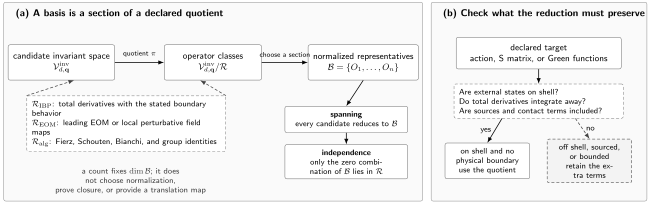
An operator basis is a normalized section of a quotient, not the unreduced candidate list or its count. Panel (a) forms classes in , chooses representatives, and tests spanning and independence separately. Panel (b) limits the reduction: on-shell observables with boundary conditions that remove total derivatives use the quotient, whereas off-shell Green functions, explicit sources and contact terms, or physical boundaries can require the extra operators. The diagram is schematic and not to scale.
At finite EFT order, the EOM relation is perturbative. A local field redefinition that removes an operator at order also generates compensating terms at order and beyond. One may discard those only when the calculation is consistently truncated before they contribute.
First application: a dimension-six scalar sector
Section titled “First application: a dimension-six scalar sector”Consider one real scalar in four dimensions with symmetry, and take the lower-order massless action
Bound the target sector to -even dimension-six scalars containing at least four fields and at most two derivatives. Since and , the only field-and-derivative gradings are and . For identical scalars, the two derivatives in the latter case either act on different fields or both act on one field. Thus a complete candidate list is
There is no nontrivial algebraic identity in this small sector. The unique dimension-five vector current with four fields and one derivative is proportional to , whose divergence gives
For fields that fall off sufficiently fast, its spacetime integral vanishes, so
The leading equation of motion is
Multiplication by supplies the only EOM descendant in the target sector:
In the ordered candidate vector , the complete relation matrix is therefore
The minor formed from the and columns has determinant , so for every , including . Hence
Choose . The two relations give
and therefore the explicit reduction map is
This proves spanning. Independence is equally explicit: suppose were a linear combination of the two relation rows. The second coordinate gives , the third then gives , and the first gives . Thus no nonzero multiple of lies in . When , the relations instead say and , leaving the same one-dimensional quotient.
Observable equivalence and its limits
Section titled “Observable equivalence and its limits”The rank calculation can be checked against amplitudes. For four incoming massless on-shell momenta, momentum conservation gives
The symmetrized contact vertex from is proportional to and vanishes. The one from is proportional to
This is an independent four-point check of the two derivative representatives. It is not a proof that their contact vertices can simply be erased in every process. At six points, the and insertions combine with ordinary interactions, while gives a direct six-field contact. Only the full amplitude reproduces the coefficient combination .
The EOM step is justified by a local perturbative change of integration variables. Such changes preserve the matrix when fields and parameters are transformed consistently, but off-shell Green functions can change; Arzt gives both the scalar reduction and the source-dependent qualification in Arzt 1995, § 2, preprint pp. 4–6, Open PDF. This is the operational content of the equivalence theorem developed in Kamefuchi, O’Raifeartaigh, and Salam 1961, pp. 529–549.
Likewise, IBP removes only when the surface integral vanishes. A physical boundary, defect, nontrivial asymptotic sector, or deliberately retained boundary observable turns it into boundary data rather than zero. The correct quotient is therefore defined by the observable and boundary conditions, not by notation alone.
A reproducible basis check
Section titled “A reproducible basis check”For a larger sector, the same argument becomes a finite exact-linear-algebra calculation:
| Stage | Object to record | Acceptance check |
|---|---|---|
| Declare the sector | Fields, spacetime dimension, charges, grading, Hermiticity convention | Every candidate has the same target labels |
| Generate candidates | Ordered monomial list for | Representation products contain every singlet once before relations |
| Generate relations | IBP currents, lower-order EOM descendants, algebraic identities | Each row stays inside the declared sector |
| Reduce exactly | Relation matrix or normal-form rules | Rank and pivots are independent of arbitrary ordering |
| Choose representatives | Ordered, normalized and coefficient map | Spanning and independence are both demonstrated |
| Check physics | On-shell amplitudes or another observable in the valid domain | Basis translations leave the observable unchanged through the retained order |
Exact rational or symbolic arithmetic is preferable during reduction: a floating-point null space can turn a true identity into a tolerance-dependent decision. A Hilbert-series count is a powerful independent dimension check, but it does not by itself provide the representative normalization or the coefficient translation. Those tasks are developed later in Hilbert-Series Counting and Completeness and Basis Translation, Scheme Dependence, and Reproducibility. The next page derives the two most common relation generators in detail: Integration by Parts and Equation-of-Motion Redundancy.
Common pitfalls
Section titled “Common pitfalls”Calling the candidate list a basis. Symmetry projection proves invariance, not independence. Form the relation space and exhibit either an exact reduction map or a normal form.
Using the full EFT EOM at the same order. The relation is generated from the lower-order action. Feeding the coefficient being eliminated back into its own EOM mixes EFT orders and loses the compensating higher-order terms.
Treating a count as a translation. Equal basis dimensions do not specify which representatives, normalizations, flavor conventions, or coefficient map were chosen. Record all of them.
Dropping total derivatives in a bounded problem. Integration by parts moves information to the boundary. Check the boundary conditions before quotienting it away.
Exercises
Section titled “Exercises”Add a mass term to . Reduce and while counting as a dimension-two spurion.
Solution
The equation of motion becomes . Multiplying by gives
Combining this with yields
The factor has total canonical dimension six once the mass is included in the grading; omitting it would be an inconsistent massless specialization.
Show directly that changing the representative to , with nonzero constant , does not change the interaction.
Solution
Since , the coefficient must transform as . The quotient class is unchanged; only its chosen normalization and the dual coefficient coordinate have changed.
References
Section titled “References”- Arzt, Christopher. “Reduced Effective Lagrangians.” Physics Letters B 342, no. 1–4 (1995): 189–195. DOI; Open PDF
- Henning, Brian, Xiaochuan Lu, Tom Melia, and Hitoshi Murayama. “Hilbert Series and Operator Bases with Derivatives in Effective Field Theories.” Communications in Mathematical Physics 347, no. 2 (2016): 363–388. DOI; Open PDF
- Kamefuchi, S., L. O’Raifeartaigh, and A. Salam. “Change of Variables and Equivalence Theorems in Quantum Field Theories.” Nuclear Physics 28 (1961): 529–549. DOI