

Flavor, Hermiticity, and CP Bookkeeping
Flavor labels turn one representation-level contraction into a tensor of operators, and that tensor is usually constrained by identical-particle permutations, Hermitian conjugation, and the chosen CP action. These constraints must be imposed in a fixed convention. Otherwise the same interaction can be counted twice, a self-adjoint operator can be assigned a complex coefficient, or a harmless flavor-basis change can be mistaken for CP violation.
Required background. Representation and Spurion Constraints on Operator Bases constructs the symmetry-allowed candidates before flavor reduction. Internal, Spacetime, Discrete, and Antiunitary Symmetries fixes the distinction between unitary discrete symmetries, CP, and complex conjugation. Helpful background. Multiplets, Invariants, and Selection Rules reviews invariant tensors and multiplicities.
Flavor tensors inherit permutation symmetry
Section titled “Flavor tensors inherit permutation symmetry”Write every field occurrence with an explicit flavor index before counting coefficients. If an operator contains identical fields, exchange of those occurrences acts simultaneously on
- the flavor tensor;
- the Lorentz and gauge contractions;
- the derivative placement; and
- the Grassmann ordering.
The sign of the full operator, not the word “fermion” alone, decides whether the surviving flavor tensor is symmetric, antisymmetric, or has mixed Young symmetry. For example, the dimension-five operator on the preceding page obeys
Exchanging the two fermion fields gives a Grassmann minus sign, while exchanging the antisymmetric spinor contraction gives another minus sign. The product is symmetric. With flavors, only the symmetric part of its coefficient contributes, giving complex entries before Hermitian or CP conditions are imposed.
For a general tensor , a reliable procedure is:
- Choose a canonical ordering of field slots and flavor indices.
- Generate the permutation group that preserves the field multiset.
- Compute its signed action on the complete Lorentz–gauge tensor.
- Project the flavor tensor onto the compatible permutation representation.
- Count the projected components, retaining open flavor labels in the operator definition.
This is also why “one operator, plus flavors” is not a sufficient basis declaration. Different contractions can carry different flavor symmetries even when their field content is identical.
Hermiticity organizes coefficients into conjugation orbits
Section titled “Hermiticity organizes coefficients into conjugation orbits”Let dagger act on the ordered operator list. Each operator belongs to one of two orbit types.
Self-adjoint orbit. If , then
Conjugate pair. If is a distinct listed tensor, then
This pair contains one complex coefficient, not two. Writing “” is safe only after the conjugate orbit, index relabeling, and normalization are known. If a conjugate maps back to the original tensor after a flavor permutation, Hermiticity becomes a matrix relation such as
not the statement that every displayed component is real.
An explicit large-basis example of this distinction—manifestly Hermitian bosonic operators, fermionic tensors related by transposed generation indices, and unlisted independent conjugates—appears in Grzadkowski et al. 2010, § 3, preprint pp. 5–6, Open PDF.
For a conjugate pair satisfying in the chosen convention, define Hermitian combinations
They are CP even and CP odd, respectively. If , then
Thus “real coefficient” is a CP statement only after the CP map and operator phase convention have been fixed.
CP conditions transform with the flavor basis
Section titled “CP conditions transform with the flavor basis”For fields with identical quantum numbers, a generalized CP transformation may mix flavors:
where is unitary and . For a CP operation squaring to the identity on these fields, ; more general consistency conditions can close into an internal symmetry.
Under a unitary flavor-basis change , the same physical CP operation is represented by
Therefore a coefficient matrix that is real in one basis can become complex in another while CP remains exact. The invariant question is whether a consistent exists and leaves every interaction tensor unchanged. For multi-scalar theories, the need to distinguish a real basis from basis-independent CP violation is developed in Gunion and Haber 2005, §§ I–III, preprint pp. 2–8, Open PDF.
Count, construct, normalize, close, translate
Section titled “Count, construct, normalize, close, translate”Flavor projection and Hermitian pairing occupy the normalization stage of the full basis workflow. They must be applied to explicit contractions, not inferred from a total count.
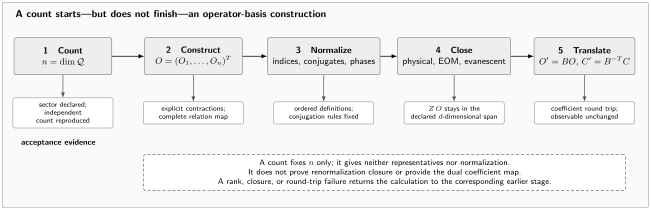
An operator-basis result is a five-stage package. Counting fixes ; construction supplies explicit contractions and relations; normalization fixes ordering, conjugation, and phases; closure enlarges the -dimensional renormalization space when EOM or evanescent operators are required; and translation applies with the dual coefficient map . The lower row states the required checks at each stage. A count alone is neither an explicit basis nor proof of RG closure. The diagram is schematic and not to scale.
An exchange convention should identify the EFT, basis, scale, operator normalization, flavor ordering, and coefficient values as separate data. WCxf is one concrete implementation of this principle for Wilson coefficients and basis translations in Aebischer et al. 2018, §§ 2–3, Open PDF.
First application: two scalar flavors
Section titled “First application: two scalar flavors”Let be two complex scalar flavors with identical exact quantum numbers, and restrict to four-field interactions containing two fields and two conjugate fields. Use the normalized symmetric-pair vector
The most general interaction in this bounded sector is
The normalization makes the symmetric-square representation of a unitary flavor rotation itself unitary. Hermiticity requires
Thus is a Hermitian matrix: three real diagonal entries and three complex off-diagonal entries, for
independent real coefficients in the fixed flavor basis.
Choose canonical CP, , so . The interaction is CP invariant precisely when
Write
with and real. Canonical CP retains the six entries of the real symmetric matrix and sets the three independent entries of to zero. Those three directions violate this chosen canonical CP; by themselves they are not basis-independent CP invariants.
Now transform the flavor basis by . In pair space,
where in the normalized basis above. A general CP matrix induces , and the CP condition is
The transformed CP matrix is
Substitution gives
so the CP condition survives the basis translation even when is not real. This exact round trip separates a convention change from physical CP violation.
The count above is coefficient data in a declared basis. It does not quotient by field redefinitions, because other masses, interactions, and sources may already fix the flavor basis. Counting basis-independent physical parameters requires transforming the complete theory, not this tensor in isolation.
The operator-basis reproducibility record
Section titled “The operator-basis reproducibility record”Use the same record for every flavor and CP reduction; the rows on flavor, conjugation, normalization, and round trips are mandatory here.
| Record | Declare before reduction | Verification retained with the result |
|---|---|---|
| Field content and order | Spacetime dimension, dynamical fields, exact symmetries, charges, EFT grading, and truncation | Every candidate and relation has the declared labels and order |
| Flavor, Hermiticity, and CP | Flavor-index ranges, conjugation rule, coefficient reality conditions, and CP convention | Conjugate completion and independent real parameter count agree |
| Operator definition | Ordered names, explicit index contractions, derivative placement, signs, and normalization factors | Each symbolic or numerical column maps to one unambiguous operator |
| Renormalization data | Regulator, subtraction scheme, gauge convention when relevant, renormalization scale , and coupling definitions | Coefficients and matrix elements use the same scheme and scale |
| Dimensional identities | Dimension used for Lorentz and spinor algebra, prescription when present, and evanescent-operator definitions | The renormalized basis closes before any four-dimensional projection |
| Redundancy generators | IBP currents and boundary conditions, lower-order EOM, field maps, and algebraic identities | Every relation row is reproducible from a displayed generator |
| Basis map | Candidate and reduced dimensions, matrix orientation, exact rank, pivots, and representative ordering | Nullities and ranks satisfy the quotient dimension and no pivot is tolerance-dependent |
| Coefficient map | Dual transformation, transpose convention, finite shifts, and perturbative order | is unchanged through the retained order |
| Implementation identity | Source or notebook version, dependency versions, input hash, and output checksum | A clean rerun reproduces the ordered map and checksum |
| Round trip and physics | Forward and inverse maps on the common subspace plus one amplitude, correlator, or counting benchmark | The round trip is the identity and the benchmark is basis independent to the stated tolerance |
For the scalar sector, record the pair ordering , the normalization, , the chosen , and the induced matrices and . The acceptance checks are the fixed-convention CP count and the covariant CP identity after translation.
Common pitfalls
Section titled “Common pitfalls”Assigning flavor symmetry from statistics alone. Exchange every part of the contracted tensor. Spinor and gauge antisymmetries can reverse the flavor symmetry.
Counting an operator and its conjugate independently. Identify dagger orbits first. A conjugate pair carries one complex coefficient.
Calling every complex coefficient CP violating. Complex entries can arise from a flavor-basis change. Transform the CP matrix and test a basis-covariant condition.
Removing phases from one sector only. A field rephasing changes every coupling involving that field. Physical parameter counts belong to the complete declared theory.
Hiding normalization in “plus h.c.” A self-adjoint tensor, a distinct conjugate pair, and a pair related by flavor exchange require different coefficient conventions.
Exercises
Section titled “Exercises”For complex scalar flavors, how many real coefficients occur in the fixed-basis sector , where spans ?
Solution
The pair-space dimension is . Hermiticity makes a Hermitian matrix, which has real parameters. For , and .
Show that canonical CP leaves six parameters in the two-flavor example.
Solution
Hermiticity decomposes into a real symmetric matrix with entries and times a real antisymmetric matrix with entries. Canonical CP requires , hence and six real entries remain.
References
Section titled “References”- Aebischer, Jason, et al. “WCxf: An Exchange Format for Wilson Coefficients beyond the Standard Model.” Computer Physics Communications 232 (2018): 71–83. DOI; Open PDF
- Grzadkowski, B., M. Iskrzyński, M. Misiak, and J. Rosiek. “Dimension-Six Terms in the Standard Model Lagrangian.” Journal of High Energy Physics 2010, no. 10 (2010): 085. DOI; Open PDF
- Gunion, John F., and Howard E. Haber. “Conditions for CP-Violation in the General Two-Higgs-Doublet Model.” Physical Review D 72, no. 9 (2005): 095002. DOI; Open PDF