

Nonperturbative Iteration, Shallow Scales, and Power-Counting Consistency
A shallow pole introduces a low scale that can make every repetition of a nominally short-range interaction equally important. The correct response is not to iterate the whole EFT indiscriminately: promote the interaction responsible for the pole, resum that leading subset, insert higher-order operators perturbatively, and demand regulator independence at each claimed order. This page derives the leading contact amplitude and its running in pionless two-body EFT.
Required background. Power Counting and Predictive Order supplies the ordinary order lattice. Loops, Counterterms, and Closure of an EFT Expansion supplies local subtraction and the retained-order regulator test. Helpful background. Partial-Wave Unitarity relates the resummed -wave amplitude to phase shifts and pole locations.
A shallow scale defeats naive contact perturbation
Section titled “A shallow scale defeats naive contact perturbation”For two nonrelativistic particles of equal mass interacting over a range , the -wave effective-range expansion is
Natural short-range dynamics has . If instead
then is a new low scale. For momenta , the product is order one. Expanding the amplitude in powers of is impossible even though remains small.
Partial-wave unitarity fixes the amplitude up to normalization. With the convention used here,
At leading order in the range expansion,
For , this has a bound-state pole at
The pole is shallow because . Its nonanalytic denominator must be generated at leading order; no finite polynomial in can reproduce it over .
Contact bubbles become leading
Section titled “Contact bubbles become leading”Use a short-range nonrelativistic EFT with a momentum-independent -wave contact interaction . A two-particle bubble scales as
With natural scattering length, and
so bubbles are perturbative. A shallow pole requires instead
which gives . The contact interaction has been promoted by relative to its natural estimate. Suppressing convention-dependent overall signs, every bubble in
is therefore the same order. Summing the geometric series gives
and the Feynman-rule convention below supplies the corresponding overall sign. Renormalizing to the scattering length turns the physical amplitude into the universal form .
Kaplan, Savage, and Wise introduced a subtraction and RG organization in which this promotion is manifest and all bubbles are leading, while derivative interactions are inserted perturbatively Kaplan, Savage, and Wise 1998, Eqs. (4)–(13), pp. 392–394.
Power-divergence subtraction makes the counting explicit
Section titled “Power-divergence subtraction makes the counting explicit”In dimensional regularization with power-divergence subtraction (PDS), the renormalized bubble is
The summed amplitude is
Choose
Substitution gives
with no dependence. Differentiating yields the exact leading-sector beta function
Thus the counterterm that renormalizes the leading contact loop must itself be leading. Treating it as a higher-order correction would leave the resummed amplitude regulator dependent at leading order.
For and ,
The subtraction scale exposes the intended counting but is not physical. Other regulators are allowed if their running coefficients reproduce the same amplitude and residual errors.
Range corrections remain perturbative
Section titled “Range corrections remain perturbative”The next contact interaction carries two derivatives, with coefficient . Matching the effective range gives in the PDS convention
For and ,
A single insertion dressed on both sides by the leading bubble sum is suppressed by at real scattering momenta . Expanding the effective-range amplitude gives
The leading denominator is kept exact because and are both . The expansion of the amplitude requires
At real , this follows from . It does not hold uniformly after analytic continuation into the neighborhood of the leading pole, where the denominator vanishes. A small shift of the pole position can still be calculated by expanding the zero of the inverse amplitude, as the exercise below shows, or by organizing the expansion around the physical pole. Iterating without a separate counting would generate selected terms of all orders and new ultraviolet sensitivity not represented by a nominal next-to-leading-order counterterm set.
Epelbaum, Hammer, and Meißner summarize pionless EFT as an expansion around the large-scattering-length limit, with the leading contact resummed and effective-range effects perturbative, in Epelbaum, Hammer, and Meißner 2009, §§ I.D and II.A.
The promoted order lattice
Section titled “The promoted order lattice”The right panel of the shared diagram now has a precise meaning: is the two-particle bubble, , and the infinite chain defines the leading amplitude. The derivative operator appears once at its assigned correction order; the dashed box is the first omitted structure.
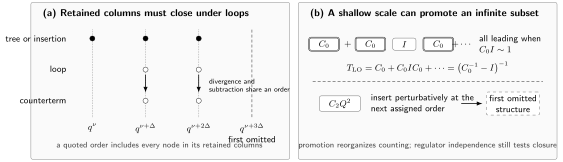
Predictive order requires closure. Panel (a) shows generic orders ; each retained column must include every tree or insertion, loop, and local counterterm assigned to it, while the dashed column is the first omitted order. Panel (b) shows the distinct case , where a shallow scale promotes the entire iteration to leading order and higher-derivative structures remain perturbative. The diagram is schematic: and the relative order of are theory dependent.
The promotion is regime specific. It applies to a short-range channel with and momenta below the range scale. It does not establish a universal rule for pion exchange, singular tensor forces, relativistic bound states, many-body resummations, or strong coupling in other partial waves.
Cutoff independence as an order-by-order test
Section titled “Cutoff independence as an order-by-order test”With a sharp momentum cutoff , the leading bubble contains
The linear term must be canceled by the cutoff dependence of at leading order. After fitting , the remaining dependence has the form of an effective-range correction and is removed or demoted consistently when enters.
A useful cutoff test is:
- choose several regulator values above the low momenta but within a range where the EFT implementation is meaningful;
- refit every coefficient present at the tested order for each regulator;
- compare predictions for withheld energies or observables; and
- verify that the spread scales with the first omitted power of .
It is not enough that one fitted datum is cutoff independent; the running coefficient guarantees that by construction. Nor should one take blindly when an iterated truncated kernel samples momenta far beyond the EFT domain. Epelbaum, Hammer, and Meißner explain that iterating a truncated potential generates ultraviolet divergences in its Neumann series and can require counterterms beyond the truncation; regulator choice and promoted counterterms must therefore be tied to a consistent counting Epelbaum, Hammer, and Meißner 2009, § II.C.3.
What may be resummed
Section titled “What may be resummed”A justified nonperturbative subset satisfies all of the following:
- a diagnosed small denominator or infrared enhancement makes every repetition the same order;
- the resummation preserves the symmetries and analytic structure required in the domain;
- all counterterms needed by the resummed ultraviolet behavior are included at the promoted order;
- subleading interactions have a declared perturbative insertion rule;
- regulator variation leaves observables stable through the retained order; and
- spurious deep poles or cutoff-scale states remain outside the claimed domain and do not contaminate low-energy predictions.
Selective iteration merely because it improves a fit is not a power counting. It can mix incomplete higher orders into the result, hide missing counterterms, and make the apparent error smaller without improving predictivity.
The three-body sector supplies an important warning. For identical bosons with a large -wave scattering length, repeated two-body interactions generate ultraviolet dependence that no two-body coefficient absorbs. A three-body counterterm is then promoted, with limit-cycle running in the Efimov regime Epelbaum, Hammer, and Meißner 2009, § II.A, Eqs. (2.5)–(2.7). Other statistics and spin channels require their own analysis. This result does not make every many-body force leading.
A common uncertainty and validation checklist
Section titled “A common uncertainty and validation checklist”Resummation changes the leading reference amplitude but does not collapse the error budget.
| Component | Record explicitly | Diagnostic or failure trigger |
|---|---|---|
| Domain and expansion parameters | Observable, kinematic window, , hard scales, thresholds, and correlations among small parameters | A threshold enters, some , or the assumed relation among parameters fails |
| Retained order and inventory | Highest order , every tree, loop, insertion, counterterm, and parameter correction included | An omitted contribution has the same assigned order as a retained one |
| Coefficient assumptions | Operator normalization, scheme and scale, expected coefficient sizes, symmetry suppressions, and any priors | Coefficients drift with fit window or require unexplained enhancement |
| EFT truncation | First omitted powers, reference size, correlation model across energies and observables, and interval interpretation | Residuals do not scale with the predicted powers or coverage fails on withheld data |
| Input and fit uncertainty | Experimental or synthetic inputs, covariance, fitted combinations, and propagation method | Results are unstable under admissible input or fit-window changes |
| Numerical uncertainty | Solver, discretization, integration, rounding, convergence tolerance, and reproducibility data | Numerical changes are not parametrically below the claimed EFT error |
| Matching and running | Matching order and scale, anomalous dimensions, threshold sequence, and residual dependence | Scale cancellation fails through the retained order or a threshold is double counted |
| Regulator, basis, and scheme checks | Regulator range, required counterterms, field/basis map, and scheme transformation | Predictions depend on an auxiliary choice at or below the claimed order |
| Model discrepancy and breakdown | Effects not represented by the EFT, validation observables, stopping rule, and alternative field content | Persistent structured residuals, new nonanalyticity, or failure across observables |
For the shallow contact EFT, the record must add the fitted scattering length, effective range when included, pole convention, regulator window, and the list of iterated versus perturbative operators. Numerical solution error must be smaller than the first omitted range correction.
Common pitfalls
Section titled “Common pitfalls”A large coupling must be iterated. The relevant criterion is the dimensionless product of the interaction and loop kernel. A numerically large coefficient can remain perturbative, while a small coefficient near a pole can be enhanced.
Exact two-body unitarity proves EFT consistency. A geometric resummation can satisfy elastic unitarity and still have uncontrolled regulator dependence or omit same-order operators.
All derivative interactions should be put into the potential and iterated. Iterating a nominal correction generates infinitely many higher-order terms and can demand new counterterms. Insert it according to the derived counting unless a separate enhancement promotes it.
Cutoff independence means taking the cutoff to infinity. The test is independence through the claimed order within a regulator window compatible with the EFT. Sending an incomplete kernel arbitrarily above can probe physics the EFT does not contain.
Exercises
Section titled “Exercises”Show directly that the PDS amplitude is independent of when .
Solution
Substitute into
Multiplying numerator and denominator by gives
The subtraction scale cancels exactly in the resummed leading sector.
For and natural , compute the leading pole energy and its first effective-range shift. Explain why a small fractional pole shift does not make the amplitude expansion uniform near the leading pole.
Solution
At leading order the pole occurs at , so with nonrelativistic energy ,
Including the effective-range term, write the shallow pole as . The zero of the inverse amplitude obeys, through this order,
With , , and natural higher shape parameters, expand the shallow root continuously connected to :
Thus the fractional pole-energy shift is small when . The shallow root of the effective-range equation is also given in Epelbaum, Hammer, and Meißner 2009, § II.A, Eq. (2.4).
The amplitude has a different test. At , its leading denominator is , so near that pole the relative correction has magnitude
It becomes order one when , even while . The pole-location expansion is controlled; the amplitude expansion about the unshifted pole is not uniform in this narrow neighborhood.
References
Section titled “References”- Epelbaum, Evgeny, Hans-Werner Hammer, and Ulf-G. Meißner. “Modern Theory of Nuclear Forces.” Reviews of Modern Physics 81 (2009): 1773–1825. DOI · Open PDF
- Kaplan, David B., Martin J. Savage, and Mark B. Wise. “A New Expansion for Nucleon–Nucleon Interactions.” Physics Letters B 424 (1998): 390–396. DOI · Open PDF