

SMEFT and HEFT: Architecture and Domain
SMEFT and HEFT can contain the same observed particles yet organize them differently. SMEFT assumes linearly realized electroweak symmetry below a heavy cutoff: the light scalar coordinates extend analytically to a transforming doublet, and canonical dimension organizes the local expansion. HEFT treats the electroweak Goldstones as coordinates on a nonlinear coset and the physical scalar as an independent singlet, so its leading functions and loop/derivative counting are more general. Choosing between them is a claim about symmetry realization, scalar-field geometry, and hierarchy—not a change of operator basis.
Required background. A Map of Effective-Theory Architectures supplies the common architecture card. Representation and Spurion Constraints on Operator Bases supplies the gauge, flavor, and spurion tests used to build either theory.
Helpful background. Cosets and Nonlinear Realizations supplies the Goldstone construction used in HEFT. Global Form, Matter Representations, and the Faithful Gauge Group explains why the faithful electroweak gauge group and its representations must be declared before calling an operator invariant.
A linear doublet defines SMEFT
Section titled “A linear doublet defines SMEFT”SMEFT retains the Standard Model gauge, fermion, and scalar field content. In particular,
is a complex scalar doublet under the usual Standard Model Lie algebra. The global form of the gauge group, baryon- and lepton-number assumptions, flavor symmetry, CP restrictions, and light sterile fields are additional choices; they change the allowed operator set.
With a heavy scale and no extra light states, the Lagrangian is
Each is local and invariant under the electroweak gauge group before spontaneous breaking. Canonical dimension organizes powers of all characteristic light scales relative to , while couplings and loops refine the estimate. If lepton number is not imposed, the dimension-five Weinberg operator is the first correction; under baryon- and lepton-number conservation, the leading corrections usually begin at dimension six.
A calculation must state more than “dimension six.” It specifies:
- the exact light field content and faithful gauge representations;
- baryon, lepton, flavor, CP, and custodial assumptions;
- the independent basis and renormalization scheme;
- the electroweak input observables used to infer , , and ;
- whether coefficients are kept linearly or quadratically; and
- the amplitude, loop, and order retained.
Brivio and Trott develop the SMEFT field content, bases, matching, input dependence, and power counting in Brivio and Trott 2019, §§ 5.1–6.1, pp. 36–64.
A Goldstone manifold and singlet scalar define HEFT
Section titled “A Goldstone manifold and singlet scalar define HEFT”For the electroweak breaking pattern, collect the three Goldstones into a dimensionless matrix
The subgroup and hypercharge direction are gauged. The physical scalar is treated as a singlet under the nonlinear transformation rather than assumed to be the fourth component of . A schematic custodially symmetric leading scalar sector is
The last line is schematic: hypercharge embeddings, flavor indices, projectors, and normalization factors are declared for each fermion species. The scalar functions are expanded about the physical vacuum,
with analogous functions in the potential and Yukawa structures. Because is dimensionless and the functions can contain arbitrarily many powers of , canonical dimension alone does not order the theory.
A common chiral assignment counts derivatives, weak gauge couplings, and Yukawa couplings as one unit, and a fermion bilinear as one unit. Boson fields and have chiral dimension zero. The leading Lagrangian has chiral dimension two; each loop raises the order by two, so the one-loop counterterms belong to the next chiral order. Additional weak-coupling or misalignment parameters, such as , may refine this hierarchy but must be declared rather than silently merged with it.
Buchalla, Catà, and Krause derive the light-Higgs electroweak chiral power counting and its next-order counterterm classes in Buchalla, Catà, and Krause 2014, §§ 2–5, pp. 555–566.
The domain test is coordinate independent
Section titled “The domain test is coordinate independent”Writing a scalar Lagrangian with does not by itself make it HEFT. Away from the symmetry-restoring point, even an ordinary doublet can be put in polar coordinates,
This change of coordinates cannot alter the S-matrix. The sharper question is whether the scalar manifold admits an electroweak-invariant point where the Goldstone orbit shrinks and the action is analytic in four Cartesian coordinates that form a doublet. SMEFT assumes such an extension and expands around it in gauge-invariant polynomials. General HEFT does not require that point to exist within the EFT domain; and the Goldstone coordinates may remain independent everywhere the theory is trusted.
In geometric language, the scalar fields are coordinates on a manifold. Curvature is coordinate invariant, but curvature alone distinguishes the renormalizable Standard Model from a flat scalar sector—not every SMEFT from every HEFT, because higher-dimensional SMEFT operators can themselves curve the metric. The relevant SMEFT criterion is the analytic electroweak-invariant point and compatible linear representation. Alonso, Jenkins, and Manohar formulate the scalar-manifold description and this invariant-point criterion in Alonso, Jenkins, and Manohar 2016, §§ I–II, pp. 335–339, Open PDF.
| Domain question | SMEFT answer | General HEFT answer |
|---|---|---|
| How do the light scalars transform? | Four real coordinates combine into one linear complex doublet . | Goldstones transform nonlinearly through ; is an independent singlet. |
| Is a symmetry-restoring scalar point in the EFT domain? | Yes, with an analytic Cartesian chart and gauge-invariant polynomial expansion. | Not required; the Goldstone orbit need not collapse at an accessible point. |
| What orders interactions? | Canonical dimension, supplemented by couplings and loops. | Chiral/derivative and loop order, possibly supplemented by or other declared spurions. |
| How are multiple Higgs insertions related? | Correlated at each fixed canonical dimension by powers of . | Encoded in independent functions of unless matching imposes correlations. |
| What invalidates the choice? | Nonanalyticity near the symmetric point, missing light states, or failure of the expansion. | Loss of derivative/loop control, an incomplete light spectrum, or functions that require a different hierarchy. |
First application: the gauge–Goldstone kinetic interaction
Section titled “First application: the gauge–Goldstone kinetic interaction”The renormalizable doublet kinetic term provides a bounded comparison. Substituting the polar form of gives
At the Standard Model point, HEFT notation therefore has
SMEFT operators such as functions of multiplying derivative structures deform the single- and multiple-Higgs couplings, but at any fixed canonical dimension only a finite set of coefficients appears and enforces correlations among them. HEFT permits , , and higher Taylor coefficients to be independent at the same chiral order unless a UV matching condition or a secondary power counting relates them. Geometrically, the decisive distinction is whether the scalar manifold admits the appropriate analytic electroweak-invariant point; curvature alone is insufficient once higher-dimensional SMEFT operators are allowed Falkowski and Rattazzi 2019, §§ 2–3.
This example is a decision procedure, not an observable fit:
- list the light spectrum and its exact gauge representations;
- ask whether and the Goldstones extend analytically to a doublet at a symmetric point;
- if yes, test whether the desired accuracy is captured by finitely many canonical-dimension terms;
- if no, retain independent HEFT functions and assign their chiral and loop order; and
- in either case, translate the chosen parameters to an input scheme before comparing amplitudes.
One measured deviation in or does not alone prove which architecture is correct. The evidence comes from a consistent pattern of amplitudes, the assumed domain, and the controlled truncation. Current observables, coefficient constraints, and global fits belong to SMEFT and HEFT in Standard Model Observables.
The electroweak architecture card
Section titled “The electroweak architecture card”These cards specialize the common fields in the architecture comparison matrix to linear and nonlinear electroweak realizations.
| Card entry | SMEFT | HEFT |
|---|---|---|
| Degrees of freedom | Standard Model fields, including a linear Higgs doublet, plus any explicitly declared light additions | Standard Model gauge and fermion fields, nonlinear Goldstones, an independent light scalar, and any declared light additions |
| Hierarchy | with an analytic expansion around the linear realization | Gradients and light masses below the chiral cutoff, with the scalar-manifold domain and any hierarchy declared |
| Symmetry | Linearly realized electroweak gauge symmetry on | Nonlinear electroweak realization on , gauge symmetry, and optional custodial/flavor spurions |
| Counting | Canonical dimension, couplings, loops, and coefficient assumptions | Chiral dimension, loops, derivatives, weak couplings, fermion bilinears, and optional secondary expansions |
| Matching | Match UV amplitudes onto a chosen SMEFT basis and input scheme | Match UV dynamics onto scalar functions and chiral operators, preserving field-space and spurion information |
| Outputs | Amplitudes and pseudo-observables expanded in | Amplitudes and pseudo-observables expanded in chiral/loop order |
| Validity limit | New thresholds, nonanalytic scalar behavior, or loss of control | Loss of gradient/loop control, unresolved light states, or failure of the assumed scalar chart and secondary hierarchy |
The shared figure separates the local-operator and nonlinear-manifold branches, while allowing them to nest in the SMEFT limit of HEFT. Inspect the common card: a symmetry label is insufficient without counting, matching, inputs, uncertainty, and a validity limit.
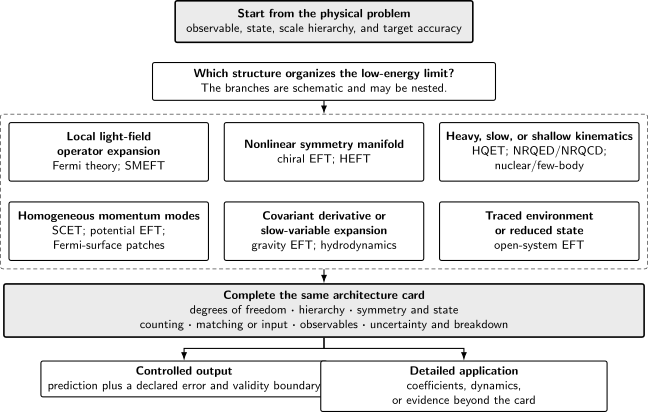
An EFT name is not a construction. Starting from the observable, state, scale hierarchy, and target accuracy, identify the dominant low-energy organizing structure, then declare degrees of freedom, symmetry and state, counting, matching or input, observables, uncertainty, and breakdown. Branches may be nested; the diagram is schematic and not to scale.
Bases, inputs, and truncation are part of the prediction
Section titled “Bases, inputs, and truncation are part of the prediction”For a SMEFT amplitude,
At relative order , an observable keeps the interference of with the dimension-six term. At order , the square of the dimension-six amplitude and the Standard Model–dimension-eight interference generally occur together. Keeping one while dropping the other is a partial prescription that needs a stated coefficient hierarchy; it is not the complete canonical-dimension truncation.
HEFT has an analogous obligation. Loops of the leading chiral Lagrangian generate divergences at the next chiral order, so the corresponding local counterterms and their renormalized coefficients must be included. Arbitrary functions of do not mean infinitely many parameters enter one fixed process: at fixed external multiplicity and chiral order, only finitely many Taylor coefficients contribute.
In both theories, field redefinitions and equations of motion change basis coefficients but not on-shell predictions. Electroweak input observables also receive EFT corrections, so the inferred Lagrangian parameters shift with the chosen input scheme. A reproducible result records basis, renormalization scheme and scale, flavor assumptions, input scheme, perturbative order, EFT order, retained coefficient products, and covariance information.
Common pitfalls
Section titled “Common pitfalls”Calling polar coordinates HEFT. A linear doublet can be rewritten with and a radial field. The architecture is determined by the analytic scalar-manifold domain and counting, not by the displayed coordinates.
Using canonical dimension to order general HEFT. Dimensionless and arbitrary functions of put many canonical dimensions at the same chiral order. Apply the loop/derivative counting actually assumed.
Treating SMEFT as only dimension six. Dimension five, dimension eight, loop corrections, and products of lower-dimension amplitudes enter according to symmetries and target accuracy. State the complete truncation rule.
Inferring a fit without an input scheme. EFT operators shift the relation between measured inputs and Lagrangian parameters. Coefficients quoted in different bases or input schemes are not directly comparable.
Declaring HEFT whenever the Higgs is composite. UV language alone does not decide the low-energy coordinates. A decoupling model with an analytic light doublet can match SMEFT; a nondecoupling scalar sector may require HEFT.
References
Section titled “References”-
Alonso, Rodrigo, Elizabeth E. Jenkins, and Aneesh V. Manohar. 2016. “A Geometric Formulation of Higgs Effective Field Theory: Measuring the Curvature of Scalar Field Space.” Physics Letters B 754: 335–342. DOI. Open PDF.
-
Brivio, Ilaria, and Michael Trott. 2019. “The Standard Model as an Effective Field Theory.” Physics Reports 793: 1–98. DOI. Open PDF.
-
Buchalla, Gerhard, Oscar Catà, and Claudius Krause. 2014. “Complete Electroweak Chiral Lagrangian with a Light Higgs at NLO.” Nuclear Physics B 880: 552–573. DOI. Open PDF.
-
Falkowski, Adam, and Riccardo Rattazzi. 2019. “Which EFT.” Journal of High Energy Physics 2019 (10): 255. DOI. Open PDF.