

Critical Exponents, Scaling Relations, and Hyperscaling Caveats
Critical exponents translate fixed-point data into observable singular behavior. The translation is not a dictionary of names: it follows from a homogeneity law for the singular free energy, a scaling dimension for the order-parameter field, and assumptions about irrelevant variables. This page derives the standard static relations, works a supplied stability spectrum, and shows precisely why dangerous irrelevance and upper critical dimensions can invalidate naive hyperscaling.
Required background. Relevant, Marginal, and Irrelevant Directions fixes the sign convention for RG eigenvalues and distinguishes ordinary from dangerous irrelevance. Helpful background. Normal Forms, Spectra, and Projectors reviews the spectral calculation behind the supplied stability data.
Observable exponents and scaling fields
Section titled “Observable exponents and scaling fields”Let be a dimensionless temperature-like scaling field that vanishes at criticality, and let be the source for an order parameter . The standard static exponents are defined by leading singular behavior:
The subscript on distinguishes the magnetization exponent from a beta function. Amplitudes such as and are generally nonuniversal; some ratios are universal after normalization conventions are fixed.
At the critical point, the connected two-point function of the order parameter behaves as
which defines the anomalous-dimension exponent . In a relativistic Euclidean QFT, here denotes spacetime dimension. In a classical equilibrium transition it denotes spatial dimension. For a quantum critical point with dynamical exponent , replacing by is justified only when time has a single anisotropic scaling and there is no hyperscaling-violation exponent or dangerous variable.
Let the two relevant RG eigenvalues be
The first governs ; the second governs . A blocking transformation that increases the coarse-graining length by sends them to and . Measured in the new length unit, the correlation length is smaller by , so
Choosing gives the first fundamental map,
The order-parameter field has dimension
Because is dimensionless, its exponent is
These two inputs, and , determine the familiar exponent set only after the free-energy scaling assumptions are stated.
Homogeneity and the scaling relations
Section titled “Homogeneity and the scaling relations”Let denote irrelevant scaling fields with . The conventional homogeneity hypothesis is
Choose . If the scaling function is regular as each irrelevant argument tends to zero, then
Two derivatives with respect to give the specific heat; one or two derivatives with respect to give the order parameter and susceptibility. The resulting exponents are
Equivalently, these imply
The first two equalities follow from the single-variable equation-of-state homogeneity form. Fisher’s relation also uses the long-distance two-point function: integrating out to gives . Josephson hyperscaling uses the stronger statement that one correlated volume supplies the singular free-energy scale, . Fisher reviews the assumptions and relations in Fisher 1967, §§ 3–5, pp. 637–666.
These are relations among exact asymptotic exponents. In an expansion truncated at order , every exponent and both sides of a relation must be expanded consistently through the same order. Inserting separately truncated rational expressions and comparing unexpanded decimal values can manufacture a disagreement of order .
Worked map from a supplied stability spectrum
Section titled “Worked map from a supplied stability spectrum”Take an illustrative three-dimensional fixed point with supplied data
These rounded numbers are chosen for the calculation; they are not a current precision table for a named model. The thermal and magnetic exponents are
The homogeneity formulas then give
The checks close at the displayed precision:
The leading correction exponent is
For an observable measured as a function of , the corresponding confluent correction occurs with power
For finite-size data at criticality it instead appears directly as . This distinction prevents a common notation error: and describe the same irrelevant field in different scaling variables.
A reproducible calculation lets the supplied stability eigenvalues be varied while keeping this translation explicit; its output is a local flow diagnostic, not an independent determination of thermodynamic exponents.
Corrections to scaling and their domain
Section titled “Corrections to scaling and their domain”For one leading irrelevant field with , the homogeneity law contains
If the scaling function is analytic in this argument near zero, an observable has the form
The coefficient is nonuniversal and may vanish for an improved action or a specially chosen observable. Subleading irrelevant exponents, analytic background terms, finite size, and imperfect critical tuning can then dominate. Wegner derives this structure in Wegner 1972, pp. 4529–4534.
Panel (b) of the shared figure depicts the competition: the irrelevant component decays inside the scaling window, while any residual relevant component eventually wins and produces crossover. Panel (c) gives the contrasting case in which an irrelevant coupling cannot simply be set to zero.
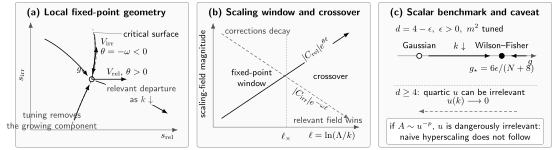
A fixed point organizes local flow, not every global trajectory. Panel (a) shows the critical surface tangent to the irrelevant eigendirection and the relevant departure under infrared flow. Panel (b) compares growth with corrections for . Panel (c) shows the tuned one-loop scalar trajectory from the Gaussian point to and the dangerously irrelevant-coupling exception to naive hyperscaling. The diagram is schematic and not to scale.
When hyperscaling fails or changes form
Section titled “When hyperscaling fails or changes form”The regularity assumption in the irrelevant arguments is the vulnerable step. Suppose
but is singular as its last argument tends to zero. Then is dangerously irrelevant. The powers extracted by simply dropping need not describe the observable.
Above four dimensions, the scalar quartic coupling supplies the standard check. The Gaussian fixed point gives , but the ordered-phase Landau minimum has and . The singularity invalidates . Mean-field values and would imply
which disagree for . Rushbrooke, Widom, and Fisher relations can still hold while Josephson hyperscaling fails. At the upper critical dimension , the leading powers happen to satisfy , but the marginal quartic produces multiplicative logarithms, so a pure-power ansatz is incomplete. Fisher gives the dangerous-variable analysis in Fisher 1983, §§ 4–5, pp. 35–55.
Other modifications require their own declared scaling structure: anisotropic fixed points can have several correlation-length exponents; boundaries have surface exponents; long-range interactions change the field dimension; and systems with a hyperscaling-violation exponent use an effective free-energy dimension . None should be diagnosed merely because a finite-window fit misses one equality.
Comparing methods for fixed points
Section titled “Comparing methods for fixed points”An exponent estimate inherits the assumptions of the method that produced it. The table separates five methods by their inputs, direct outputs, dominant systematics, and limits of the conclusions. Read each row horizontally: agreement across rows is valuable because the limitations are different, not because every route measures exactly the same object.
| Method | Essential assumptions and control | Direct outputs or observables | Dominant systematics and limits of the conclusions |
|---|---|---|---|
| Perturbative expansion | A small , weak fixed-point coupling, large- parameter, or other declared expansion; specified renormalization scheme and operator sector | Beta-function zeros, stability eigenvalues, anomalous dimensions, and resummed exponent or amplitude-ratio estimates | Missing orders, asymptotic-series resummation, scheme and operator truncation; controlled local evidence within the expansion domain, not a global existence proof at order-one parameters |
| Lattice finite-size scaling | A Euclidean discretization in the target basin; controlled critical, continuum, and infinite-volume limits; reflection positivity when used | Correlation lengths, step scaling, Binder-type ratios, spectra, exponents, amplitude ratios, and scaling functions | Cutoff and volume extrapolation, critical tuning, autocorrelation, action dependence, and analytic continuation; strong nonperturbative IR evidence for the simulated universality class |
| Functional RG | An exact flow equation combined with a declared ansatz, projection, regulator, identity constraints, and convergence tests | Global flow portraits, effective potentials, fixed-point spectra, equations of state, and crossover trajectories | Truncation, projection, regulator dependence, symmetry identities, convexity, and numerics; quantitative candidate evidence unless convergence is independently controlled |
| Conformal bootstrap | Conformal invariance, crossing, a symmetry sector, unitarity or reflection positivity when imposed, and explicit gap assumptions | Allowed or excluded regions for operator dimensions and OPE coefficients; islands and universal CFT data | Derivative and spin truncations, assumed gaps, navigator or optimization choices, and numerical certification; characterizes or excludes a CFT under stated assumptions but does not supply an RG trajectory |
| Rigorous or constructive analysis | A precise lattice or continuum model, norm, positivity domain, and theorem hypotheses, often in restricted dimensions or coupling ranges | Existence or nonexistence, controlled continuum correlations, bounds, and in some cases complete RG trajectories | Transfer is limited by theorem hypotheses and model class; strongest conclusion inside the proved domain, with no automatic extension to nearby physical theories |
Representative primary analyses illustrate the distinct ceilings: the epsilon expansion constructs a perturbative fixed point Wilson and Fisher 1972, pp. 240–243; finite-size lattice scaling controls volume and correction terms Hasenbusch 2010, §§ II–V; effective-average-action studies expose truncation and regulator choices Berges, Tetradis, and Wetterich 2002, §§ 2–3, pp. 245–287; bootstrap bounds assume crossing and unitarity El-Showk et al. 2012, §§ II–IV; and rigorous construction can establish a complete trajectory for a precisely defined modified model Abdesselam 2007, pp. 727–772.
The matrix is not a ranking. A theorem about a restricted model, a high-order perturbative series, a converged lattice result, a stable functional truncation, and a bootstrap island answer different questions. A strong universality claim identifies which assumptions overlap and which conclusions are genuinely independent.
Critical Surfaces, Crossover, and Corrections to Scaling next turns the relevant and irrelevant exponents into tuning conditions and departure scales.
Common pitfalls
Section titled “Common pitfalls”Treating derived exponents as independent measurements. If , , and were computed from the same and using scaling relations, their agreement with those relations is an algebraic check, not three independent confirmations.
Using hyperscaling without testing irrelevant variables. The sign only says that flows to zero. One must also check that the observable’s scaling function is regular there.
Mixing asymptotic orders. Scaling relations must be tested after every expression is expanded to a common perturbative order. Unexpanded ratios can contain uncontrolled higher-order terms.
Fitting outside the scaling window. Far from criticality, analytic backgrounds and crossover dominate; too close in a finite system, finite-size rounding dominates. A stable result varies both ends of the fit window and includes justified correction terms.
Exercises
Section titled “Exercises”1. Reconstruct the exponent set
Section titled “1. Reconstruct the exponent set”In , take and . Assuming ordinary hyperscaling, compute , , , , , and .
Solution
The two RG eigenvalues are
Then
The rounded values satisfy .
2. Translate the leading correction
Section titled “2. Translate the leading correction”An observable has and a leading irrelevant exponent . What correction powers appear in a finite-size fit at criticality and in a reduced-temperature fit in infinite volume?
Solution
The correction exponent is . At criticality the finite-size correction is proportional to . In an infinite-volume fit versus , it is proportional to . Their amplitudes need not be the same.
3. Locate the failed assumption above four dimensions
Section titled “3. Locate the failed assumption above four dimensions”Use the mean-field values , , , , , and in . Test all four displayed scaling relations.
Solution
Rushbrooke gives , Widom gives , and Fisher gives . All three hold. Josephson hyperscaling gives on the left but on the right, so it fails. The dangerous quartic invalidates the free-energy-per-correlation-volume assumption, not the other three algebraic statements.
4. Identify independent evidence
Section titled “4. Identify independent evidence”A functional-RG calculation reports and derives from hyperscaling. A lattice study measures from a correlation-length crossing and measures the singular free-energy exponent independently. Which comparison tests hyperscaling?
Solution
The functional-RG pair does not independently test hyperscaling because was defined from . The lattice comparison can test it if the continuum, volume, tuning, and background systematics of the two measurements are controlled and their covariance is included. Agreement between the FRG value of and the lattice value is a separate cross-method check.
References
Section titled “References”- Abdesselam, Abdelmalek. “A Complete Renormalization Group Trajectory Between Two Fixed Points.” Communications in Mathematical Physics 276 (2007): 727–772. DOI. Open PDF.
- Berges, Jürgen, Nikolaos Tetradis, and Christof Wetterich. “Non-Perturbative Renormalization Flow in Quantum Field Theory and Statistical Physics.” Physics Reports 363 (2002): 223–386. DOI. Open PDF.
- El-Showk, Sheer, Miguel F. Paulos, David Poland, Slava Rychkov, David Simmons-Duffin, and Alessandro Vichi. “Solving the 3D Ising Model with the Conformal Bootstrap.” Physical Review D 86 (2012): 025022. DOI. Open PDF.
- Fisher, Michael E. “Scaling, Universality and Renormalization Group Theory.” In Critical Phenomena, Lecture Notes in Physics 186, 1–139. Berlin: Springer, 1983. DOI.
- Fisher, Michael E. “The Theory of Equilibrium Critical Phenomena.” Reports on Progress in Physics 30 (1967): 615–730. DOI.
- Hasenbusch, Martin. “Finite Size Scaling Study of Lattice Models in the Three-Dimensional Ising Universality Class.” Physical Review B 82 (2010): 174433. DOI. Open PDF.
- Wegner, Franz J. “Corrections to Scaling Laws.” Physical Review B 5 (1972): 4529–4536. DOI.
- Wilson, Kenneth G., and Michael E. Fisher. “Critical Exponents in 3.99 Dimensions.” Physical Review Letters 28 (1972): 240–243. DOI.