

Representation and Spurion Constraints on Operator Bases
Before integration by parts, equations of motion, or Fierz identities can reduce an operator list, symmetry must decide which local tensors are candidates at all. Lorentz and gauge invariance require singlets in explicit representation products; exact global symmetries impose selection rules; controlled symmetry breaking is encoded by spurions with declared transformation laws. These filters produce a checkable candidate space, but they do not yet settle flavor multiplicities, Hermitian completion, CP conventions, or redundancy.
Required background. From Operator Lists to Independent Bases defines the ambient invariant space. Multiplets, Invariants, and Selection Rules supplies the representation-theory logic, while Gauge Fields, Redundancy, and Observable Content distinguishes exact gauge redundancy from global symmetry. Helpful background. Compact Lie Groups, Roots, Weights, and Weyl Structure supplies weights and characters for non-Abelian projections.
Symmetry filters define the candidate space
Section titled “Symmetry filters define the candidate space”Fix a multiset of fields and derivatives. If a bosonic species appears times in representation and a fermionic species appears times in representation , the relevant representation is contained in
with additional permutation structure when fields carry distinguishable flavor labels. The number of invariant contractions is
where is the Lorentz group and the gauge group. A nonzero multiplicity says that singlet contractions exist; multiplicity greater than one means that every independent invariant tensor must be constructed explicitly.
In four dimensions it is often convenient to use the complexified Lorentz labels :
| Building block | Lorentz representation |
|---|---|
| Scalar | |
| Left-handed Weyl field | |
| Conjugate Weyl field | |
| Covariant derivative | |
| Self-dual and anti-self-dual field strengths | and |
Spinor indices are contracted with the invariant antisymmetric tensors, vector indices with the metric or equivalent spinor tensors, and gauge indices with invariant intertwiners. The Bose or Fermi projection is imposed before the singlet multiplicity is interpreted. Otherwise a contraction can be counted even though it vanishes for identical fields.
For a compact group, character orthogonality implements the singlet projection:
Plethystic exponentials package all symmetric or antisymmetric field products, while the Haar integral extracts the trivial representation. This gives a powerful independent count, but not the index contractions themselves; that distinction is explicit in Lehman and Martin 2015, §§ 2–3, preprint pp. 3–8, Open PDF. Derivatives, IBP, and EOM require further quotient data, as developed in Henning et al. 2016, §§ 1–2, preprint pp. 1–7, Open PDF.
Continuous and discrete charge tests
Section titled “Continuous and discrete charge tests”For Abelian global factors, the representation test becomes charge addition. A monomial containing fields of charge and spurions of charge is invariant under only if
For a unitary symmetry, the corresponding condition is
Conjugate fields carry conjugate representations and opposite Abelian charges. A derivative is neutral under an internal symmetry unless a background construction assigns it additional structure. Antiunitary CP is not merely another additive charge: phases, complex conjugation, field maps, and coefficient reality conditions must be declared, which is the subject of the next page.
Gauge invariance is stricter than a phenomenological global selection rule. A Wilson coefficient cannot simply carry an uncompensated gauge index. A “gauge spurion” must be a legitimate background field, compensator, or vacuum value in a gauge-covariant formulation; otherwise it represents explicit violation of the gauge redundancy and the candidate is inadmissible.
Spurions record controlled breaking
Section titled “Spurions record controlled breaking”Suppose a coupling breaks a global group . Promote it temporarily to a nondynamical tensor transforming in a representation such that every term is formally invariant. Count operators at a fixed number of insertions, construct every contraction, and only then freeze to its physical background value.
This procedure separates two statements:
- the formal covariance of the operator-plus-spurion tensor under ;
- the actual unbroken subgroup that leaves the chosen background invariant.
Freezing the spurion does not restore an exact symmetry. It records the direction and order of explicit breaking. D’Ambrosio, Giudice, Isidori, and Strumia use this logic by assigning the Yukawa matrices definite flavor representations and then fixing their background values in D’Ambrosio et al. 2002, § 2, preprint pp. 3–5, Open PDF.
A complete spurion declaration includes its group representation, Abelian and discrete charges, canonical or EFT weight, complex-conjugation rule, maximum insertion order, and fixed background. If several spurions have the same labels, their identities and relative power counting must remain distinct.
Counting is only the first stage
Section titled “Counting is only the first stage”The symmetry projection supplies a dimension or a candidate multiplicity. A usable basis still needs explicit representatives, conventions, renormalization closure, and a coefficient translation.
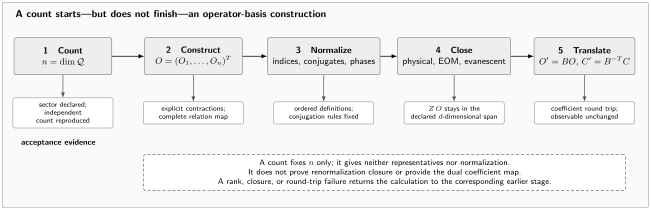
An operator-basis result is a five-stage package. Counting fixes ; construction supplies explicit contractions and relations; normalization fixes ordering, conjugation, and phases; closure enlarges the -dimensional renormalization space when EOM or evanescent operators are required; and translation applies with the dual coefficient map . The lower row states the required checks at each stage. A count alone is neither an explicit basis nor proof of RG closure. The diagram is schematic and not to scale.
For each bounded field multiset, retain a record like this before proceeding:
| Filter | Required input | Output |
|---|---|---|
| Canonical and EFT order | Field dimensions, derivative count, spurion weights | Allowed graded multisets |
| Lorentz | labels and statistics | Independent scalar contractions |
| Gauge | Representations, index orientation, invariant tensors | Gauge-singlet multiplicity and contractions |
| Exact global symmetry | Non-Abelian representations and Abelian charges | Allowed exact-symmetry sectors |
| Discrete symmetry | charges and unitary action | Congruence-allowed sectors |
| Controlled breaking | Spurion representations, insertion order, and background | Formally covariant symmetry-breaking structures |
Only after this list is explicit should flavor permutations, Hermitian pairing, CP, IBP, EOM, and dimension-specific identities reduce or reorganize it.
First application: the dimension-five lepton operator
Section titled “First application: the dimension-five lepton operator”Use two left-handed lepton doublets and two Higgs doublets . Here are weak indices, is a left-handed spinor index, and is left open as a flavor label. Their relevant data are
| Field | Lorentz | Hypercharge | Lepton number | Dimension | |
|---|---|---|---|---|---|
The field content has dimension five and total hypercharge zero. Contract each weak doublet pair with and the two left-handed spinors with :
This is a Lorentz and gauge singlet. Alternative pairings of the four weak doublets reduce to the same structure after the epsilon identity and field statistics, so the singlet multiplicity is one for fixed ordered flavor labels. The operator carries lepton number . An exact continuous forbids it, whereas lepton parity permits it because .
Introduce a coefficient spurion with lepton number . Then the oriented interaction
is formally invariant. Freezing records lepton-number violation by two units; it does not make exact. The symmetry of the flavor tensor, its conjugate completion, and the number of independent real parameters are deliberately left to Flavor, Hermiticity, and CP Bookkeeping.
This is the unique dimension-five Standard Model field-content class first identified in Weinberg 1979, pp. 1566–1570. The calculation above supplies the representation and charge analysis rather than using that classification as a substitute for it.
Common pitfalls
Section titled “Common pitfalls”Adding charges but ignoring tensor multiplicity. Charge neutrality is sufficient only for Abelian one-dimensional representations. Non-Abelian products can contain zero, one, or several singlets.
Counting before imposing field statistics. A formal invariant tensor can vanish or become related to another after identical bosons are symmetrized or identical fermions antisymmetrized.
Calling a frozen spurion an exact symmetry. The background value breaks the formal group to its stabilizer. State the insertion order and the actual residual symmetry.
Using a Wilson coefficient to hide gauge noninvariance. Ordinary coefficients are gauge singlets. Any object carrying gauge indices needs a genuine gauge-covariant origin.
Stopping at the Hilbert-series coefficient. A multiplicity is a cross-check on dimension. Construct the index contractions and later prove redundancy reduction and RG closure.
Exercises
Section titled “Exercises”For which nontrivial lepton-number subgroups is an operator with invariant?
Solution
The condition is , so must divide . The only nontrivial cyclic choice is . In particular, a lepton-number symmetry forbids the operator unless a spurion supplies charge modulo .
Show that the Haar projection selects charge-neutral monomials.
Solution
A charge- monomial has character . Therefore
Applying the integral to a generating function deletes every nonzero-charge term and retains precisely the invariant sector.
References
Section titled “References”- D’Ambrosio, G., G. F. Giudice, G. Isidori, and A. Strumia. “Minimal Flavour Violation: An Effective Field Theory Approach.” Nuclear Physics B 645, no. 1–2 (2002): 155–187. DOI; Open PDF
- Henning, Brian, Xiaochuan Lu, Tom Melia, and Hitoshi Murayama. “Hilbert Series and Operator Bases with Derivatives in Effective Field Theories.” Communications in Mathematical Physics 347, no. 2 (2016): 363–388. DOI; Open PDF
- Lehman, Landon, and Adam Martin. “Hilbert Series for Constructing Lagrangians: Expanding the Phenomenologist’s Toolbox.” Physical Review D 91, no. 10 (2015): 105014. DOI; Open PDF
- Weinberg, Steven. “Baryon- and Lepton-Nonconserving Processes.” Physical Review Letters 43, no. 21 (1979): 1566–1570. DOI