

Technical Naturalness and Symmetry Protection
A small parameter is technically natural when setting its symmetry-breaking spurions to zero restores an exact quantum symmetry. Ward identities then force counterterms, RG evolution, and threshold corrections to carry the same breaking spurions. The zero-spurion surface is invariant under renormalization, so choosing a small breaking once does not require a new unrelated cancellation at every order.
This criterion is a statement about radiative stability, not a prediction of the parameter’s value or a probability for it. The decisive work is to identify the enhanced symmetry, assign spurion transformations, and check the quantum measure, every coupling, heavy threshold, and mixing channel relevant to the claimed order.
Required background. Scale Sensitivity and Radiative Stability supplies the additive-versus-multiplicative threshold diagnostic.
Helpful background. What Is an Anomaly? explains how a classical symmetry can fail in the quantum theory. Explicit Breaking and Pseudo-Goldstone Modes develops the symmetry realization whose EFT consequence is used below.
The zero-spurion surface must be quantum invariant
Section titled “The zero-spurion surface must be quantum invariant”Write a theory as
where is invariant under a group , while the operators break it. Promote each to a nondynamical spurion with a transformation law that makes the full expression formally invariant. If the regulator, measure, and renormalization prescription respect the nonanomalous symmetry, the quantum effective action obeys the same spurion selection rules.
Suppose a renormalized parameter is the only spurion with the charge needed to multiply an operator . Local counterterms then have the structure
and its RG equation is
Thus is an invariant surface. A small value can run, sometimes substantially, but it cannot be generated from symmetry-preserving couplings alone. This is the operational content of the enhanced-symmetry criterion associated with ‘t Hooft 1980, pp. 135–157.
For several spurions, “multiplicative” should not be read too literally. Operators with the same quantum numbers can mix:
The protected statement is that the complete vector is invariant. An individual component need not remain zero if another spurion with the same charges is nonzero.
Chiral symmetry protects a fermion mass
Section titled “Chiral symmetry protects a fermion mass”Consider Dirac fermions in a vectorlike gauge theory,
At , the non-singlet flavor symmetry enlarges to
Treating the mass matrix as a spurion,
makes the mass term formally invariant. A chirality-flipping counterterm must transform in the same way, so in a mass-independent scheme its leading form is
There is no term proportional to times the identity: it would break without a spurion. Equivalently, at leading order, and remains zero under perturbative running. This protects small fermion masses even though their numerical values are not determined.
The conclusion survives a heavy threshold only if its interactions preserve the same chiral symmetry. If a heavy scalar couples through , then is another chiral-breaking spurion. A matched light mass may contain terms such as times heavy-sector expectation values or other spurions; it need not be proportional to the original . The symmetry test therefore inventories all breaking sources, not just the parameter whose smallness prompted the question.
Shift symmetry protects a pseudo-Goldstone mass
Section titled “Shift symmetry protects a pseudo-Goldstone mass”Let be a Goldstone coordinate with exact shift symmetry
The exact-symmetry EFT contains derivatives of but no potential. Introduce one dimensionless breaking spurion through
Expanding about a minimum gives
Every nonderivative term must contain enough breaking spurions to be invariant. Loops may renormalize the coefficient, generate higher harmonics, or mix several breakings, but the potential vanishes when all explicit-breaking spurions vanish. In chiral perturbation theory the quark-mass matrix plays precisely this role; the systematic use of external sources and symmetry-breaking insertions is developed by Gasser and Leutwyler 1984, §§ 2–6, pp. 145–173.
The analogy with the fermion mass is structural. A chiral mass flips left and right representations; a pseudo-Goldstone potential violates a shift symmetry. In both cases the quantum effective action must carry the corresponding breaking source. The detailed power counting and infrared logarithms differ.
Ordinary scalar masses expose the contrast
Section titled “Ordinary scalar masses expose the contrast”For a real scalar with , the term respects the same discrete symmetry whether vanishes or not. Setting therefore does not, by itself, supply an internal symmetry that forbids the heavy-scalar threshold calculated on the previous page:
Classical scale invariance of the massless Lagrangian is insufficient when quantum running or a physical heavy mass breaks it. A scalar mass can be protected in a larger structure—an exact shift symmetry for a Goldstone mode or exact supersymmetry are familiar possibilities—but the relevant quantum symmetry and its breaking parameters must be stated. A cancellation among diagrams with no enforcing identity is not protection.
Apply the symmetry test before interpreting smallness
Section titled “Apply the symmetry test before interpreting smallness”The diagram shows where the technical-naturalness test sits in a broader hierarchy argument. Inspect the solid “quantum symmetry” box: it can license a selection rule only after the path-integral measure, thresholds, and operator basis have been checked. Coordinates, priors, and explanatory judgments remain separate inputs.
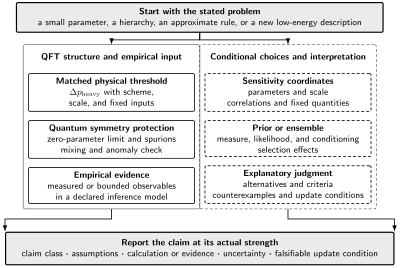
Physical thresholds, quantum symmetry protection, and measured observables supply different evidence from sensitivity coordinates, priors, and explanatory judgments. Technical naturalness occupies the symmetry branch: it licenses spurion selection rules only within the stated quantum theory. The diagram is schematic and not to scale.
A practical test has five parts:
- Zero limit: set every claimed breaking spurion to zero and display the enlarged transformation group.
- Quantum check: verify that the measure and regulator preserve the needed symmetry, or include its anomaly explicitly.
- Counterterm check: classify local operators and show that the target coefficient can arise only with the required spurion charges.
- Threshold check: assign transformations to all heavy-sector masses, couplings, and expectation values before matching.
- Mixing check: evolve the full vector of operators with the same exact quantum numbers and retain the first omitted order.
Passing these tests establishes radiative stability. It does not establish that the spurion should be small, that its observed value is likely, or that one UV completion is preferred.
That separation between symmetry protection and broader typicality or explanatory claims is also emphasized in Giudice 2008, §§ 1–2, pp. 1–7, Open PDF and Craig 2022, §§ 2 and 5, pp. 5–7 and 18–21, Open PDF.
Anomalies and regulator effects can remove protection
Section titled “Anomalies and regulator effects can remove protection”A classical transformation may fail because the functional measure is not invariant. The Ward identity then contains an anomalous term even when the classical breaking spurion vanishes. Fujikawa’s measure calculation makes this mechanism explicit Fujikawa 1979, pp. 1195–1198.
For vectorlike gauge theories, the singlet axial is anomalous, whereas the non-singlet chiral symmetry used above can remain exact in the massless theory. In a one-flavor theory, or when nonperturbative sectors and other mass spurions are relevant, one must not invoke the anomalous singlet symmetry as an all-orders protection theorem. The correct conclusion may be perturbative multiplicativity only, with separately estimated nonperturbative breaking.
A regulator can also obscure a genuine symmetry. Wilson fermions on a lattice, for example, break chiral symmetry at nonzero lattice spacing and permit an additive bare-mass renormalization. Recovering the chiral continuum theory requires the corresponding tuning or a formulation with an exact lattice chiral relation. This is regulator bookkeeping only if the continuum Ward identities and matched observables recover the symmetry; it is not permission to ignore a physical anomalous or heavy-sector breaking.
Claim-classification table
Section titled “Claim-classification table”The technical-stability row is deliberately narrower than the other rows. It records a quantum selection rule and its hypotheses; it neither supplies a parameter-space measure nor converts a symmetry into empirical evidence.
| Claim class | Evidence or mathematical object | Conditional choices that must be declared | Supported conclusion | Does not establish |
|---|---|---|---|---|
| Calculated threshold | Renormalized parent-to-EFT matching relation | Scheme, matching scale, matched observable, fixed inputs, and perturbative order | Size and operator structure of a heavy-scale contribution in that relation | Probability, inconsistency, or a preferred UV theory |
| Technical stability | Enhanced quantum symmetry, Ward identities, and spurion selection rules | Field content, symmetry limit, anomaly status, thresholds, basis, and retained order | Which corrections vanish or carry declared symmetry-breaking factors | Numerical value, typicality, or empirical success |
| Sensitivity diagnostic | Cancellation ratio or derivative such as | Parameter coordinates, correlations, scale, observable, and quantities held fixed | Local response or cancellation in the declared chart | Coordinate-free observable, probability, or universal model ranking |
| Probabilistic typicality | Normalized measure, prior, likelihood, and posterior | Sample space, measure, conditioning data, selection effects, and parameterization | Probability within the declared ensemble and inference model | Ensemble-independent fact or theorem of QFT |
| Empirical fact | Measurement, exclusion, or reproducible bound | Dataset, likelihood, model assumptions, date, and validity domain | What observations favor or exclude within those assumptions | A unique explanatory principle or prior |
| Explanatory heuristic | Comparative argument about autonomy, simplicity, mechanism, or research priority | Alternatives, virtues, counterexamples, historical scope, and update conditions | A transparent conditional preference or strategy | Calculation, symmetry theorem, probability, or empirical result |
Common pitfalls
Section titled “Common pitfalls”Testing only the classical Lagrangian. A symmetry that is anomalous in the measure cannot support the advertised all-orders Ward identity. State whether the result is exact, perturbative, or limited to a nonanomalous subgroup.
Setting one breaking parameter to zero while leaving another on. Operator mixing and threshold matching can transfer breaking between spurions with compatible charges. Inventory the complete symmetry-breaking sector.
Mistaking a cancellation for a selection rule. Cancellation at one loop is stable only when a Ward identity or other exact structure enforces it at the next order and across thresholds. Repeat the test in the counterterm basis.
Treating spontaneous breaking as explicit breaking. A spontaneously broken exact symmetry still constrains the effective action and produces Goldstone modes. A pseudo-Goldstone mass requires an explicit breaking spurion.
Inferring a numerical value from protection. Technical naturalness explains why a chosen small value remains small. It does not determine how small the UV boundary condition should be.
References
Section titled “References”-
Craig, Nathaniel. 2022. “Naturalness: A Snowmass White Paper.” arXiv:2205.05708 [hep-ph]. arXiv. Open PDF.
-
Fujikawa, Kazuo. 1979. “Path-Integral Measure for Gauge-Invariant Fermion Theories.” Physical Review Letters 42: 1195–1198. DOI.
-
Gasser, Jürg, and Heinrich Leutwyler. 1984. “Chiral Perturbation Theory to One Loop.” Annals of Physics 158: 142–210. DOI.
-
Giudice, Gian Francesco. 2008. “Naturally Speaking: The Naturalness Criterion and Physics at the LHC.” In Perspectives on LHC Physics, edited by G. Kane and A. Pierce, 155–178. World Scientific. DOI. Open PDF.
-
‘t Hooft, Gerard. 1980. “Naturalness, Chiral Symmetry, and Spontaneous Chiral Symmetry Breaking.” In Recent Developments in Gauge Theories, edited by Gerard ‘t Hooft et al., 135–157. NATO Advanced Study Institutes Series B, vol. 59. Boston: Springer. DOI.