

Competing Orders and Electronic Nematicity
Magnetic, charge, superconducting, and nematic orders can compete, coexist, or generate one another because they involve the same low-energy fermions. The central task is to separate three questions: which symmetry is broken, whether thermodynamic order forms, and what microscopic field drives it. A stable coupled-order theory answers the first two only within its declared regime; similar onset temperatures or anticorrelated intensities do not, by themselves, answer the third.
Required background. Use Pomeranchuk and density-wave distinctions and Hubbard symmetries. Helpful background. Functional RG compares weak-coupling channels.
Order parameters and the symmetries they break
Section titled “Order parameters and the symmetries they break”An order parameter is defined by its transformation law, not by the probe that happens to detect it.
Stripe magnetism. The fields at and at break spin rotation and translation when their expectation values are nonzero; a single stripe also selects a lattice axis. Establishing it requires the magnetic structure factor, correlation length, ordered moment, domain population, and thermodynamic scaling.
Charge order. The complex amplitudes and at the same two wavevectors break translation and may also select an axis. A charge-order claim must state the wavevector and form factor and control the correlation length and probe matrix elements.
Superconductivity. A complex field describes phase coherence in a neutral effective theory. In a charged system the gauge redundancy itself is not an ordinary spontaneously broken symmetry; gauge-invariant evidence comes from phase stiffness, Meissner response, and long-range or quasi-long-range pair correlations in the appropriate dimensional and temperature limit.
Primary nematicity. A uniform fermion bilinear breaks a point-group rotation, commonly , while preserving translation. Evidence requires a zero-strain response, spontaneous-domain and finite-size tests, and an explicit crystal-axis convention.
Vestigial nematicity. A composite such as or can break the same point-group symmetry while the finite-wavevector parent fields remain disordered. Establishing this mechanism requires both composite scaling and the predicted short-range parent correlations, not merely the shared broken symmetry.
A uniform nematic variable transforms in a nontrivial one-dimensional representation of the point group. With axes along square-lattice bonds, is conventionally called and is ; rotating the axes by forty-five degrees interchanges those names. A quarter turn exchanges the two nematic domains and reverses the sign of either basis function. Naming the crystallographic axes and unit cell is therefore part of the definition.
Use an extensive operator and its intensive density distinctly:
Convenient square-lattice basis functions are
The continuum Pomeranchuk bilinear and its collective dynamics are developed by Oganesyan, Kivelson, and Fradkin 2001, Eq. (1), pp. 195109-1–2. Electronic liquid-crystal taxonomy is due to Kivelson, Fradkin, and Emery 1998, pp. 550–553. A primary field and a vestigial composite may transform identically, so a term is symmetry allowed and the observed order is generally a mixture Fernandes et al. 2012, Eqs. (74)–(76), p. 024534-24. Symmetry alone cannot reveal which microscopic field is primary.
The figure separates the microscopic objects that produce the same broken lattice symmetry: inspect whether the parent field carries zero momentum or whether finite momenta cancel only in a composite.
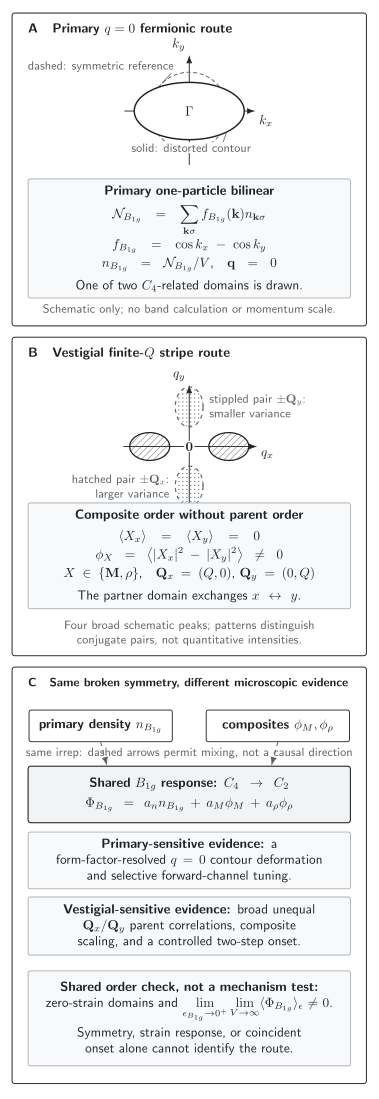
Primary and vestigial routes to the same bond-axis nematic symmetry. A fermion bilinear directly distorts a -symmetric Fermi contour, whereas unequal short-range stripe fluctuations generate the uniform composite even when neither stripe amplitude orders. A ninety-degree rotation reverses either nematic domain, and symmetry permits the two fields to mix. The schematic is not to scale and does not identify the microscopic cause; distinguishing the routes requires comparing the form-factor response with finite- parent correlations in the zero-strain thermodynamic limit.
The machine-readable figure record preserves the equations, arrow meanings, diagnostics, assumptions, and nonclaims without relying on vision.
Stripe magnetism, nematicity, and superconductivity
Section titled “Stripe magnetism, nematicity, and superconductivity”Magnetic and vestigial sectors
Section titled “Magnetic and vestigial sectors”The subscripts in and label the ordering wavevectors, not spin components. A bond-axis quarter turn exchanges and , so
where . The source must transform like ; consequently is explicit symmetry breaking. Take all order-parameter amplitudes below to be intensive and write the uniform free-energy density as
The real spin vectors displayed here are appropriate when each ordering wavevector is self-conjugate modulo a reciprocal lattice vector, . For complex amplitudes define and , but then the displayed functional is only a restricted amplitude sector. Invariants such as , inter-wavevector contractions, and commensurate Umklapp terms may also occur and can distinguish collinear, helical, and different double- states.
Because , the magnetic quartic
is nonnegative for all magnetic configurations exactly when and . It is strictly stabilizing in every nonzero direction when both inequalities are strict. On either equality boundary the quartic truncation has a flat direction, and a negative quadratic coefficient requires sixth-order or other stabilizing terms.
At fixed , favors a single- stripe with either or , whereas favors an equal-amplitude double- state with . An additional invariant such as is needed to decide whether two real double- spin vectors are collinear or orthogonal. The composite is invariant under spin rotation, translation, and time reversal but changes sign under the quarter turn, so fluctuations can produce
This is a vestigial Ising-nematic phase. In a strictly two-dimensional short-range system with exact continuous spin-rotation symmetry, magnetic long-range order is forbidden at nonzero temperature, while the discrete Ising nematic symmetry may still break Mermin and Wagner 1966, pp. 1133–1136. Weak interlayer coupling or spin anisotropy can restore a finite-temperature magnetic transition. An intermediate nematic regime is therefore symmetry allowed, not guaranteed. In a specific itinerant model, the preemptive regimes depend on dimension, elastic coupling, and generated coefficients Fernandes et al. 2012, Eq. (14), p. 024534-6, and Fig. 1 with §§ III.A–C, pp. 024534-8–20.
Competition with superconductivity
Section titled “Competition with superconductivity”The pure superconducting sector requires . The sign of gives the local mean-field tendency: penalizes simultaneous magnetic amplitude and pairing, whereas favors them together. This coefficient does not replace the gauge-invariant superconducting evidence described above.
In the single- sector set
Then
Define . Solving both stationarity equations gives
A locally stable homogeneous mixed point requires , , , and ; the determinant condition alone does not place the solution in the physical quadrant. For , global boundedness on also requires . Positive leaves the quartic bounded on the physical quadrant but makes the mixed point unstable, producing competing pure phases or a first-order boundary at this order. This criterion is the page’s normalization of the standard two-order Ginzburg–Landau test Fernandes and Schmalian 2010, Eqs. (2)–(4), pp. 014521-3–4. Gradients, gauge fields, fluctuations, disorder, and higher-order terms can change this local uniform classification.
Charge-order couplings
Section titled “Charge-order couplings”Charge order enters by the same symmetry logic. Its composite
can mix linearly with and when all three belong to the same point-group representation. Terms such as describe local competition or cooperation. For a wavevector with modulo a reciprocal lattice vector, momentum conservation can also permit
and thereby relate a spin modulation to a charge harmonic Nie et al. 2017, Eqs. (2.1)–(2.3), (2.10), and (4.1)–(4.2), pp. 085142-2–5. When , the same contraction instead couples to a uniform scalar. Every allowed term must be derived from wavevectors and representations; shared symmetry or coincident onsets do not determine which field is primary.
Quantum susceptibility is an imaginary-time integral
Section titled “Quantum susceptibility is an imaginary-time integral”Susceptibility is useful because a soft eigenvector reveals which normalized combination of coupled fields responds most strongly. It is not, by itself, a mechanism label.
Static thermodynamic response
Section titled “Static thermodynamic response”Let
where each source-independent is extensive, is its conjugate intensive field, and . The isothermal equilibrium susceptibility is the zero-Matsubara-frequency Kubo correlation
Equilibrium cyclicity gives the two integral orderings and makes the symmetry of the free-energy Hessian explicit. If itself depends on , its explicit derivative supplies an additional contact term. The companion page on sources and Kubo formulae develops the general response framework; the exact isothermal identity is Kubo 1957, Eq. (3.16), p. 576.
Whenever the source operator is imaginary-time independent—for example, when it commutes with —the integral reduces to
The same reduction holds in a classical commuting description; accidental special cases may also agree. For a generic quantum order parameter, however, replacing the imaginary-time integral by times an equal-time covariance can give the wrong magnitude and temperature dependence.
Matsubara and retarded response
Section titled “Matsubara and retarded response”Equilibrium simulations commonly evaluate discrete imaginary-frequency response, whereas an experiment measures causal real-time response. The Matsubara object is
For the perturbation , define
so and analytic continuation of gives with this sign convention. If zero-frequency modes equilibrate, the relevant ergodicity conditions hold, and the static continuation is regular, the thermodynamic response follows the static path
Without equilibration, Kubo’s isolated or adiabatic static response can differ from the isothermal susceptibility even after an apparently regular limit Kubo 1957, Eqs. (3.15)–(3.26), pp. 576–577. Taking the homogeneous limit first can also change the answer for conserved quantities, transport coefficients, or slow collective modes. A zero-Matsubara susceptibility and a low-frequency measurement are therefore not interchangeable without the limit path and relaxation assumptions.
Mixed susceptibility channels
Section titled “Mixed susceptibility channels”For several orders, is a real symmetric matrix. In the unbroken phase, off-diagonal mixing is restricted to operators in the same symmetry block. Its entries depend on the normalization of both operators and sources, so raw matrices from different bases are not directly comparable. A size-diverging eigenvalue—equivalently a vanishing eigenvalue of after fixing normalization—supports an instability in the associated mixed channel; it does not identify whether that channel is primary, composite, electronic, or lattice assisted. At finite frequency, the retarded matrix is generally complex, and its poles or dynamical eigenmodes replace this static thermodynamic criterion.
Correlated estimates must retain the full covariance. Resample the underlying joint measurements, reconstruct the entire matrix in each bootstrap or jackknife replicate, and diagonalize each replicate; fitting entries and eigenvalues independently loses the correlations that determine the soft direction.
Strain, probes, and thermodynamic limits
Section titled “Strain, probes, and thermodynamic limits”Fixed strain
Section titled “Fixed strain”Nematic order couples linearly to strain in the same point-group representation. With the tensor-strain convention
the engineering shear is ; changing convention rescales the associated modulus and coupling. For a generic intensive electronic nematic variable , the uniform, static, harmonic free-energy density is
Under imposed strain, is a conjugate field: it selects a domain and rounds an Ising singularity. If the electronic sector equilibrates at each strain, its clamped-lattice susceptibility softens the measured uniform modulus to
An elastoresistive slope is not automatically this thermodynamic susceptibility. For the symmetry-matched transport anisotropy ,
The first factor is a possibly parameter-dependent transport vertex; the second term is a regular direct piezoresistive background. The identification is therefore restricted to the linear near-zero-strain regime after controlling built-in strain and backgrounds Chu et al. 2012, Eqs. (1)–(4), pp. 710–712; Shapiro et al. 2015, Table II and Eqs. (17a)–(17b), pp. 235147-6–7.
Fixed stress
Section titled “Fixed stress”At fixed zero stress, minimizing over the relaxed strain gives
and hence
The lattice thus shifts the transition and mixes electronic and structural response; imposed strain and fixed stress are different ensembles Fernandes et al. 2010, Eqs. (1), (2), and (5), pp. 157003-1–3; Chu et al. 2012, Eqs. (1)–(3), pp. 710–711. These scalar relations apply to uniform static response. At finite momentum, elastic compatibility produces a nonlocal anisotropic kernel. Long-range elasticity can then change the asymptotic critical theory Paul and Garst 2017, Eq. (2) and Figs. 2 and 4, pp. 227601-1–4.
Spontaneous order on finite systems
Section titled “Spontaneous order on finite systems”The normalized spontaneous nematic density is
At exactly zero source, a finite symmetric system instead has even in an ordered regime. Its even moments retain the information. For a scalar Ising nematic define
True long-range order gives along a controlled sequence. Binder crossings and susceptibility peaks are finite-size estimators, not thermodynamic conclusions: fix the aspect ratio, boundary conditions, temperature or ground-state scaling, operator normalization, and leading corrections Binder 1981, pp. 119–140. The sibling sign-free QMC page derives a covariance-aware crossing workflow that applies to any appropriately defined dimensionless ratio.
A uniform source and quenched random strain are different problems. For random strain, state its distribution and correlation length, average disorder explicitly, and declare the order of disorder averaging, , and . A uniform-field extrapolation cannot recover a clean spontaneous intercept from an uncontrolled random-field domain pattern. Residual uniform strain, domain pinning, and unequal detector response can likewise imitate a nonzero intercept.
Testing mechanisms and causal limits
Section titled “Testing mechanisms and causal limits”The chapter comparison keeps a converged response separate from a mechanism attribution and lists the shared covariance and competing-explanation checks.
- Define each field. Give its wavevector, form factor, spin or orbital content, extensive or intensive normalization, and broken symmetry.
- Establish the response. Use the full Kubo susceptibility or an equivalent derivative, with volume, temperature, boundaries, limit order, contacts, and covariance controlled. Reconstruct and diagonalize a susceptibility matrix inside each joint resample.
- Establish order. Demonstrate correction-aware thermodynamic scaling, stiffness, or a long-range correlator. A broad maximum or one finite-size crossing is not an ordered phase.
- Separate explicit, random, and spontaneous symmetry breaking. Extrapolate uniform strain or stress and domain imbalance in the correct order; treat quenched random strain with its own disorder average and limits.
- Test coexistence microscopically. Follow region-resolved joint distributions or spatial cross-correlations and their finite-size scaling. An interior peak of a distribution built only from global amplitudes is not sufficient, because a phase-separated configuration can make both global intensities nonzero. Homogeneous coexistence requires thermodynamic weight for both orders in the same microscopic region or pure phase and an explicit exclusion of segregation; axis peaks or separated domains do not pass this test.
- Bound causality. Compare primary and vestigial models, tune a selective control where possible, and predict a discriminating observable. Coincident onsets and spectral anticorrelation establish neither direction of cause.
Intertwined order is a useful organizing description even when no unique hierarchy survives these tests.
Common pitfalls
Section titled “Common pitfalls”Using equal-time covariance as a quantum susceptibility. The static response is an imaginary-time integral in general. Check the operator dynamics before multiplying an equal-time fluctuation by .
Calling strain a neutral probe. Symmetry-matched strain is a conjugate field and changes the electronic Hamiltonian. State the mechanical ensemble, transport vertex, background, and zero-strain extrapolation.
Inferring mechanism from shared symmetry. Primary Pomeranchuk and vestigial magnetic or charge composites can all produce the same nematic representation and may mix. Require both the response and finite- parent-correlation tests.
Averaging domains into coexistence. Simultaneous bulk signals may come from mutually exclusive regions or Monte Carlo sectors. Use joint distributions, local probes, or spatial correlations before claiming homogeneous coexistence.
Promoting one finite-size feature to a phase boundary. A crossing or peak drifts with irrelevant corrections and geometry. Fit a controlled size sequence and propagate covariance.
Exercises
Section titled “Exercises”Explain how can coexist with .
Solution
is invariant under spin rotations but odd under the lattice operation exchanging and . Fluctuations can choose unequal variances,
without choosing a spin direction. Point-group symmetry is then broken while spin rotation and translation remain unbroken: this is vestigial nematic order.
Derive the local stability criterion for a homogeneous single- magnetic and superconducting coexistence state.
Solution
For and , the Hessian of is
It is positive definite when its first diagonal entry and determinant are positive. Thus and . Solving the stationarity equations gives
Both values must be positive. For negative , global boundedness additionally requires ; a positive competitive can leave the physical quadrant bounded even when the mixed stationary point is unstable.
Use with and a perturbation to show why equal-time covariance is not generally the quantum susceptibility.
Solution
The positive eigenenergy is , so the perturbed level splitting is . Thermal alignment with the Hamiltonian gives
Therefore
whereas because . They agree only in the high-temperature limit . If instead the source operator commutes with , its imaginary-time correlator is constant and the Kubo integral reduces to times the equal-time covariance.
Compare the nematic response at fixed zero stress with the elastic response at imposed strain.
Solution
Write the electronic free-energy density to quadratic order as . At fixed zero stress, stationarity gives . Substitution yields
At imposed strain, minimizing over instead gives and
The first result is a relaxed-lattice nematic susceptibility; the second gives the electronically softened uniform elastic modulus. They answer different mechanical boundary conditions.
A strained finite sample shows a growing transport anisotropy, broad magnetic peaks near that are stronger than those near , no magnetic Bragg peak, and an increasing nematic susceptibility on cooling. What is established, what remains unproved, and which tests distinguish a primary from a vestigial mechanism?
Solution
The observations establish a strain-induced nematic response and anisotropic short-range stripe correlations. The absence of a Bragg peak is consistent with disordered magnetic parents, so the data are compatible with vestigial nematicity. They do not yet establish spontaneous order, exclude a primary field, or prove that the stripe fluctuations cause the anisotropy: strain already supplies a conjugate field, and the transport slope contains a vertex and a regular background.
First extrapolate the uniform strain to zero and control random strain and domains. Then test , , and the full Kubo susceptibility along a correction-aware size sequence, preserving covariance. Compare the scaling and selective tuning of the form-factor response with the finite- parent correlations. A vestigial account becomes stronger only if one common model and parameter set explains both sectors and survives these zero-strain thermodynamic tests.
References
Section titled “References”- Kurt Binder, “Finite Size Scaling Analysis of Ising Model Block Distribution Functions,” Zeitschrift für Physik B Condensed Matter 43 (1981) 119–140, doi:10.1007/BF01293604.
- Jiun-Haw Chu, Hsueh-Hui Kuo, James G. Analytis, and Ian R. Fisher, “Divergent Nematic Susceptibility in an Iron Arsenide Superconductor,” Science 337 (2012) 710–712, doi:10.1126/science.1221713.
- Rafael M. Fernandes, Andrey V. Chubukov, Johannes Knolle, Ilya Eremin, and Jörg Schmalian, “Preemptive Nematic Order, Pseudogap, and Orbital Order in the Iron Pnictides,” Physical Review B 85 (2012) 024534, doi:10.1103/PhysRevB.85.024534; erratum, Physical Review B 85 (2012) 109901, doi:10.1103/PhysRevB.85.109901.
- Rafael M. Fernandes and Jörg Schmalian, “Competing Order and Nature of the Pairing State in the Iron Pnictides,” Physical Review B 82 (2010) 014521, doi:10.1103/PhysRevB.82.014521.
- Rafael M. Fernandes, L. H. VanBebber, S. Bhattacharya, P. Chandra, V. Keppens, D. Mandrus, M. A. McGuire, B. C. Sales, A. S. Sefat, and J. Schmalian, “Effects of Nematic Fluctuations on the Elastic Properties of Iron Arsenide Superconductors,” Physical Review Letters 105 (2010) 157003, doi:10.1103/PhysRevLett.105.157003.
- Steven A. Kivelson, Eduardo Fradkin, and Victor J. Emery, “Electronic Liquid-Crystal Phases of a Doped Mott Insulator,” Nature 393 (1998) 550–553, doi:10.1038/31177.
- Ryogo Kubo, “Statistical-Mechanical Theory of Irreversible Processes. I. General Theory and Simple Applications to Magnetic and Conduction Problems,” Journal of the Physical Society of Japan 12 (1957) 570–586, doi:10.1143/JPSJ.12.570.
- N. David Mermin and Herbert Wagner, “Absence of Ferromagnetism or Antiferromagnetism in One- or Two-Dimensional Isotropic Heisenberg Models,” Physical Review Letters 17 (1966) 1133–1136, doi:10.1103/PhysRevLett.17.1133.
- Laimei Nie, Akash V. Maharaj, Eduardo Fradkin, and Steven A. Kivelson, “Vestigial Nematicity from Spin and/or Charge Order in the Cuprates,” Physical Review B 96 (2017) 085142, doi:10.1103/PhysRevB.96.085142.
- Vadim Oganesyan, Steven A. Kivelson, and Eduardo Fradkin, “Quantum Theory of a Nematic Fermi Fluid,” Physical Review B 64 (2001) 195109, doi:10.1103/PhysRevB.64.195109.
- Ipsita Paul and Markus Garst, “Lattice Effects on Nematic Quantum Criticality in Metals,” Physical Review Letters 118 (2017) 227601, doi:10.1103/PhysRevLett.118.227601.
- Maxwell C. Shapiro, Patrik Hlobil, A. T. Hristov, Akash V. Maharaj, and Ian R. Fisher, “Symmetry Constraints on the Elastoresistivity Tensor,” Physical Review B 92 (2015) 235147, doi:10.1103/PhysRevB.92.235147.
Further reading
Section titled “Further reading”- Eduardo Fradkin, Steven A. Kivelson, and John M. Tranquada, “Colloquium: Theory of Intertwined Orders in High Temperature Superconductors,” Reviews of Modern Physics 87 (2015) 457–482, doi:10.1103/RevModPhys.87.457, Open PDF.