

Cluster DMFT and Nonlocal-Correlation Validity
Cluster extensions of DMFT retain the full dynamics of several sites, allowing short-range spatial correlations and momentum differentiation while a self-consistent bath represents the rest of the lattice. Cellular DMFT (CDMFT) embeds an open real-space cluster; the dynamical cluster approximation (DCA) embeds a periodic cluster after coarse-graining momentum. Both define a thermodynamic-limit lattice approximation through a finite auxiliary cluster: controls correlation range or momentum resolution, not the physical system size. No finite is the exact lattice, so a nonlocal conclusion must survive cluster-size, cluster-shape, solver, and reconstruction tests.
Required background. Use the single-site DMFT mapping. Helpful background. Convergence and extrapolation supplies general certification principles.
For definiteness, the equations use the equilibrium one-band Hubbard model in dimension , with dispersion , onsite interaction , chemical potential , filling , inverse temperature , and a normal paramagnetic solution unless another symmetry sector is declared. Throughout, denotes on the Matsubara axis or for a retarded function. We use ; this fixes the Fourier signs below.
The common cluster impurity problem
Section titled “The common cluster impurity problem”Tile a lattice of sites by identical clusters containing sites at internal positions , where . A superlattice momentum lies in the reduced Brillouin zone. Both CDMFT and DCA replace the single-site Weiss field by an matrix and solve an auxiliary one-band cluster action,
The site-basis Green matrix is . The solver returns and
At a fixed point, the impurity cluster must equal the corresponding projection of the lattice:
It is often useful to expose the bath explicitly:
Here is the isolated intracluster hopping matrix in CDMFT. In DCA it is the real-space Fourier transform of the coarse-grained dispersion , equivalently a diagonal matrix in the cluster-momentum basis. The matrix contains the dynamical coupling to the environment.
An exact impurity solver would give the exact self-energy of this auxiliary cluster action. Identifying that matrix with a restricted lattice self-energy is the cluster approximation; practical calculations add solver, bath, and statistical errors.
A numerical loop also needs an operational stopping rule. Let be the self-energy used for the lattice projection and the unmixed self-energy returned by the solver. On a declared Matsubara window , useful dimensionless residuals are
and are small positive scales with the corresponding units. Report the basis, matrix norm, frequency window, floors, mixing rule, and observable drift. A small mixed-update norm can hide a poor fixed point; mixing belongs only in the next numerical input, not in the comparison with the returned solution. For CT-QMC, residuals must also be statistically consistent with the estimated covariance. Matrix inversion makes especially noise sensitive, so a deterministic tolerance below the sampling floor is meaningless.
CDMFT and DCA embeddings
Section titled “CDMFT and DCA embeddings”In CDMFT, is the hopping matrix between the internal sites after Fourier transforming only the cluster superlattice. The projected lattice Green function is
The prefactor averages over the reduced-zone momenta Kotliar et al. 2001, printed p. 186401-2, eq. (7). Because the auxiliary cluster has an edge, its internal sites are not translation equivalent; CDMFT can describe real-space textures but has boundary and shape errors Maier et al. 2005, § II.D.4, printed pp. 1041–1042. Translationally invariant lattice estimators require a separate reconstruction Maier et al. 2005, § II.C.3, printed p. 1039, eqs. (65)–(67).
DCA instead partitions the full Brillouin zone into equal cells. Write , where labels a patch center and runs inside that patch. DCA approximates by the patch value and uses
Define the patch-averaged cluster dispersion and Weiss field by
Combining the fixed-point Dyson equation with gives the explicit DCA bath update
DCA preserves translations on its periodic cluster but replaces exact lattice momentum conservation by cluster-momentum conservation. It therefore has no real-space edge, at the price of a patch resolution for a regular cluster of linear extent . Report the patch boundaries and point-group or momentum-shell quality, not just Hettler et al. 1998, printed pp. R7475–R7477, eqs. (1)–(3) and Hettler et al. 2000, § III and § IV.A, printed pp. 12741–12743, eqs. (1)–(4) and (7)–(9).
The figure makes the geometric distinction explicit. Inspect where translation symmetry is broken in CDMFT and where momentum resolution is discarded in DCA.
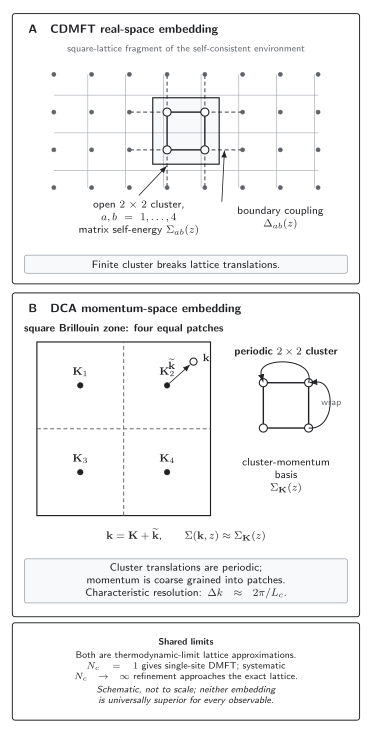
CDMFT and DCA retain different finite sets of nonlocal degrees of freedom while approximating an infinite lattice. The open real-space cluster resolves site and bond structure; the periodic DCA cluster resolves patch momenta with . The diagram is schematic and not to scale. Neither finite auxiliary cluster is the thermodynamic lattice.
The structured figure description records every object, relation, limit, and nonclaim without relying on the image.
| Question | CDMFT | DCA |
|---|---|---|
| Cluster representation | open real-space cluster | periodic cluster and momentum patches |
| Finite- symmetry | lattice translations are broken | cluster translations are preserved; momenta are coarse-grained |
| Natural direct output | site-matrix correlators | patch-momentum correlators |
| Resolution scale | retained real-space separations and boundary-to-bulk ratio | patch diameter, typically |
| Characteristic drift | edge, cluster-shape, estimator, and periodization dependence | patch-shape, momentum-shell, and coarse-graining dependence |
| Exact-limit checks | gives single-site DMFT; appropriate compact sequences with recover the lattice | the same limits, through a systematic refining patch sequence |
To match Maier et al.’s large-cluster analysis, let denote the cluster-to-medium hybridization kernel—the bath role carried by above—and use their frequency-inclusive trace
The trace runs over cluster labels and frequency; this is not the pointwise quantity . For fixed dimension, short-ranged hopping, and regular compact cluster sequences with , Maier et al. 2005, § II.D.5, printed p. 1042, eqs. (72)–(73) find
These are asymptotic properties of the standard constructions, not universal error bars for every observable and not a theorem that DCA is always better at the same . Observable convergence can be nonmonotonic and shape dependent, especially for exceptional small clusters.
Lattice reconstruction is a second approximation
Section titled “Lattice reconstruction is a second approximation”Periodization is the nonunique reconstruction of a translationally invariant lattice quantity from finite-cluster data. CDMFT directly returns matrices on an open cluster, not a unique lattice spectrum. With the Fourier convention stated above, define
Equivalently, with . The three common choices make , the cluster cumulant , or the -resolved lattice Green matrix translationally invariant. They agree in controlled limits but need not agree at finite .
Self-energy periodization sets
Cumulant periodization instead starts from
and reconstructs
A Green-function reconstruction Fourier transforms the -resolved lattice matrix
and then forms
where is the reduced-zone representative of the full momentum . This is not merely the Fourier transform of the impurity matrix . These constructions and their strong-coupling differences are developed in Sakai et al. 2012, § II, printed pp. 035102-2–035102-3, eqs. (4)–(11), and Appendix A, printed pp. 035102-9–035102-10; the cumulant construction also appears in Stanescu and Kotliar 2006, printed pp. 125110-2–125110-3, eqs. (5)–(7).
Near a Mott self-energy pole, interpolating can be ill conditioned while the cumulant may be smoother; elsewhere that advantage need not hold. The different reconstructions can therefore move a gap edge or a putative zero surface. Report direct cluster observables first. For CDMFT, state whether a local estimator uses a central site, a boundary site, all sites, or selected bonds, and keep that estimator fixed along the cluster sequence. Compare at least two justified reconstructions before making a momentum-resolved claim.
For retarded functions, the quadratic-form identity gives
That useful sign check does not make nonlinear self-energy, cumulant, and Green-function reconstructions equivalent. In the standard CDMFT and DCA loops described here, a periodized or interpolated lattice output is postprocessing and is not fed back into a different fixed-point equation Maier et al. 2005, § II.C.3, printed p. 1039.
Two-particle response is a separate reconstruction
Section titled “Two-particle response is a separate reconstruction”A one-particle spectrum does not supply a lattice susceptibility. A magnetic, charge, pairing, or nematic response requires measuring the connected cluster four-point function, extracting the irreducible vertex in a declared channel, and solving the corresponding lattice Bethe–Salpeter equation with the same CDMFT embedding or DCA coarse-graining. The frequency cutoff, cluster or patch indices, covariance, crossing relations, and applicable Ward identities must be checked independently.
Neither a periodized product of one-particle Green functions nor the auxiliary cluster susceptibility is automatically the lattice response. A one-particle momentum-selective suppression can motivate an ordering test, but it does not establish the broken symmetry or its thermodynamic transition.
A validity protocol for nonlocal claims
Section titled “A validity protocol for nonlocal claims”First converge the matrix fixed point and inspect imaginary-axis quantities. Define the Hermitian matrix imaginary part by
For a retarded calculation, require both a causal bath and a causal solver output:
The solver must produce the self-energy sign, and the self-consistency map must preserve the bath sign. Given a causal input self-energy, the standard CDMFT map preserves bath causality Kotliar et al. 2001, printed pp. 186401-3–186401-4, eqs. (12)–(15); DCA has the corresponding causal construction Hettler et al. 2000, § IV.D and Appendix C, printed pp. 12744–12745 and 12754–12755. These statements do not certify an arbitrary approximate solver.
Also require
together with normalization, analyticity, and high-frequency moments such as . Positivity alone is not a complete validation.
A defensible nonlocal claim follows a staged protocol:
- Declare the problem. Give , , , or , , boundary and cluster conventions, symmetry sector, solver, estimator, frequency grid, and target observable.
- Converge the fixed point. Report , , observable drift, tail moments, initialization, mixing, and every coexisting branch. A small residual is necessary, not sufficient.
- Separate solver error. For exact diagonalization, vary bath-site count, fit window and weights, and bath-fit tolerance. For CT-QMC, report average sign or phase, warmup, autocorrelation and binning, effective independent samples, and the full index-frequency covariance. Propagate resampled correlated data through matrix inversion, periodization, and continuation. The dedicated NRG and CT-QMC validity page develops these controls.
- Vary the cluster approximation. Change , , shape, boundary convention, and point-group or momentum-shell bias; compare CDMFT and DCA when both address the same observable. Hold the local or bond estimator fixed. Near long correlation lengths, show the behavior with and cluster commensurability.
- Separate reconstruction from continuation. Compare self-energy, cumulant, and Green-function periodizations on the imaginary axis first. Treat reconstruction spread as a systematic sensitivity bracket, not a Monte Carlo confidence interval. Only then vary continuation priors, grids, resolution, and synthetic-recovery tests.
- Test phase claims in two stages. Hold the symmetry sector fixed while measuring cluster drift, then repeat every relevant competing sector. Two converged fixed points establish coexistence or metastability, not the stable phase. A first-order boundary requires a thermodynamically consistent grand-potential comparison; quote spinodals separately.
A four-site plaquette can establish short-range differentiation within that approximation. It cannot establish a thermodynamic phase boundary without drift data. Cluster size alone is not a convergence coordinate: two clusters with the same can have different , symmetry, boundary weight, or commensurability. Long correlation lengths, stripes that fit one cluster but not another, and a sign change between reconstructions are characteristic stop conditions.
A worked momentum-selective test
Section titled “A worked momentum-selective test”A published two-dimensional benchmark makes the protocol concrete without turning its result into a universal phase claim. Sakai et al. studied the square-lattice dispersion
with , , , paramagnetic symmetry, fillings , , and , and CDMFT clusters of , including two distinct 12-site shapes Sakai et al. 2012, printed pp. 035102-1–035102-2 and Appendix B. Here the lowest fermionic Matsubara frequency is , which sets an important imaginary-axis energy-resolution scale. Their inability to push the largest cluster to lower temperature or larger hole doping because of the sign problem is part of the evidence boundary, not a footnote to discard.
Before analytic continuation, use the thermally broadened zero-energy proxy
At finite , is a normalized convolution of width , so only when is nearly constant across that window. If is continuous at , then as . It is not proof of a hard gap.
Sakai et al. plotted using cumulant periodization at for the main cluster sequence; their same-size shape comparison used the cumulant-periodized rather than a full reconstruction-by-shape grid Sakai et al. 2012, § III.C, printed pp. 035102-6–035102-8, eq. (14) and Fig. 8(a), and Appendix B, Fig. 9. A new calculation following this protocol should compare nodal and antinodal , direct cluster components, and any continued spectrum across the cluster sequence, both 12-site shapes, and at least self-energy and cumulant reconstructions. It should carry the CT-QMC covariance and sign limitations through the comparison. The article does not publish full covariance or average-sign data, so that part of the uncertainty analysis cannot be reconstructed from the paper alone.
The strongest conclusion is the one common to those tests: perhaps a stable low-energy momentum differentiation in the declared normal state, but not automatically a hard gap, a unique microscopic mechanism, or a thermodynamic pseudogap boundary. The successor pseudogap evidence page applies that distinction. The shared claim-validity table gives the corresponding stop conditions and limit on the conclusion.
Common pitfalls
Section titled “Common pitfalls”Treating the auxiliary cluster as a finite lattice. CDMFT and DCA approximate an infinite lattice at every . The relevant drift is with cluster correlation range, geometry, and resolution, not an ordinary physical-volume extrapolation.
Choosing the smoothest periodization. Smoothness is not correctness. Prefer direct cluster quantities, exact moments, causality, agreement among justified reconstructions, and stability along a controlled cluster sequence.
Calling one cluster size a sequence. Equal does not imply equal , symmetry, boundary weight, or commensurability. A single plaquette is one approximation point.
Equating numerical convergence with physical validity. Small fixed-point residuals do not control bath discretization, Monte Carlo sign and covariance, analytic continuation, competing symmetry sectors, or missing long-range correlations.
Exercises
Section titled “Exercises”Single-site limit. Show that reduces either cluster construction to single-site DMFT.
Solution
With one cluster site, every bold quantity is a scalar. The CDMFT reduced-zone average becomes . DCA has one patch containing the whole Brillouin zone and gives the same average. In both cases , exactly the single-site DMFT update.
DCA bath update. Starting from the DCA fixed-point equations, derive the displayed update for .
Solution
The cluster Dyson equation is . Substitute and solve for the hybridization:
Every term has units of energy. The update is patch dependent because , , and are all patch dependent.
Periodization near a Mott pole. Why can self-energy and cumulant periodization disagree most strongly near a Mott gap?
Solution
A Mott gap can be associated with a self-energy pole. Fourier reconstructing a rapidly varying or divergent is ill conditioned, whereas can remain smoother. That advantage is regime dependent, not a theorem. Their disagreement is observable reconstruction sensitivity that must be reported, not an uncertainty that can be hidden.
Local self-energy check. Let . Show that self-energy- and cumulant-style periodizations cannot create additional momentum dependence in the irreducible interaction correction.
Solution
The reconstruction gives
independent of . Likewise , so cumulant reconstruction gives . The lattice Green function still varies with momentum through :
Thus the periodizations add no momentum dependence to the interaction correction; they do not make the full propagator momentum independent.
Matrix causality. Let
Find the conditions for this Hermitian matrix to be positive semidefinite. Why are nonnegative diagonal entries insufficient? Then show that a direct Fourier quadratic form preserves the sign.
Solution
The principal-minor conditions are
Positive diagonal entries alone allow a negative eigenvalue when . If , then for the normalized Fourier vector ,
This certifies the linear quadratic form, not every nonlinear reconstruction built from it.
Two-particle boundary. A periodized one-particle Green function has a strong antinodal suppression. Why does this not by itself establish an antiferromagnetic or pairing susceptibility divergence?
Solution
A susceptibility contains a two-particle vertex, not only a product of dressed one-particle propagators. One must measure the cluster four-point function, extract the irreducible vertex in the chosen channel, reconstruct the lattice bubble and vertex consistently, and solve the Bethe–Salpeter equation while controlling frequency cutoffs, covariance, cluster drift, and competing sectors. A one-particle suppression is compatible with several mechanisms and does not identify broken symmetry.
Supported conclusion for a plaquette. A plaquette CDMFT calculation shows an antinodal suppression after self-energy periodization, but cumulant periodization moves the gap edge substantially and a second cluster shape is unconverged. What survives?
Solution
Only a plaquette- and reconstruction-dependent tendency toward momentum differentiation. The calculation has not established a thermodynamic pseudogap boundary. One should report the direct cluster and imaginary-axis quantities, reduce solver error, compare a controlled cluster sequence, and carry the reconstruction spread as a systematic sensitivity bracket rather than a statistical confidence interval.
References
Section titled “References”- Matthias H. Hettler, A. N. Tahvildar-Zadeh, Mark Jarrell, Thomas Pruschke, and H. R. Krishnamurthy, “Nonlocal Dynamical Correlations of Strongly Interacting Electron Systems,” Physical Review B 58 (1998) R7475–R7479, doi:10.1103/PhysRevB.58.R7475.
- Matthias H. Hettler, M. Mukherjee, Mark Jarrell, and H. R. Krishnamurthy, “Dynamical Cluster Approximation: Nonlocal Dynamics of Correlated Electron Systems,” Physical Review B 61 (2000) 12739–12756, doi:10.1103/PhysRevB.61.12739.
- Gabriel Kotliar, Sergej Y. Savrasov, Gunnar Pálsson, and Giulio Biroli, “Cellular Dynamical Mean Field Approach to Strongly Correlated Systems,” Physical Review Letters 87 (2001) 186401, doi:10.1103/PhysRevLett.87.186401.
- Thomas Maier, Mark Jarrell, Thomas Pruschke, and Matthias H. Hettler, “Quantum Cluster Theories,” Reviews of Modern Physics 77 (2005) 1027–1080, §§ II–IV, doi:10.1103/RevModPhys.77.1027.
- Shiro Sakai, Giorgio Sangiovanni, Marcello Civelli, Yukitoshi Motome, Karsten Held, and Masatoshi Imada, “Cluster-Size Dependence in Cellular Dynamical Mean-Field Theory,” Physical Review B 85 (2012) 035102, doi:10.1103/PhysRevB.85.035102.
- Tudor D. Stanescu and Gabriel Kotliar, “Fermi Arcs and Hidden Zeros of the Green Function in the Pseudogap State,” Physical Review B 74 (2006) 125110, doi:10.1103/PhysRevB.74.125110.