

Synthetic Gauge Fields and Spin–Orbit Coupling
Synthetic gauge fields arise when spatially or temporally controlled internal states imprint geometric phases on neutral particles. The resulting vector potential is an effective low-energy object: its gauge-invariant flux, band geometry, and spin–orbit structure are meaningful only after rotating-wave, dressed-state, band-projection, micromotion, scattering, and interaction corrections are bounded.
Required background. Galilean fields and scales fixes the kinetic and recoil conventions. Gauge fields, redundancy, and observable content distinguishes a gauge choice from flux and holonomy. Berry geometry and the quantum metric supplies the geometric connection and projection data.
Helpful background. Integer quantum Hall and Chern-insulator bands develops the topological response that a synthetic band may be designed to emulate.
Adiabatic dressed states and Berry gauge fields
Section titled “Adiabatic dressed states and Berry gauge fields”Let an atom have center-of-mass coordinate and an internal Hamiltonian with normalized eigenstate
Projecting onto a nondegenerate dressed band gives
where
Under , one has and , leaving the full state and synthetic field invariant. Omitting the scalar Born–Huang term can change trapping and band minima even when the flux is correct. Dalibard et al. 2011, §§II–III and Goldman et al. 2014, §§2–3 derive this adiabatic gauge structure and its validity conditions.
For a degenerate dressed subspace, the connection is matrix valued,
Noncommuting components produce a non-Abelian field strength. Calling a coupling “SU(2)” requires this subspace, transformation law, and Wilson-loop or dynamical consequence; two uncoupled Abelian phases are not equivalent.
Raman spin–orbit Hamiltonian
Section titled “Raman spin–orbit Hamiltonian”For two internal states coupled by counterpropagating Raman beams, a convenient rotating-frame convention is
Here is the momentum transfer, the two-photon Rabi frequency, and the two-photon detuning after calibrated light and Zeeman shifts. Expanding the square gives the equal Rashba–Dresselhaus term plus a constant recoil energy. A different spin rotation or momentum gauge changes the displayed Pauli matrices and momentum labels but not the dressed dispersion or measured spin texture. The first controlled synthetic magnetic field for a neutral Bose gas used a spatially varying dressed-state construction Lin et al. 2009, main text.
The validity diagram shows the required gates from laser settings to a many-body conclusion. Inspect the adiabatic branch: a measured single-particle band is a calibration of the projected Hamiltonian, not evidence that interactions have produced a topological or ordered many-body state.
On a narrow screen, swipe or use the Left and Right arrow keys to pan across the figure. Home and End move to its edges. A full-size link is also available.
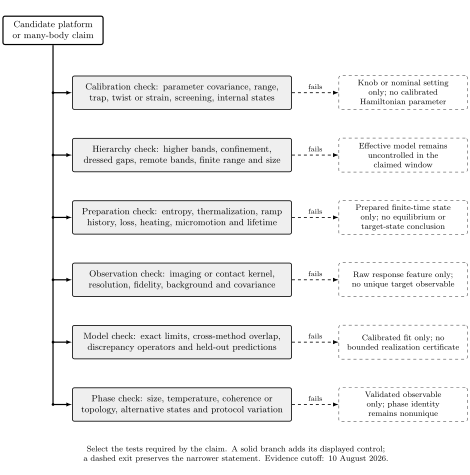
Validity map for synthetic gauge and spin–orbit systems. Dressed-band geometry, dynamical realization, and interacting phase evidence are distinct levels of inference. Original schematic, not to scale; platform evidence is bounded through 10 August 2026.
Text description of this diagram · Figure data (JSON)
Approximation and heating hierarchy
Section titled “Approximation and heating hierarchy”The rotating-wave approximation requires counterrotating terms to be small compared with the optical or microwave carrier frequency. Adiabatic projection additionally requires nonadiabatic couplings to be small relative to the dressed gap :
Spontaneous emission scales with excited-state admixture and laser intensity; intensity noise and magnetic noise broaden and . Momentum-dependent interactions appear after dressing because the internal composition varies across the band. A single-band interaction obtained by inserting a bare contact without dressed-state form factors can violate the very projection used for the kinetic term.
Periodically driven artificial fluxes have a separate expansion. For drive frequency , a high-frequency effective Hamiltonian is useful only when the retained energy scales are small compared with , while resonances to excluded bands and many-body absorption remain negligible over the observation time. The stroboscopic and micromotion operator jointly map laboratory observables; measuring between stroboscopic times cannot be interpreted with alone.
Liang et al. 2024, main text and source data demonstrated chiral dynamics under a tunable SU(2) synthetic gauge field and compared trajectories with a calibrated model. This establishes controlled non-Abelian single-particle dynamics in the reported window. Interaction-dominated phases, long-time heating limits, and other geometries require additional evidence.
The source assessment is current through 10 August 2026. Later gauge protocols, lifetime records, and interacting-phase claims belong in the Quantum Matter and Emergence Research synthesis. The canonical cold-atom and synthetic-matter claim test matrix keeps the Hamiltonian term, gap hierarchy, preparation, resolution, heating, discrepancy, and limit on the conclusion together. A reproducible verification workflow should propagate the relevant uncertainties.
Exercise
Section titled “Exercise”Gauge covariance of the projected Hamiltonian. Show that under and , the operator transforms with the same phase as .
Solution
The connection changes as
Using ,
Therefore the kinetic energy and all expectation values are invariant. The exercise also shows why comparing vector potentials from two papers without first matching their dressed-state phases can be misleading.
References
Section titled “References”- Dalibard, J., Gerbier, F., Juzeliūnas, G., and Öhberg, P. (2011). “Colloquium: Artificial gauge potentials for neutral atoms.” Reviews of Modern Physics 83, 1523–1543. doi:10.1103/RevModPhys.83.1523.
- Goldman, N., Juzeliūnas, G., Öhberg, P., and Spielman, I. B. (2014). “Light-induced gauge fields for ultracold atoms.” Reports on Progress in Physics 77, 126401. doi:10.1088/0034-4885/77/12/126401.
- Liang, Q., Dong, Z., Pan, J.-S., Wang, H., Li, H., Yang, Z., Yi, W., and Yan, B. (2024). “Chiral dynamics of ultracold atoms under a tunable SU(2) synthetic gauge field.” Nature Physics 20, 1738–1743. doi:10.1038/s41567-024-02644-4.
- Lin, Y.-J., Compton, R. L., Jiménez-García, K., Porto, J. V., and Spielman, I. B. (2009). “Synthetic magnetic fields for ultracold neutral atoms.” Nature 462, 628–632. doi:10.1038/nature08609.