

Cold-Atom RF, Bragg, Time-of-Flight, and Microscopy Probes
Cold-atom probes can measure momentum distributions, spectral transfer, density response, in-situ profiles, and site-resolved occupation with exceptional control; Bloch, Dalibard, and Zwerger 2008 review the many-body platform and its principal observables. That control does not remove the forward model: expansion dynamics, Wannier envelopes, final-state interactions, trap averaging, point-spread functions, light-assisted loss, and detection fidelity stand between the atomic state and the reported correlator. A simulator validates a many-body observable only after those transformations and the realized Hamiltonian are tested together.
Required background. The benchmark ladder supplies cross-platform validation levels. Resource and continuum certification supplies realization checks. Kubo response fixes linear-response conventions. Correlator conventions fixes the measured many-body objects.
Evidence cutoff. This method and evidence account covers primary and official sources available through 10 August 2026. Later calibrations, corrections, datasets, and changing assessments belong in the dated Quantum Matter and Emergence Research synthesis.
Time of flight and in-situ density
Section titled “Time of flight and in-situ density”After sudden release and sufficiently long ballistic expansion, position maps to initial quasimomentum,
where is the Wannier envelope for a lattice gas. Finite expansion time adds near-field phases; collisions during expansion, gravity, interactions, line-of-sight integration, saturation, and camera response modify the map. Noise correlations can reveal reciprocal-lattice, pairing, or exchange structure, but their normalization depends on atom-number fluctuations and detector covariance.
In-situ imaging measures a point-spread-function convolution of the density. A local-density approximation uses only when the trap varies slowly relative to correlation lengths. Differentiating a noisy density profile to infer compressibility requires a joint trap and imaging model rather than binwise finite differences.
The chapter validity figure shows where cold-atom observables join other evidence. Inspect the realization and detector branches before treating agreement with a target Hamiltonian as automatic.
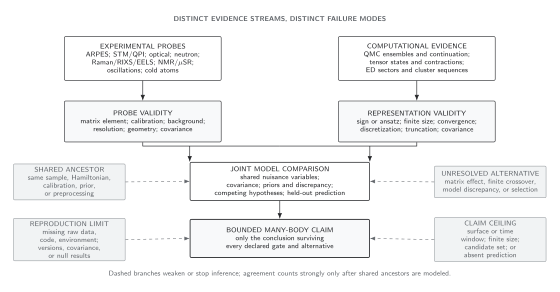
Cold-atom measurement and model validation. A calibrated observable can test a realized model over a stated scale window; trap, preparation, loss, finite size, and detector response bound any claim of phase realization. Schematic.
RF, Bragg, and microscopy operators
Section titled “RF, Bragg, and microscopy operators”Radio-frequency spectroscopy transfers atoms from an interacting internal state to another state. Let denote the calibrated detuning, in cycles per unit time, from the bare internal-state transition, so that the internal offset has already been removed and is the detuning energy. In a weak, long pulse and negligible-final-state-interaction limit, momentum-resolved transfer has the form
followed by the pulse envelope and detector response. Hartree shifts, final-state interactions, trapped density variation, and clock shifts must be included before reading a pairing gap from a threshold. Stewart, Gaebler, and Jin 2008 demonstrate momentum-resolved RF spectroscopy and its spectral interpretation.
A weak Bragg pulse with momentum and angular frequency couples to density or spin. The transferred momentum or energy is governed by the corresponding , weighted by the finite pulse’s Fourier envelope. Strong pulses, finite duration, inhomogeneity, and nonlinear response invalidate direct proportionality.
Quantum-gas microscopy reports a detected local outcome , not automatically the occupation . Single-site fluorescence imaging and its parity projection were established by Bakr et al. 2009, while Weitenberg et al. 2011 demonstrated local spin addressing. A detection matrix
must include missed atoms, hopping during fluorescence, off-resonant loss, spin-removal fidelity, and—in early bosonic imaging—parity projection from light-assisted collisions. Correlators are inferred from the joint detection model; correcting each site’s mean independently does not generally correct connected correlations.
From platform benchmark to phase evidence
Section titled “From platform benchmark to phase evidence”The strongest workflow proceeds through calibrated single-particle scales, few-body interactions, conserved quantities, local observables with exact limits, and only then collective phase diagnostics. Vary trap, entropy, preparation ramp, system size, boundary, and detection protocol. Compare more than one observable, including a negative test that the target phase predicts but a nearby alternative does not.
A microscope image can establish antiferromagnetic correlations over measured separations, not thermodynamic long-range order without size and temperature extrapolation. A momentum-distribution peak can establish coherence, not superfluid stiffness. A spectroscopic gap can establish suppressed weight, not phase coherence. The probe and computation claim test matrix states these ceilings.
Exercise
Section titled “Exercise”Parity projection. A bosonic microscope detects . If a site has probabilities for , what mean does the detector report, and why can it underestimate density?
Solution
The detected occupation is one only for odd , so . The physical mean is . Doubly occupied sites appear empty after pair loss, so density and density correlations cannot be recovered without an independently validated occupation model.
References
Section titled “References”- Waseem S. Bakr, Jonathon I. Gillen, Amy Peng, Simon Fölling, and Markus Greiner, “A Quantum Gas Microscope for Detecting Single Atoms in a Hubbard-Regime Optical Lattice,” Nature 462 (2009) 74–77. DOI
- Immanuel Bloch, Jean Dalibard, and Wilhelm Zwerger, “Many-Body Physics with Ultracold Gases,” Reviews of Modern Physics 80 (2008) 885–964. DOI
- J. T. Stewart, J. P. Gaebler, and Deborah S. Jin, “Using Photoemission Spectroscopy to Probe a Strongly Interacting Fermi Gas,” Nature 454 (2008) 744–747. DOI
- Christian Weitenberg, Manuel Endres, Jacob F. Sherson, Marc Cheneau, Peter Schauß, Takeshi Fukuhara, Immanuel Bloch, and Stefan Kuhr, “Single-Spin Addressing in an Atomic Mott Insulator,” Nature 471 (2011) 319–324. DOI