

Exact Diagonalization and Finite-Size Evidence
Exact diagonalization constructs a finite many-body Hamiltonian in a declared symmetry sector and computes eigenpairs or dynamics to numerical precision. Within that finite matrix it offers unmatched access to spectra, eigenstates, and real-time observables. Its central limitation is not the eigensolver but exponential Hilbert-space growth: cluster shape, boundary, sector, energy window, disorder sample, and finite-size drift control every thermodynamic interpretation.
Required background. The measurement-to-claim map supplies inference standards. Basis construction and symmetry sectors and convergence certification supply the finite-matrix workflow.
Helpful background. Heating, finite size, and open-system evidence supplies dynamical observation-window checks.
Evidence cutoff. This method and evidence account covers primary and official sources available through 10 August 2026. Later algorithms, benchmarks, corrections, and changing assessments belong in the dated Quantum Matter and Emergence Research synthesis.
Finite Hilbert space and numerical exactness
Section titled “Finite Hilbert space and numerical exactness”For spin- sites, the full Hilbert dimension is ; at fixed it is
Translation, point-group, spin, particle-number, and antiunitary symmetries reduce the matrix and define which levels may be compared. Mixing independent symmetry sectors produces artificial crossings and Poisson-like level statistics. Conversely, an unnoticed degeneracy or incompatible boundary twist can duplicate states.
For each computed eigenpair, report
orthogonality, and—when only part of the spectrum is targeted—the transformation and convergence criterion. The sparse Krylov construction originates with Lanczos 1950, and modern ground-state, finite-temperature, and dynamical uses are reviewed by Bonča and Prelovšek 2013. A small residual proves an eigenpair of the finite matrix, not convergence of the Hamiltonian sequence to a thermodynamic phase.
The chapter validity map puts the finite representation on the same footing as instrumental resolution. Inspect the geometry branch before extrapolating a single highly symmetric cluster.
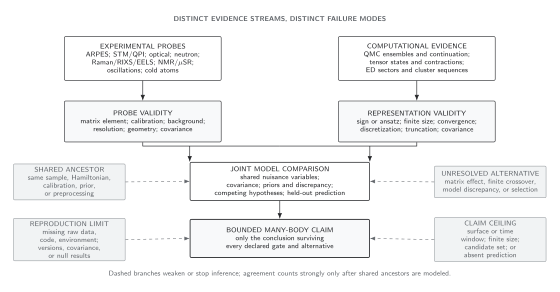
ED evidence in the chapter comparison. Symmetry sectors, cluster sequence, boundary twists, eigensolver residuals, energy density, broadening, disorder covariance, and finite-size alternatives accompany every claim. Schematic.
Spectral and dynamical diagnostics
Section titled “Spectral and dynamical diagnostics”Within one irreducible sector, adjacent-gap ratios
avoid unfolding but still require a stationary energy-density window. Poisson and random-matrix values are asymptotic ensemble predictions; small sizes and unresolved sectors interpolate for many reasons. Oganesyan and Huse 2007 introduced this diagnostic in an interacting-localization setting. Eigenstate entanglement, participation, order parameters, stiffness under boundary twists, and matrix-element statistics supply complementary tests.
A finite spectral function is a sum of delta peaks,
Plot broadening is a visualization or finite-time window, not a physical lifetime unless justified independently. Compare integrated weights and moments across sizes and show several values. In dynamics, recurrence and boundary-traversal times grow with size; a plateau shorter than those scales is a finite-window observation.
Cluster sequences and limits of interpretation
Section titled “Cluster sequences and limits of interpretation”A phase claim should use multiple compatible shapes and boundaries, not just more sites. Track aspect ratio, point group, allowed ordering wavevectors, topological sectors, and surface-to-volume ratio. For disorder, average observables and distributions over independent samples and retain sample covariance; a few rare realizations can dominate means.
Crossings can drift monotonically beyond accessible sizes. Extrapolations should compare power-law, exponential, and transition-specific forms, vary the smallest included size, and predict held-out clusters. Towers of states, quasi-degenerate manifolds, entanglement spectra, or gap ratios identify a finite-size pattern; their thermodynamic meaning comes from scaling and consistency with defining observables.
The probe and computation claim test matrix records sector, geometry, residual, broadening, size range, and alternative extrapolations.
Exercise
Section titled “Exercise”Why sectors matter. Two independent chaotic symmetry sectors each have level repulsion internally. What happens if their sorted eigenvalues are merged before computing gap ratios?
Solution
Levels from different sectors do not repel because symmetry forbids mixing. After merging, arbitrarily close cross-sector levels occur, increasing small spacings and lowering the mean gap ratio toward a Poisson-like value. The result could be misread as integrability or localization. Statistics must be computed separately in every irreducible sector and then combined with declared weights.
References
Section titled “References”- Janez Bonča and Peter Prelovšek, “Ground State and Finite Temperature Lanczos Methods,” in Strongly Correlated Systems: Numerical Methods, Springer, 2013, pp. 1–30. DOI
- Cornelius Lanczos, “An Iteration Method for the Solution of the Eigenvalue Problem of Linear Differential and Integral Operators,” Journal of Research of the National Bureau of Standards 45 (1950) 255–282. DOI
- Vadim Oganesyan and David A. Huse, “Localization of Interacting Fermions at High Temperature,” Physical Review B 75 (2007) 155111. DOI