

Unitary Fermi-Gas Platforms and Benchmark Evidence
A balanced two-component Fermi gas at a broad three-dimensional resonance is universal because the scattering length drops out while the effective range remains negligible. Universality fixes scaling forms and exact relations, not the numerical values of the equation of state, pairing gap, contact, viscosity, or superfluid transition. Those require experiment or a controlled many-body calculation with a stated uncertainty and convention.
Required background. Fermi-gas and Fermi-surface kinematics fixes , , and density conventions. The BCS–BEC crossover supplies the resonant pairing problem. Thermal effective potentials and thermodynamic phases supplies thermodynamic potentials and phase criteria.
The unitary fixed point and its scales
Section titled “The unitary fixed point and its scales”For equal spin populations with total density ,
The unitary scaling limit is
where represents other microscopic interaction lengths. The -wave amplitude then saturates the two-body unitarity bound, in the stated low-energy convention. In a homogeneous equilibrium state, every intensive thermodynamic quantity becomes a universal dimensionless function of , or equivalently , only after normalization by its appropriate Fermi-scale unit—for example, pressure by and entropy density by .
At zero temperature one defines the Bertsch parameter by
The last relation follows from three-dimensional scale invariance and survives at nonzero temperature for the zero-range homogeneous gas. It is an exact structural statement; the value of is not analytically fixed. Claiming an exact solution because the system has no interaction length confuses dimensional analysis with many-body dynamics.
The platform structure figure places resonance calibration, density and range checks, state preparation, and thermometry before a benchmark number. Inspect the uncertainty branch: the same symbol, such as a “gap,” can denote an odd–even energy difference, a spectral threshold, or a fit parameter unless the observable definition is retained.
On a narrow screen, swipe or use the Left and Right arrow keys to pan across the figure. Home and End move to its edges. A full-size link is also available.
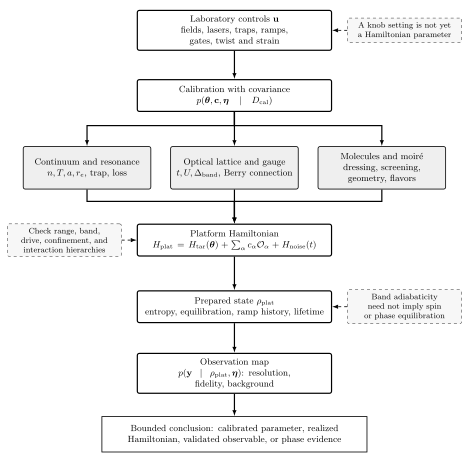
Unitary-gas benchmarks in the platform-to-model chain. Scale invariance fixes relations and dimensionless representations, while range, trap, temperature, response kernel, and many-body method control numerical inferences. Original schematic, not to scale; benchmark evidence is bounded through 10 August 2026.
Text description of this diagram · Figure data (JSON)
Equation of state and exact relations
Section titled “Equation of state and exact relations”One convenient grand-canonical representation is
Density and entropy follow by differentiation:
Thermodynamic consistency requires that independently reported pressure, density, compressibility, entropy, and energy satisfy these derivative relations within their correlated uncertainties. A trapped density profile can be inverted using LDA, but the trap potential and absolute density calibration then enter the covariance.
Tan’s adiabatic relation defines the contact in a convention tied to the momentum tail Tan 2008, §§2–4:
for the usual extensive-contact normalization. The tail must lie between many-body momenta and the inverse interaction range; final-state effects and imaging resolution modify radio-frequency or momentum-distribution extractions. Contact values obtained from the adiabatic derivative, tail, pressure relation, and high-frequency response should agree only after using the same extensive or intensive convention.
For isotropic harmonic confinement, scale invariance implies a virial theorem . The exact zero-range identities and their finite-scattering-length corrections are collected by Werner and Castin 2012, §§III–V. Finite , , anharmonicity, imbalance, or transverse confinement adds correction terms. In two dimensions the contact interaction has a quantum scale anomaly, so the three-dimensional trace relation cannot simply be transplanted.
Pairing, response, and benchmark records
Section titled “Pairing, response, and benchmark records”Superfluidity requires phase coherence, not merely a suppressed low-frequency spectrum. Condensate fraction after a rapid sweep, vortices under rotation, collective modes, second sound, moment of inertia, and equation-of-state singularities have different preparation and forward models. Spectroscopic peak separations can be broadened by trap averaging, final-state interactions, pseudogap correlations, and finite pulse duration.
Ku et al. 2012, main text and supplementary thermodynamic reconstruction measured a homogeneous equation of state from trapped data and used multiple thermodynamic quantities to locate superfluid behavior. Mukherjee et al. 2017, main text established homogeneous-box control that reduces LDA ambiguity. These are benchmark inputs, not declarations that every reported observable shares the same systematic error.
A durable numerical or experimental benchmark record should include:
| Field | Required content |
|---|---|
| Quantity | Operational definition, normalization, spin convention, and units |
| State | or , polarization, density window, and equilibrium test |
| Interaction | , , confinement, and field covariance |
| Method | Observable kernel or Hamiltonian solver, extrapolation, and analytic continuation if any |
| Uncertainty | Statistical covariance, calibration systematics, finite-size/range/trap corrections |
| Cross-check | Exact relation, alternative observable, or independent method |
| Evidence date | Source version, correction/withdrawal check, and cutoff |
Current benchmark values are deliberately not frozen into this durable method page. The source assessment is complete through 10 August 2026; evolving values, comparisons, and corrections belong in the Quantum Matter and Emergence Research synthesis. The canonical cold-atom and synthetic-matter claim test matrix supplies the cross-platform context, and a reproducible verification workflow propagates calibration uncertainty through a selected dimensionless observable.
Exercise
Section titled “Exercise”Derive the pressure relation. At zero temperature, suppose scale invariance makes the energy density , where is independent of density. Show that and .
Solution
The chemical potential is
At zero temperature , hence
The derivation uses homogeneity of degree , which follows from three-dimensional nonrelativistic scale invariance. A finite inverse scattering length, effective range, lattice, or two-dimensional anomaly introduces additional scales and invalidates the simple Euler relation.
References
Section titled “References”- Ku, M. J. H., Sommer, A. T., Cheuk, L. W., and Zwierlein, M. W. (2012). “Revealing the superfluid lambda transition in the universal thermodynamics of a unitary Fermi gas.” Science 335, 563–567. doi:10.1126/science.1214987.
- Mukherjee, B., Yan, Z., Patel, P. B., Hadzibabic, Z., Yefsah, T., Struck, J., and Zwierlein, M. W. (2017). “Homogeneous atomic Fermi gases.” Physical Review Letters 118, 123401. doi:10.1103/PhysRevLett.118.123401.
- Tan, S. (2008). “Energetics of a strongly correlated Fermi gas.” Annals of Physics 323, 2952–2970. doi:10.1016/j.aop.2008.03.004.
- Werner, F., and Castin, Y. (2012). “General relations for quantum gases in two and three dimensions: Two-component fermions.” Physical Review A 86, 013626. doi:10.1103/PhysRevA.86.013626.