

Kondo Screening and Impurity RG Flow
Antiferromagnetic Kondo exchange grows logarithmically as electronic states are eliminated toward the Fermi surface. In a specified density-of-states convention, leading poor-man’s scaling generates an exponentially small Kondo scale. The divergence marks the failure of weak-coupling RG and a flow toward strong coupling; it is not itself a solution of the screened infrared state.
Required background. Impurity models and local moments supplies the channel and bath definitions. Beta functions and momentum-shell RG supply the running-coupling logic.
Poor-man’s scaling in a fixed convention
Section titled “Poor-man’s scaling in a fixed convention”Take one spin- channel,
Let be the density of states per spin and define . Eliminating electron and hole shells as the half-bandwidth decreases from to , with , gives
Therefore
Equivalently, if a source uses the total two-spin density of states , then and the same flow reads , with . Other texts absorb factors into the exchange vertex itself. The numerical coefficient is meaningful only together with the Hamiltonian and density-of-states definition.
For , the coupling grows and the perturbative logarithms must be resummed. Kondo 1964, pp. 37–43 identified the logarithmic scattering correction, and Anderson 1970, pp. 2438–2440 gives the scaling construction. Cheng et al. 2017, accepted manuscript, Eqs. (66)–(67), pp. 11–12, PDF displays the same , per-spin- convention and fixes the coefficient above. For , approaches zero from below: the ferromagnetic model is marginally irrelevant rather than screened in the same way.
Kondo temperature is not unique without a definition
Section titled “Kondo temperature is not unique without a definition”Beyond leading logarithms, the prefactor and even the quoted numerical value of depend on the bandwidth scheme and observable definition. Common choices use the zero-temperature impurity susceptibility, the half-width of a spectral resonance, entropy crossover, or conductance scaling. A comparison must state which one is used and the conversion for the model.
The length characterizes the spatial crossover associated with screening. It is not the size of a rigid bound electron orbital; equal-time spin correlations, entanglement, and response reveal different spatial structures. Finite size , temperature , or a superconducting gap cuts off the flow before the ordinary strong-coupling fixed point.
Anisotropic exchange obeys at leading order
The invariant organizes the trajectories. A pseudogap bath adds tree-level scaling and can create a finite-coupling critical point; the metallic beta function above cannot be reused unchanged.
Strong-coupling behavior
Section titled “Strong-coupling behavior”Weak-coupling RG is reliable while . Once the running coupling is order one, stop. The screened singlet, phase shift, irrelevant operators, and low-temperature observables require Wilson’s numerical RG, Bethe ansatz, boundary field theory, or the local Fermi-liquid description on the strong-coupling page. Wilson 1975 supplies the nonperturbative flow and scale separation.
The structure map shows that the perturbative divergence marks the need for a strong-coupling description without determining the infrared behavior.
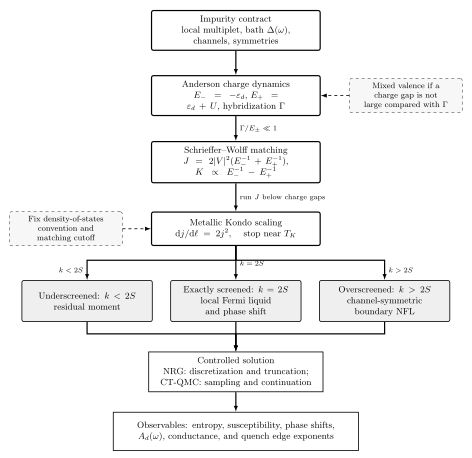
Poor-man’s scaling generates the Kondo scale and identifies the direction of flow. The divergence only marks loss of perturbative control; it does not compute the infrared fixed point. Original schematic, not to scale.
The impurity claim test matrix records the scheme and stop rule.
Exercise
Section titled “Exercise”Integrate the flow. With in the per-spin convention, estimate .
Solution
. This is the leading-log scale. A susceptibility-defined or higher-loop differs by a convention-dependent prefactor, so quoting more digits would be misleading without that definition.
References
Section titled “References”- Anderson, P. W. (1970). “A poor man’s derivation of scaling laws for the Kondo problem.” Journal of Physics C 3, 2436–2441. doi:10.1088/0022-3719/3/12/008.
- Cheng, M., Chowdhury, T., Mohammed, A., and Ingersent, K. (2017). “Phase boundaries of power-law Anderson and Kondo models: A poor man’s scaling study.” Physical Review B 96, 045103. doi:10.1103/PhysRevB.96.045103.
- Kondo, J. (1964). “Resistance minimum in dilute magnetic alloys.” Progress of Theoretical Physics 32, 37–49. doi:10.1143/PTP.32.37.
- Wilson, K. G. (1975). “The renormalization group: Critical phenomena and the Kondo problem.” Reviews of Modern Physics 47, 773–840. doi:10.1103/RevModPhys.47.773.