

Griffiths Effects, Rare Regions, and Avalanches
Rare regions convert exponentially improbable spatial fluctuations into broad, often power-law relaxation scales. In interacting localized systems, a sufficiently large thermal inclusion can instead grow by resonantly absorbing nearby degrees of freedom, producing an avalanche. Both mechanisms are asymptotic statements whose criterion depends on disorder tails, dimension, interaction range, entropy density, and the convention used for localization length.
Required background. Anderson localization and scaling supplies localization length and finite-size flow. Quenched disorder supplies ensemble tails and typical-versus-average distinctions.
Helpful background. Quantum phase transitions and competing scales supplies dynamical scaling language.
Evidence cutoff. This research-sensitive account covers primary sources available through 10 August 2026. Later results, corrections, and changing assessments belong in the dated Quantum Matter and Emergence Research synthesis.
From rare probability to a Griffiths exponent
Section titled “From rare probability to a Griffiths exponent”Suppose a favorable region of linear size has probability
while its lowest relaxation scale is . Eliminating gives
Writing defines a Griffiths dynamical exponent. Equivalently, the relaxation-time tail is . Its raw moment of order diverges for , logarithmically at equality; in particular, the mean relaxation time diverges when , even though a typical region is not critical. Vojta 2006, §§3–5 reviews this probability-to-timescale construction and its dependence on rare-region dimensionality.
The chapter’s original validity diagram separates this broad-distribution mechanism from a thermal avalanche. Inspect the arrows from rare inclusions: slow response and global delocalization are different possible outcomes.
On a narrow screen, swipe or use the Left and Right arrow keys to pan across the figure. Home and End move to its edges. A full-size link is also available.
Rare-region slowing versus avalanche growth. Exponentially broad times can occur without a thermodynamic localized phase, and a finite inclusion becomes an avalanche only when its growing many-body density of states overcomes spatially decaying couplings. Schematic, not to scale.
Text description of this diagram · Figure data (JSON)
Thermal-inclusion stability criterion
Section titled “Thermal-inclusion stability criterion”Take a one-dimensional thermal inclusion of length and entropy density at the relevant energy density. Its level spacing scales as
Define by an amplitude coupling to a localized degree of freedom at distance . The eigenstate-thermalization estimate for a local bath operator supplies a matrix element , so
If each absorbed site increases by order one, the ratio grows asymptotically when . In this amplitude convention the threshold is . Definitions based on squared matrix elements or end-to-end correlators move the factor of two; every numerical comparison must translate its convention before quoting a threshold.
The argument assumes a featureless thermal inclusion, local coupling, no exact blocking symmetry, and arbitrarily large random samples. De Roeck and Huveneers 2017 develops the avalanche instability, and Thiery et al. 2018 connects it to the putative one-dimensional transition.
What present evidence establishes
Section titled “What present evidence establishes”Cold-atom experiments have directly coupled a thermal region to a disordered system and observed accelerated, site-resolved spreading over their accessible size and time window Léonard et al. 2023. This supports the avalanche mechanism in that calibrated protocol; it does not by itself settle the existence or absence of an asymptotic isolated phase for every random or quasiperiodic Hamiltonian.
Recent model calculations continue to find strong drift under bath and inclusion tests—for example, Zhang, Xu, and Fan 2026 studied a -preserving interacting Ising–Majorana chain. Their conclusion is model- and diagnostic-specific. Random and quasiperiodic potentials differ because only the random ensemble necessarily contains arbitrarily large statistical inclusions.
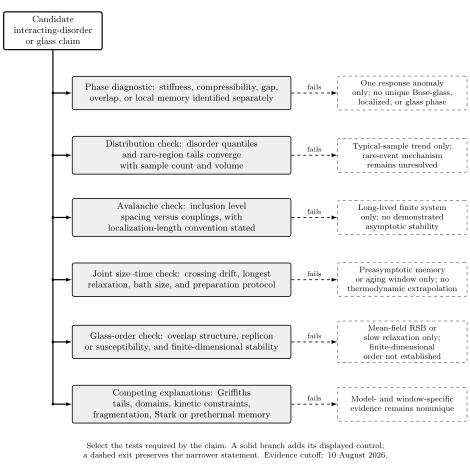
The strongest durable conclusion is conditional: a localization claim must remain stable when inclusion size, sample size, time, bath coupling, interaction range, and disorder tail are varied. The disorder and glass claim test matrix makes those negative tests explicit.
Exercise
Section titled “Exercise”Derive the rare-energy distribution. Ignore logarithmic Jacobian factors and eliminate between and .
Solution
The second relation gives . Hence
Converting a cumulative probability to a density supplies one inverse power of , so , with logarithmic factors from .
References
Section titled “References”- Wojciech De Roeck and François Huveneers, “Stability and Instability towards Delocalization in Many-Body Localization Systems,” Physical Review B 95 (2017) 155129. DOI
- Julian Léonard, Sooshin Kim, Matthew Rispoli, Alexander Lukin, Robert Schittko, Joyce Kwan, Eugene Demler, Dries Sels, and Markus Greiner, “Probing the Onset of Quantum Avalanches in a Many-Body Localized System,” Nature Physics 19 (2023) 481–485. DOI
- Thimothée Thiery, François Huveneers, Markus Müller, and Wojciech De Roeck, “Many-Body Delocalization as a Quantum Avalanche,” Physical Review Letters 121 (2018) 140601. DOI
- Thomas Vojta, “Rare Region Effects at Classical, Quantum and Nonequilibrium Phase Transitions,” Journal of Physics A: Mathematical and General 39 (2006) R143–R205. DOI
- Lv Zhang, Kai Xu, and Heng Fan, “Quantum Avalanches in -Preserving Interacting Ising Majorana Chain,” Scientific Reports 16 (2026) 2819. DOI