

Quantum Impurity Models and Local Moments
A quantum impurity is a small quantum system coupled locally to an environment with infinitely many low-energy degrees of freedom. The word impurity is historical: the small system may be a magnetic ion, a quantum dot, a molecular orbital, a two-level defect, or an auxiliary problem produced by dynamical mean-field theory. What makes the problem special is its boundary character. The impurity changes an part of the free energy while the bath remains thermodynamically large.
The first task is therefore not to choose a solver or announce “Kondo physics.” It is to declare the local states, the bath spectrum seen at the coupling point, the independent screening channels, the symmetries, and the relevant scale hierarchy. A local moment is a low-energy multiplet protected from real charge fluctuations. It is a regime—or, in some structured baths, a phase—not merely a large instantaneous value of .
Required background. Fermi-surface kinematics supplies the metallic bath density of states. Dyson equations supplies the self-energy and causality language used for the hybridization kernel.
From a host to a boundary problem
Section titled “From a host to a boundary problem”A useful decomposition is
defines the impurity Hilbert space, including interactions, crystal-field splittings, and conserved quantum numbers. In an atomic basis one may write
declares the environment: its dispersion, chemical potential, ultraviolet cutoff, gap or pseudogap, and any interactions that remain active. identifies which local transitions talk to which bath operators. Hybridization changes impurity charge, whereas exchange, density, and dissipative couplings can preserve it.
For a Gaussian fermionic bath with orbitals , linear hybridization can be summarized by the matrix
On the real axis write
The matrix is positive semidefinite. Its real part partner is fixed by a dispersion relation, so a proposed bath with independently chosen real and imaginary parts generally violates causality. Integrating out a Gaussian bath gives a nonlocal-in-time term in the impurity action,
Thus , rather than a bare hopping amplitude by itself, is the complete one-particle bath input for this class of impurity models. Both and have units of energy. A different microscopic host that produces the same low-energy produces the same Gaussian boundary problem, up to operators omitted in the reduction. Bulla, Costi, and Pruschke 2008, §II.A, pp. 399–402 develops this bath-to-impurity reduction for the Anderson model, while Hewson 1993, ch. 1 gives the standard metallic impurity models and conventions.
This simplification has a boundary. An interacting bath cannot always be compressed into a hybridization function. Critical bosonic baths, Luttinger liquids, and superconductors can carry correlations or anomalous kernels that must be retained explicitly. Vojta 2006, §III explains why the local bath spectrum is decisive in many impurity problems and why a Gaussian-bath description can nevertheless fail.
Charge gaps and the local-moment window
Section titled “Charge gaps and the local-moment window”Suppose the lowest local sector has charge and internal degeneracy . Use grand-canonical local energies , with the same chemical potential as the bath. Its costs to add and remove one particle are
Both must be positive, and every other charge or multiplet sector must also remain higher, for the chosen multiplet to be the atomic ground sector. Adjacent gaps alone do not exclude an anomalously low pair-addition or pair-removal state. Let denote the hybridization broadening sampled over the relevant charge-excitation window. A controlled moment description requires, schematically,
and it requires the states retained inside the sector to remain degenerate—or to have splittings smaller than the scale window in which the multiplet is being used. The first inequality suppresses real charge changes. Hybridization still produces virtual excursions into the sectors, and those excursions generate exchange and potential scattering on the Schrieffer–Wolff page.
Several observations should agree before the words “local moment” are trusted:
- the charge distribution has a plateau near , and its susceptibility to a local level shift is small;
- moment-sector probability is close to one over the claimed window;
- a symmetry-protected multiplet remains after crystal-field, spin–orbit, Zeeman, and tunnelling splittings are included;
- the susceptibility shows the Curie response appropriate to that multiplet over an intermediate range; and
- the bath and coupling permit the proposed low-energy fate.
For an approximately free spin , with ,
In the metallic one-channel Kondo problem, with the largest retained multiplet splitting denoted by , free-moment behavior is visible only in the window
up to crossover factors. At , the spin- moment is screened and the impurity entropy tends to zero. A moment can therefore be well formed microscopically even though it is absent as a free degree of freedom in the ground state.
One must also distinguish local from impurity observables. A local susceptibility responds to a field applied only to the impurity operator. The thermodynamic impurity contribution instead compares the full system with and without the impurity under the same uniform field:
These differences include the bath polarization and displaced charge surrounding the impurity; they are not expectation values of strictly local operators. The distinction matters at interacting boundary fixed points, where local and uniform responses can have different scaling. Vojta 2006, §IV gives the response definitions and their fixed-point interpretation.
Channels, symmetries, and bath structure
Section titled “Channels, symmetries, and bath structure”A screening channel is an orthogonal bath flavor that remains independently coupled to the moment at low energy. It is not the same thing as a physical lead, a spin label, or a band name. The count must be made after diagonalizing the bath and coupling matrices subject to the conserved symmetries.
For example, one dot orbital coupled to two equivalent normal leads has
Only the normalized even annihilation operator proportional to couples; the orthogonal combination decouples. The device has two leads but one screening channel. Two channels survive only when an additional conserved orbital, valley, or lead structure prevents this rotation and keeps two orthogonal combinations coupled. Energy-dependent or nonfactorizable lead couplings require the same rank test frequency by frequency.
The bath then determines what the coupling can do. In an ordinary active metallic eigenchannel, the corresponding eigenvalue of is nonzero. A metallic host can nevertheless look locally pseudogapped to a particular orbital because symmetry or destructive interference makes its projected hybridization vanish. More generally, a pseudogap eigenchannel may have
which can stabilize an unscreened phase and an impurity quantum critical point. A hard gap can stop screening altogether; a superconducting bath competes through both its gap and anomalous correlations; a Luttinger-liquid bath changes boundary scaling dimensions. The phrase “antiferromagnetic exchange screens the spin” is therefore incomplete until the locally projected bath, channel symmetry, and competing infrared cutoffs are stated. Vojta 2006, §III develops this bath-sensitive classification.
Before calculation, record the following model card.
| Input | What must be stated | Failure exposed by the statement |
|---|---|---|
| Local sector | charges, spin or multiplet representation, degeneracy, and nearby levels | an omitted level or splitting invalidates the low-energy Hilbert space |
| Bath | local spectral matrix, chemical potential, cutoff, gap or power law, and interactions | the assumed metallic continuum is absent |
| Coupling | hybridization, exchange, density, or dissipative operator and its normalization | charge-changing and charge-preserving processes are conflated |
| Channels | rank after allowed basis rotations and conserved channel labels | leads or bands are overcounted as screening channels |
| Symmetries | spin, charge, time reversal, particle–hole, and point-group constraints | a relevant perturbation removes a degeneracy or fixed point |
| Scales | , broadening, temperature, field, finite size, and eventual crossover scales | no window exists in which the proposed description is controlled |
| Observable | local, thermodynamic-impurity, bath-scattering, transport, or spectral quantity | a measured response is assigned to the wrong operator |
The chapter’s dependency map shows where each declaration enters. Inspect the first two boxes before following the later matching and RG arrows. In its lower half, means the number of equivalent, conserved spin- screening channels coupled SU(2)-symmetrically to an impurity spin ; the versus classification is not a general rule outside those assumptions.
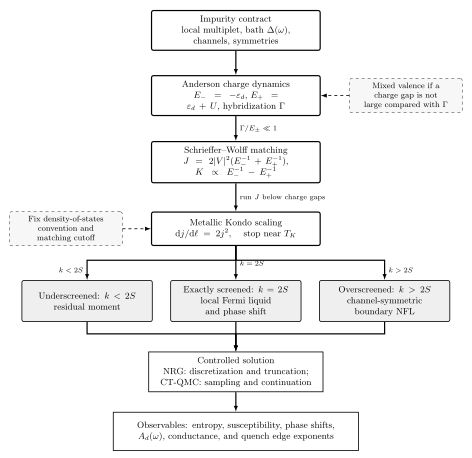
Impurity physics begins with the local state space, bath function, channels, symmetries, and scale hierarchy. Matching or Kondo language is licensed only after those inputs establish a separated moment sector. The later branches summarize possible infrared fates rather than asserting that every bath flows to the metallic one-channel fixed point. Original schematic, not to scale.
The complete impurity claim test matrix gives the observable, necessary control, and decisive failure test for each later claim.
The Anderson-model page now specializes this model definition to one correlated spinful orbital and derives its exact noninteracting checkpoint.
Common pitfalls
Section titled “Common pitfalls”A large instantaneous spin is not a free moment. Mixed-valence states can have sizable while charge changes occur on the same scale as the measurement. Require a charge plateau, separated charge gaps, and a Curie or fixed-point diagnostic.
Two reservoirs are not automatically two channels. Count the rank of the low-energy coupling after every symmetry-allowed bath rotation. A single dot orbital with factorized left and right tunnelling generally couples only to the even combination.
An impurity crossover is not a lattice phase transition. A single impurity contributes to thermodynamics and cannot establish bulk order or lattice coherence. Adding independent impurity contributions is justified only when impurity–impurity scattering, induced RKKY exchange, and collective-coherence corrections are negligible on the stated temperature and frequency scales. The spatial extent of a nominal Kondo cloud is not by itself a universal failure criterion. When those corrections matter, disorder, exhaustion, and coherence can enter; the Kondo-lattice page develops that distinct problem.
Exercises
Section titled “Exercises”1. Count the active lead combinations. A dot couples to two identical noninteracting leads through amplitudes and to the same orbital. Show that only one lead combination hybridizes.
Solution
Let and define
This is a unitary rotation. The coupling becomes
and is absent. There is one screening channel even though current can enter through two terminals. A second channel would require a second conserved combination that cannot be rotated away.
2. Extract a flat-band hybridization. Take one impurity orbital with coupled to a bath whose density of states per spin and per bath site is for and zero otherwise. Find and the real shift for a particle–hole-symmetric band.
Solution
Replacing the momentum sum by the density-of-states integral gives
Therefore
The principal-value integral is odd in for the symmetric band, so . Away from the band center it is frequency dependent and diverges logarithmically near an ideal sharp edge; replacing it by a constant there would be uncontrolled.
3. Test whether a moment window exists. A local doublet of charge has , , broadening , and a symmetry-breaking doublet splitting . Can it be treated as a free twofold moment at and at ? Use and ignore any Kondo crossover.
Solution
At , in energy units is . It is well below both charge gaps and comparable to the broadening, but is not small. Charge is frozen and a two-level moment description is useful, yet the free degenerate doublet approximation is only marginal: the actual two-level Boltzmann weights must be retained. The ratios and quantify the much better charge-sector separation.
At , . Charge remains frozen, but the doublet is no longer thermally active as a degenerate spin- moment: the lower state is selected. This example separates moment formation by charge gaps from protection of the internal degeneracy.
References
Section titled “References”- Bulla, R., Costi, T. A., and Pruschke, T. (2008). “Numerical renormalization group method for quantum impurity systems.” Reviews of Modern Physics 80, 395–450. doi:10.1103/RevModPhys.80.395. Open PDF.
- Hewson, A. C. (1993). The Kondo Problem to Heavy Fermions. Cambridge University Press. doi:10.1017/CBO9780511470752.
- Vojta, M. (2006). “Impurity quantum phase transitions.” Philosophical Magazine 86, 1807–1846. doi:10.1080/14786430500070396. Open PDF.