

Hubbard Bands and Spectral-Weight Transfer
Hubbard bands are many-body electron-addition and electron-removal sectors, not ordinary one-electron bands separated by a larger gap. Correlations can move weight between those sectors while the exact total remains fixed. Three quantities must therefore be kept separate: an integrated spectral weight, the residue of a coherent quasiparticle pole, and the charge gap or compressibility that decides whether the state is insulating.
Required background. Use the Hubbard atomic and strong-coupling limits and spectral moments and sum rules. Helpful background. Dyson equations define self-energy poles and quasiparticle residues.
Atomic addition and removal poles
Section titled “Atomic addition and removal poles”Begin with one Hubbard site in grand-canonical form,
Here is a complex frequency, , and is the declared chemical potential. At zero temperature it is useful to retain the Lehmann labels “addition” and “removal” explicitly. With nonnegative excitation costs measured using ,
Usually lies above and below the chemical potential. The sector labels are nevertheless more fundamental than the sign of : at an exact level crossing, an addition pole and a removal pole can both occur at .
For spin , adding or removing an electron costs one energy when the opposite spin is absent and another when it is present. Conditioning on those two sectors gives the exact atomic Green function
Equivalently,
With , the spectrum per spin is
The residues are occupation probabilities, not adjustable peak heights. They obey
At paramagnetic half filling, and particle–hole symmetry fixes . The poles then sit at with equal per-spin weight:
Hopping broadens these exact transitions into lower and upper Hubbard bands. It also changes their internal moments and, away from the filled-lower-band half-filled limit, can change their integrated weights. Calling the effect “broadening” alone misses that redistribution.
Full and Hartree-shifted self-energies
Section titled “Full and Hartree-shifted self-energies”The apparent form of the atomic self-energy depends on what is included in the reference propagator. For the unshifted Hamiltonian above, take
Inverting the exact Green function gives
The first term is the static Hartree contribution. If it is absorbed into a shifted chemical potential,
then
At paramagnetic half filling, and
Thus the often-quoted is the Hartree-subtracted self-energy, not the full self-energy paired with . The particle–hole shift coincides with the Hartree shift only at paramagnetic half filling.
Exact moments before band labels
Section titled “Exact moments before band labels”For a Hubbard dispersion and frequencies measured relative to the chemical potential, define
The exact zeroth and first moments are
For the atom, the two delta functions give directly. At symmetric half filling this vanishes because equal weights lie at opposite energies. Harris and Lange developed a band-resolved moment expansion and used its zeroth moments to show the hopping-induced transfer of integrated weight away from exactly one electron per site Harris and Lange 1967, §§ IV–V, printed pp. 301–308. At exactly one electron per site and zero temperature, the lower band is filled and the upper band empty, so their total weights retain the atomic counting even though their shapes and moments change.
These identities are stronger checks than a visually plausible two-peak spectrum. A numerical or experimental decomposition should reproduce the total zeroth moment and, after its energy convention is fixed, the first moment before lower- and upper-band weights are interpreted.
A controlled lattice bridge: paramagnetic DMFT
Section titled “A controlled lattice bridge: paramagnetic DMFT”The atomic solution alone does not describe a metal or a transition. A controlled bridge is supplied by the homogeneous one-band Hubbard model in the large-coordination limit. With hopping scaled so that remains finite, dynamical mean-field theory (DMFT) makes the self-energy local while preserving its frequency dependence:
The self-consistent impurity bath vanishes in the zero-hopping limit, recovering the exact atom Georges et al. 1996, §§ II.C and III, printed pp. 20–27. At finite hopping it allows repeated motion into and out of the local environment, so the atomic poles evolve into incoherent Hubbard bands and—on a metallic branch—a low-energy coherent resonance Georges et al. 1996, § VII.C.1, printed pp. 62–64. This is a controlled large-coordination statement, not a claim that a local self-energy is exact in two dimensions Georges et al. 1996, § IX.A, printed pp. 107–108.
At zero temperature a Fermi-liquid solution has the low-frequency expansion
and hence a coherent dispersion
The coherent scale is therefore of order , whereas the Hubbard bands remain at energies of order . In the symmetry-restricted, half-filled paramagnetic DMFT problem at , the metallic branch approaches its endpoint with : the coherent scale collapses while the sum rule forces the missing pole weight into incoherent sectors Zhang, Rozenberg, and Kotliar 1993, pp. 1666–1668. This bounded result reconstructs the advertised coherent-to-incoherent evolution.
It is not a universal transition law. For finite , the paramagnetic DMFT metal and insulator coexist and the physical first-order transition is selected by thermodynamics, not by continuing a single curve Georges et al. 1996, § VII.D.1, printed pp. 65–66. The zero-temperature endpoint instead occurs at Georges et al. 1996, § VII.E, printed pp. 70–71. On a bipartite lattice, antiferromagnetic order can preempt the paramagnetic transition Georges et al. 1996, § VII.D.3, printed pp. 69–70. In finite dimensions, nonlocal correlations can also create momentum-selective loss of coherence that a single local cannot represent. The DMFT mapping page develops the fixed-point construction and these control tests.
Hole doping: exact counting and dynamical transfer
Section titled “Hole doping: exact counting and dynamical transfer”Let be the hole density, so the electron density is . In the zero-hopping, large-, zero-temperature counting limit, double occupancy is absent: a fraction of sites is empty and a fraction is singly occupied. For , this strict atomic statement is a canonical mixture—or an ensemble at the degeneracy between empty and singly occupied sites—not a nondegenerate grand-canonical atomic ground state at generic .
The spin-summed weights per site are
| Process | Counting reason | Atomic weight |
|---|---|---|
| Electron removal | One removable electron on each singly occupied site | |
| Low-energy electron addition | Either spin can fill each empty site | |
| Upper-Hubbard-band addition | Only the opposite spin can join each singly occupied site |
The total removal weight is , and the full addition weight is . Their sum is the exact spin-summed zeroth moment, . The factor is state counting, not a quasiparticle residue Eskes, Meinders, and Sawatzky 1991, printed pp. 1035–1036.
To state the finite-hopping result unambiguously, choose a separated-band window
and define the zero-temperature low-energy addition weight using the Lehmann addition sector,
The label matters at the atomic degeneracy because a sign-of-frequency split cannot distinguish addition from removal there. At nonzero temperature, photoemission and inverse-photoemission weights are separated by the equilibrium factors and , subject to probe matrix elements.
The strong-coupling transformation gives more than a definition of the transferred weight. Use the prerequisite convention , let project onto states without doublons, and transform the creation operator together with the Hamiltonian:
Using completeness within the low-energy sector converts the integrated addition spectrum into an equal-time expectation value of these matched operators. Let be the normalized projected representative of the transformed low-energy ground state, with , and define
then, through first order in ,
The zeroth-order term counts the two ways to fill an empty site. The commutator term describes an added electron that makes a virtual doublon and then reaches a neighboring hole; it is typically and positive for the usual kinetic-energy convention. This derivation and its local form appear in Randeria et al. 2005, printed p. 137001-2, eqs. (5)–(6), especially eq. (6). It is the operator-level version of dynamical spectral-weight transfer developed on the superexchange page.
Because the full addition weight remains , the separated upper-band addition weight is
Thus weight moves downward without violating the total sum rule. The leading correction vanishes in the no-hole projected state because cannot move an electron at exactly one electron per site. At finite temperature or finite doublon density, the simple three-process atomic partition acquires thermally or virtually activated contributions even though the total addition, removal, and full zeroth-moment identities remain exact.
The diagram summarizes the exact counting and the controlled leading transfer. Inspect the arrow rather than the sketched line shapes: moves addition weight between separated sectors, while is defined in a different, momentum-resolved inset.
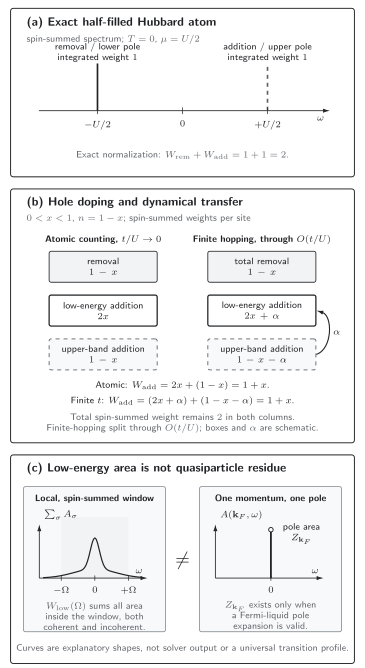
Spectral-weight accounting for the repulsive one-band model at zero temperature. Atomic hole counting gives removal , low-energy addition , and upper-band addition ; in a separated-band strong-coupling expansion, transfers addition weight downward while the spin-summed total stays . The line shapes and transfer arrow are schematic, depends on the cutoff and projected kinetic energy, and neither nor a symmetric low-energy integral equals the momentum-resolved pole residue .
Open the diagram at full size or download its semantic data.
| Regime | Total removal | Low-energy addition | Upper-band addition | Status |
|---|---|---|---|---|
| Half-filled atom | Exact at , | |||
| Hole-doped atom | Exact no-doublon counting at , | |||
| Separated bands, finite hopping | in total | Addition weights through the declared order and cutoff | ||
| Fermi-level quasiparticle | Not an integrated sector | Not | Not applicable | Pole residue only when a quasiparticle exists |
When Hubbard bands overlap, no unique separates them and becomes a window-dependent descriptor rather than a sharply band-resolved quantity. The cutoff dependence follows from the definition itself. Exact-diagonalization results show growth beyond the static count and sensitivity to doping and hybridization; temperature can enter indirectly when it changes that hybridization Meinders, Eskes, and Sawatzky 1993, printed pp. 3917–3921 and 3925–3926.
Integrated weight is not quasiparticle residue
Section titled “Integrated weight is not quasiparticle residue”Let be the number of sites and
the local spectrum per site and per spin. It obeys . A symmetric low-energy integral,
includes both addition and removal weight, and every coherent and incoherent contribution inside the chosen window. It is therefore not the same object as the addition-only above.
By contrast,
is the residue of a Fermi-level quasiparticle pole when the derivative exists and a Fermi-liquid description applies. It is momentum resolved in general. Consequently, neither , , nor is . The atomic Mott insulator makes the distinction stark: its Hubbard bands have finite integrated weights, while its Fermi-level self-energy pole leaves no quasiparticle residue.
An experimental peak area is a third object. Photoemission measures a matrix-element-weighted occupied intensity, schematically , convolved with energy and momentum resolution and mixed with backgrounds. Inverse photoemission or absorption accesses addition weight with different matrix elements. A pole residue can be inferred only after those effects and the incoherent background are controlled.
What the spectrum can establish
Section titled “What the spectrum can establish”The chapter comparison keeps the full Hubbard spectrum distinct from a projected low-energy Hamiltonian and gives the stop conditions for spectral and mechanism claims.
| Proposed conclusion | Minimum checks | What survives if a check fails |
|---|---|---|
| “The sum rule is satisfied” | Positivity, declared , , , chemical-potential convention, and sufficient frequency range | Only a windowed intensity, not a normalized spectral function |
| “Weight moved between Hubbard sectors” | A stable separating window, cutoff variation, temperature control, and matched orbital or probe matrix elements | A redistribution within the measured window |
| “A coherent quasiparticle exists” | Momentum-resolved pole or Fermi-liquid self-energy, resolution below the coherent scale, and a controlled background | A narrow feature, not a certified |
| “The state is a Mott insulator” | Charge gap or zero-temperature incompressibility, symmetry-restored persistence, atomic continuity or self-energy evidence, and exclusion of leading alternatives | An insulating or two-feature spectrum with unresolved mechanism |
Analytic continuation is an inverse problem: broad Hubbard bands are usually more stable than a narrow low-energy resonance, while peak splitting and small gaps can depend on the prior, regularization, and covariance. A finite cluster adds discrete levels and limited momentum sectors; size, shape, boundary conditions, broadening, periodization, and interpolation must be varied before a thermodynamic or momentum-selective conclusion is drawn. Magnetic order can fold bands and open a Slater gap, and disorder, hybridization, phonon satellites, multiplets, and charge-transfer physics can all produce more than one spectral feature.
The strongest conclusion from two broad peaks alone is therefore modest: the measured or computed electron spectrum contains two resolved energy regions in the stated channel and resolution. Mottness requires the additional thermodynamic, symmetry, operator, and mechanism tests developed on the insulator-comparison page.
Common pitfalls
Section titled “Common pitfalls”Separating addition and removal only by the sign of frequency. This works away from zero-cost degeneracies. At the atomic crossing, retain the Lehmann-sector label or take a controlled finite-hopping limit.
Calling a quasiparticle weight. It is an addition-sector integral over all coherent and incoherent states below a cutoff. is the residue of one momentum-resolved pole.
Treating quasiparticle collapse as universal. The continuous statement above belongs to the zero-temperature paramagnetic large-coordination DMFT branch. A finite-temperature first-order transition, magnetic preemption, or momentum-selective finite-dimensional transition can look different.
Identifying Mottness from two peaks. Two structures do not establish incompressibility, a self-energy pole, or continuity to the interaction-blocked atomic limit. Test symmetry breaking, disorder, orbital character, and probe matrix elements.
Exercises
Section titled “Exercises”For the atomic Hamiltonian, derive the general Green function and self-energy, verify and , and specialize to paramagnetic half filling in both self-energy conventions.
Solution
When , the propagator is ; when , it is . Averaging the two sectors gives
Using in Dyson’s equation yields
The residues sum to one, so . Weighting the poles by their energies gives
At half filling, and , so and
Subtracting the Hartree term and shifting gives . Both conventions produce the same .
In the atomic hole-doped counting limit, derive the three spin-summed weights and the spin-summed first moment. Which part of the answer requires spin balance?
Solution
There are singly occupied sites, so removal has weight . There are empty sites and either spin can be added, giving low-energy addition weight . Each singly occupied site accepts only the opposite spin at energy , giving upper-band addition weight . The sum is
At the atomic crossing, the lower pole combines removal and low-energy addition and has spin-summed weight ; the upper pole has weight . Hence
With a generic algebraic energy origin the result is . This spin-summed identity does not require spin balance. Only the further statement assumes a paramagnetic or spin-balanced mixture.
Use the matched operator to explain why the low-energy addition weight is at zeroth order and why its first correction is controlled by the projected kinetic energy. What consistency bounds must obey?
Solution
Insert a complete set of no-doublon final states into the integrated Lehmann sum. This replaces the sum over final states by the equal-time product of matched projected operators. The leading operator can act only on an empty site, of which there are per site, and it has two spin choices. Its spin-summed contribution is therefore .
The cross term between and contains one virtual doublon denominator and one projected hop. Summing sites and spins gives
For the stated hopping convention, , so is positive. A separated-band decomposition also requires and . Failure of those bounds signals a sign error, an uncontrolled truncation, or a cutoff that no longer isolates the two sectors.
A finite cluster produces two broad peaks after analytic continuation. The low-energy integral changes by 20 percent when the cutoff is moved within the apparent valley; antiferromagnetic folding is present, and the narrow central feature is comparable to the continuation resolution. State what can and cannot be concluded.
Solution
One may report two resolved spectral regions for that cluster, continuation, temperature, and broadening. The cutoff sensitivity prevents a precise band-resolved ; magnetic folding leaves a Slater contribution viable; and the unresolved central feature cannot establish a quasiparticle pole or . A Mott attribution additionally requires size and cluster-shape convergence, moment and normalization checks, symmetry-restored behavior, a charge-gap or compressibility test, and comparison with hybridization, disorder, orbital, and matrix-element alternatives.
Continue the correlated-electron route
Section titled “Continue the correlated-electron route”The superexchange and t–J page derives the transformed operators that generate the leading low-energy transfer. The DMFT mapping supplies the controlled local lattice construction, and the insulator comparison tests whether the resulting spectrum supports a Mott, Slater, band, charge-transfer, or Anderson mechanism.
References
Section titled “References”- H. Eskes, M. B. J. Meinders, and G. A. Sawatzky, “Anomalous Transfer of Spectral Weight in Doped Strongly Correlated Systems,” Physical Review Letters 67 (1991) 1035–1038, doi:10.1103/PhysRevLett.67.1035.
- Antoine Georges, Gabriel Kotliar, Werner Krauth, and Marcelo J. Rozenberg, “Dynamical Mean-Field Theory of Strongly Correlated Fermion Systems and the Limit of Infinite Dimensions,” Reviews of Modern Physics 68 (1996) 13–125, doi:10.1103/RevModPhys.68.13; Open PDF.
- A. Brooks Harris and Robert V. Lange, “Single-Particle Excitations in Narrow Energy Bands,” Physical Review 157 (1967) 295–314, doi:10.1103/PhysRev.157.295.
- M. B. J. Meinders, H. Eskes, and G. A. Sawatzky, “Spectral-Weight Transfer: Breakdown of Low-Energy-Scale Sum Rules in Correlated Systems,” Physical Review B 48 (1993) 3916–3926, doi:10.1103/PhysRevB.48.3916.
- Mohit Randeria, Rajdeep Sensarma, Nandini Trivedi, and Fu-Chun Zhang, “Particle-Hole Asymmetry in Doped Mott Insulators: Implications for Tunneling and Photoemission Spectroscopies,” Physical Review Letters 95 (2005) 137001, doi:10.1103/PhysRevLett.95.137001; Official PDF; Open preprint PDF.
- X. Y. Zhang, Marcelo J. Rozenberg, and Gabriel Kotliar, “Mott Transition in the Hubbard Model at Zero Temperature,” Physical Review Letters 70 (1993) 1666–1669, doi:10.1103/PhysRevLett.70.1666.