

Tensor-Network Phase Diagnostics in Quantum Matter
Tensor networks turn entanglement structure into a controlled variational representation. Matrix-product states are exceptionally effective in one dimension, while cylinders, projected entangled-pair states, and related ansätze extend the approach to higher dimensions with harder contraction problems. A low variational energy is important but not sufficient for phase identification: bond dimension, geometry, symmetry sector, environment approximation, metastability, and finite-entanglement scaling determine the limit on the conclusion.
Required background. The measurement-to-claim map supplies uncertainty and competing-model standards. Tensor-network ansätze, matrix-product states and finite entanglement, and contraction and truncation errors supply the representation.
Helpful background. PEPS in higher dimensions and convergence certification supply the difficult limits.
Evidence cutoff. This method and evidence account covers primary and official sources available through 10 August 2026. Later algorithms, benchmarks, corrections, and changing assessments belong in the dated Quantum Matter and Emergence Research synthesis.
Entanglement capacity and transfer spectrum
Section titled “Entanglement capacity and transfer spectrum”An open-boundary matrix-product state, introduced as a variational renormalization representation by White 1992, is
Across a bond of dimension , the Schmidt rank is at most and
The transfer matrix supplies a finite-entanglement correlation length . At a one-dimensional conformal critical point, an infinite MPS should approach
A fit for central charge therefore needs increasing , a stable transfer spectrum, sufficiently large windows, and corrections; fitting directly against without the emergent confuses algorithmic and physical scaling. Tagliacozzo et al. 2008 and Pollmann et al. 2009 establish the finite-entanglement framework.
The chapter validity map shows the representation limit before the phase label. Inspect the shared-Hamiltonian branch: agreement between two tensor algorithms using the same ansatz bias is not fully independent evidence.
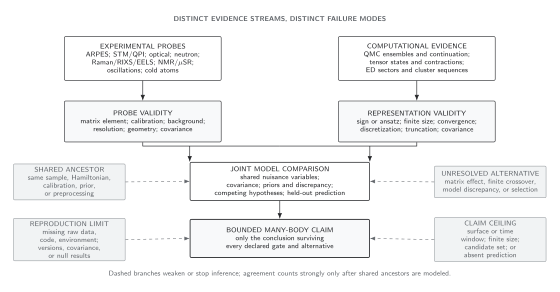
Tensor-network phase evidence. Energy variance, bond dimension, transfer length, cylinder geometry, contraction environment, competing initializations, and observable extrapolations accompany every phase diagnosis. Schematic.
Variational and contraction checks
Section titled “Variational and contraction checks”For a normalized variational state,
vanishes for an exact eigenstate. Energy, variance, discarded weight, local residuals, symmetry quantum numbers, and observables should be extrapolated separately; a tiny energy difference between phases is meaningful only after both states have comparable convergence quality. Distinct initial states and unit cells test metastable minima.
In two dimensions, cylinder circumference and length create different finite-size scales. Competing orders can be favored by wrapping vectors or pinning boundaries. PEPS adds an approximate contraction dimension distinct from the state bond dimension ; convergence in one at fixed inadequate value of the other is incomplete. Verstraete, Murg, and Cirac 2008 review the computational structure, and Cirac, Pérez-García, Schuch, and Verstraete 2021 summarize the modern structural theory.
Diagnosing order and topology
Section titled “Diagnosing order and topology”Local order requires order-parameter correlations and extrapolation in length, width, and representation. In a symmetry-preserving finite system, the one-point function of a symmetry-breaking order parameter vanishes unless a pinning or symmetry-selection protocol is declared; symmetry-invariant one-point observables need not vanish. A valence-bond pattern requires bond correlations and competing unit cells. A spin-liquid claim should test correlation lengths, symmetry, flux sectors, topological entanglement signatures, and nearby ordered ansätze rather than rely only on a featureless local expectation value.
Entanglement spectra and topological entanglement entropy are finite-geometry diagnostics with substantial subleading corrections. Modular transformations or minimally entangled states depend on isolating the correct ground-state manifold. A robust conclusion triangulates several quantities and tests perturbations and boundary conditions.
The probe and computation claim test matrix keeps or , environment dimension, geometry, symmetry implementation, optimization history, and held-out observables adjacent to the phase claim.
Exercise
Section titled “Exercise”Entanglement lower bound. A target bipartition has entropy . What necessary lower bound does this place on an exact MPS bond dimension?
Solution
Since , exact representation requires , hence integer . This is only necessary: the full Schmidt spectrum and all cuts can demand a larger bond dimension.
References
Section titled “References”- J. Ignacio Cirac, David Pérez-García, Norbert Schuch, and Frank Verstraete, “Matrix Product States and Projected Entangled Pair States: Concepts, Symmetries, Theorems,” Reviews of Modern Physics 93 (2021) 045003. DOI
- Frank Pollmann, Subroto Mukerjee, Ari M. Turner, and Joel E. Moore, “Theory of Finite-Entanglement Scaling at One-Dimensional Quantum Critical Points,” Physical Review Letters 102 (2009) 255701. DOI
- Luca Tagliacozzo, Thiago R. de Oliveira, Stefano Iblisdir, and José I. Latorre, “Scaling of Entanglement Support for Matrix Product States,” Physical Review B 78 (2008) 024410. DOI
- Frank Verstraete, Valentin Murg, and J. Ignacio Cirac, “Matrix Product States, Projected Entangled Pair States, and Variational Renormalization Group Methods for Quantum Spin Systems,” Advances in Physics 57 (2008) 143–224. DOI
- Steven R. White, “Density Matrix Formulation for Quantum Renormalization Groups,” Physical Review Letters 69 (1992) 2863–2866. DOI