

Finite-Dimensional Quantum Glass Dynamics and Evidence
Finite-dimensional quantum-glass evidence must distinguish equilibrium overlap order from aging during incomplete equilibration, Griffiths-like rare-cluster slowing, and a finite experimental observation window. No single cusp, stretched exponential, memory protocol, or annealing curve makes that distinction. The strongest inference comes from a common model fitted to static overlap-sensitive response, two-time dynamics, length or size scaling, bath dependence, and explicit alternatives.
Required background. Mean-field quantum spin glasses supplies overlap and replica-symmetry-breaking predictions. Rare regions and avalanches supplies the broad-relaxation alternative.
Helpful background. Evidence triangulation and reproducibility supplies the theory-to-data comparison standard.
Evidence cutoff. This research-sensitive comparison covers primary sources available through 10 August 2026. Later platform results, corrections, and supersession belong in the dated Quantum Matter and Emergence Research synthesis.
Static overlap and finite-size tests
Section titled “Static overlap and finite-size tests”For two replicas of the same disorder realization,
The disorder average distinguishes competing equilibrium scenarios only after equilibration and thermodynamic extrapolation. The spin-glass susceptibility
and the second-moment correlation length can be scaled across , temperature, and transverse field. A crossing that shifts with Monte Carlo time or population-annealing depth is not an equilibrium critical point.
The original validity diagram shows the inference boundary. Inspect the branch that separates a mean-field overlap structure from finite-dimensional equilibration and rare-region tests.
On a narrow screen, swipe or use the Left and Right arrow keys to pan across the figure. Home and End move to its edges. A full-size link is also available.
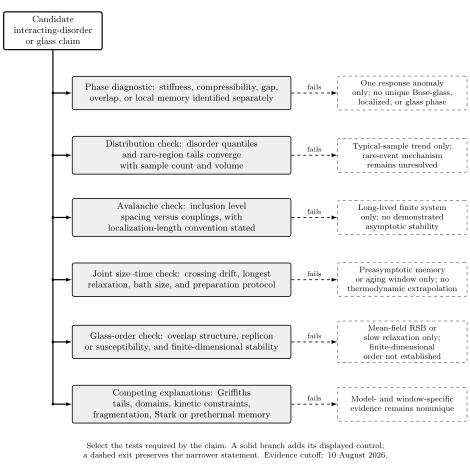
Glass evidence is a model-comparison problem. Static and two-time observables must share the same disorder, preparation, bath, and time-window description; slow response alone has a lower evidential ceiling than equilibrium overlap order. The diagram is schematic and not to scale.
Text description of this diagram · Figure data (JSON)
Aging, response, and memory
Section titled “Aging, response, and memory”After a quench, measure a two-time autocorrelation and response,
Equilibrium implies time-translation invariance and the fluctuation–dissipation relation. Aging means that relaxation depends on the waiting time ; memory and rejuvenation probe how the active length distribution changes under temperature or field cycling. These effects are characteristic of glasses but can also be produced by broad independent clusters, domain-wall pinning, or slow thermalization.
For a small longitudinal field, write . A growing nonlinear susceptibility is more directly overlap-sensitive than an ac cusp, but demagnetization, heating, sweep rate, and frequency window must enter the forward model. Experiments on dilute dipolar Ising magnets show how quantum tuning, hyperfine coupling, and long equilibration complicate this inference Ancona-Torres et al. 2008.
Comparing present platform claims
Section titled “Comparing present platform claims”Programmable systems can test sharply defined dynamical questions. A 5,000-qubit superconducting annealer exhibited quantum critical spin-glass dynamics and benchmarked small instances against Schrödinger evolution King et al. 2023. That supports the reported finite-time scaling in its programmed graph and open-device setting; it is not an equilibrium proof for a generic finite-dimensional closed magnet.
Likewise, direct visualization of replica-symmetry-breaking and ultrametric structure in a vector quantum-optical spin glass is a major model-specific result Kroeze et al. 2025. Its long-range, driven-dissipative cavity dynamics must not be silently transferred to a short-range equilibrium material.
For any finite-dimensional claim, compare at least:
- an RSB-like model with a nontrivial overlap distribution;
- a droplet/domain-growth model with a single growing length;
- a Griffiths or cluster model with a broad barrier distribution;
- a bath- and protocol-limited model with no thermodynamic transition.
Use the same likelihood, covariance, temperature calibration, history, and held-out protocols. A successful description of one frequency decade cannot establish the asymptotic state. The disorder and glass claim test matrix records this ceiling.
Exercise
Section titled “Exercise”Equilibrium response checkpoint. In equilibrium, for in a common classical normalization. Show that the integrated response satisfies .
Solution
Integrating the fluctuation–dissipation relation gives
A parametric plot of against therefore has slope in equilibrium. Waiting-time dependence or a different long-time slope diagnoses nonequilibrium response, but identifying its cause still requires the competing-model tests above.
References
Section titled “References”- C. Ancona-Torres, D. M. Silevitch, G. Aeppli, and Thomas F. Rosenbaum, “Quantum and Classical Glass Transitions in ,” Physical Review Letters 101 (2008) 057201. DOI
- Andrew D. King, Jack Raymond, Trevor Lanting, Richard Harris, Alex Zucca, Fabio Altomare, Andrew J. Berkley, Kelly Boothby, Sara Ejtemaee, Colin Enderud, Emile Hoskinson, Shuiyuan Huang, Eric Ladizinsky, Allison J. R. MacDonald, Gaelen Marsden, Reza Molavi, Travis Oh, Gabriel Poulin-Lamarre, Mauricio Reis, Chris Rich, Yuki Sato, Nicholas Tsai, Mark Volkmann, Jed D. Whittaker, Jason Yao, Anders W. Sandvik, and Mohammad H. Amin, “Quantum Critical Dynamics in a 5,000-Qubit Programmable Spin Glass,” Nature 617 (2023) 61–66. DOI
- Ronen M. Kroeze, Brendan P. Marsh, David Atri Schuller, Henry S. Hunt, Alexander N. Bourzutschky, Michael Winer, Sarang Gopalakrishnan, Jonathan Keeling, and Benjamin L. Lev, “Directly Observing Replica Symmetry Breaking in a Vector Quantum-Optical Spin Glass,” Science 389 (2025) 1122–1126. DOI