

Replica and Supersymmetry Methods for Disorder
Replica and boson–fermion supersymmetry methods represent normalized disorder averages by enlarged theories whose normalization can be handled algebraically. Replicas compute integer moments before a formal continuation; supersymmetry cancels determinants exactly at finite dimension but requires convergent bosonic contours. Neither device makes the disorder average exact when its saddle point, continuation, or gradient expansion is uncontrolled.
Required background. Quenched disorder fixes the order of thermal and disorder averages. Grassmann functional integrals and Gaussian fields and sources supply the determinant identities.
Replication and the zero-replica limit
Section titled “Replication and the zero-replica limit”For positive integers ,
The formal identity
requires an analytic continuation from positive integer to a neighborhood of zero. Integer moments do not by themselves guarantee that this continuation is unique. The method is therefore a representation plus a continuation assumption, not a theorem about every random system.
For static Gaussian potential disorder with covariance , completing the square gives
The minus sign belongs to the effective action, and the terms are essential: independent replicas become coupled only through the shared disorder. This is the basic construction used in spin-glass and localization theories; Mézard, Parisi, and Virasoro 1987, chs. 1–2 gives the classical replica framework and its continuation caveats.
The following original diagram shows where this representation enters. It is upstream of the diffusive saddle and must not be confused with the physical symmetry class of the Hamiltonian.
On a narrow screen, swipe or use the Left and Right arrow keys to pan across the figure. Home and End move to its edges. A full-size link is also available.
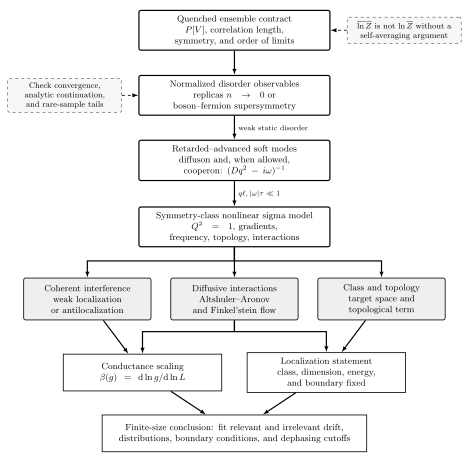
Two representations of the same normalized disorder average. Their auxiliary fields differ, while the physical Green functions and declared disorder ensemble must agree. The schematic does not assert that the replica continuation or a later saddle is exact.
Text description of this diagram · Figure data (JSON)
Supersymmetric normalization
Section titled “Supersymmetric normalization”For a finite Hermitian matrix and a retarded resolvent, a Grassmann integral represents while a convergent complex-boson integral represents its inverse. Combining equal bosonic and fermionic sectors makes the source-free partition function unity:
up to matched measure conventions. Sources differentiate to generate resolvents, so no random denominator remains. The sign of fixes the bosonic convergence contour; retarded–advanced products require both sectors and a noncompact bosonic manifold.
Efetov’s construction derives localization sigma models from this cancellation Efetov 1983, §§2–4. The benefit is an exact normalization at finite regulator. The cost is a graded integration domain whose boundaries and noncompact directions cannot be discarded casually.
Saddles, symmetry, and limits
Section titled “Saddles, symmetry, and limits”A saddle is selected only after specifying retarded/advanced content, symmetry class, frequency regulator, and disorder strength. Replica-symmetric saddles can be unstable in glass models, while replica symmetry breaking is an ansatz for a particular mean-field phase rather than an automatic consequence of taking . In supersymmetry, a vanishing partition function denominator does not eliminate rare saddles or invalidate boundary contributions.
The two methods should agree on regulator-independent observables where both are controlled. A useful finite-dimensional check is to average a small random matrix directly and compare its resolvent with both auxiliary representations before invoking a continuum saddle. Zirnbauer 1996 explains how symmetry and graded target spaces organize this comparison.
The canonical disorder and glass claim test matrix lists the continuation, contour, saddle, and finite-regulator checks required downstream.
Exercise
Section titled “Exercise”Recover the replica coupling. Take independent replica densities coupled to one Gaussian variable of variance : . Average and identify the cross-replica term.
Solution
The Gaussian identity with gives
Thus . The terms encode correlations caused by the common realization; omitting them would average independent disorder for each replica.
References
Section titled “References”- Konstantin B. Efetov, “Supersymmetry and Theory of Disordered Metals,” Advances in Physics 32 (1983) 53–127. DOI
- Marc Mézard, Giorgio Parisi, and Miguel A. Virasoro, Spin Glass Theory and Beyond, World Scientific, 1987. DOI
- Martin R. Zirnbauer, “Riemannian Symmetric Superspaces and Their Origin in Random-Matrix Theory,” Journal of Mathematical Physics 37 (1996) 4986–5018. DOI