

Phase Winding, Flux Quantization, and Josephson Effects
A superconducting ring and a Josephson junction use the same physical object: the phase of a charged pair field combined with electromagnetic parallel transport. On a closed contour this combination quantizes a fluxoid. Across a weak link it gives the phase that controls the supercurrent and whose time derivative measures voltage. Keeping one orientation and one signed-charge convention throughout exposes the factors of , the signs, and the assumptions behind the familiar relations.
The ideal results are precise but not interpretation-free. Magnetic screening separates flux from fluxoid; capacitance and dissipation determine the measured junction dynamics; and an apparent fractional periodicity is not unique evidence for a topological junction.
Required background. Gauge-invariant Meissner response fixes the charged stiffness and penetration depth. Vortices and topological defects supplies winding, core physics, and the condition under which a winding sector can change.
Helpful background. Parallel transport and holonomy clarifies why a phase difference becomes physical only after a connection is included.
The covariant pair phase fixes every sign
Section titled “The covariant pair phase fixes every sign”Let the electronic pair field be
Restoring , the site’s convention gives
The local gauge-invariant phase gradient is therefore
For an isotropic local phase-only theory,
Here is the pair-phase stiffness and is conventional charge current. This normalization agrees with the prerequisite relation ; replacing by an undefined “superfluid density” would hide both dimensions and charge factors.
Winding quantizes the fluxoid
Section titled “Winding quantizes the fluxoid”Choose an oriented closed contour lying in superconducting material and not crossing a core. Single-valuedness gives
Let use the surface orientation induced by . Substituting and then the current relation yields
Equivalently,
is the signed fluxoid. In the local London regime,
so the current coefficient is . Reversing the contour reverses , the oriented flux, and the current integral together. It does not change the positive flux-quantum spacing
With , negligible current gives the signed relation for the chosen winding convention; the experimentally relevant spacing is . This sign is physical orientation bookkeeping, not a second flux quantum.
The bare-flux limit requires a contour several penetration depths from every surface, so that the circulating current term is negligible. A thin wall, a narrow wire, finite penetration depth, or a film with Pearl electrodynamics can retain a large kinetic contribution. For a uniform ring of circumference and cross-section , define
If includes geometric self-inductance, the fluxoid condition becomes
Thus a ring may support metastable currents even when its magnetic flux is not exactly an integer multiple of . Changing requires the amplitude to vanish somewhere on a crossing path—a phase slip or vortex crossing—not a continuous deformation within the phase-only manifold. Tinkham 2004, §4.5.1, pp. 127–128 distinguishes flux from fluxoid; the charge- spacing was established in the classic ring experiments of Deaver and Fairbank 1961, pp. 43–46 and the gauge-periodicity argument of Byers and Yang 1961, pp. 46–49.
The figure freezes the orientation used in both the loop and junction derivations. Inspect which arrows reverse when the contour or endpoint order is reversed.
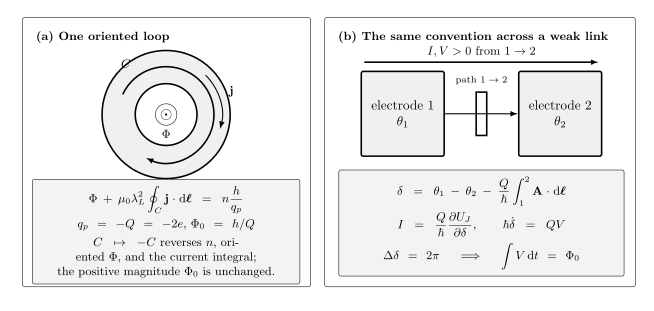
One signed-charge and orientation convention for loop and weak-link physics. The pair charge is ; reversing the loop orientation reverses every signed circulation but not . Across the junction, path, conventional current, and passive voltage point from electrode 1 to 2, giving and . A slip has voltage-pulse area . Original schematic, not to scale.
An oriented weak link has one physical phase
Section titled “An oriented weak link has one physical phase”Label the electrodes 1 and 2 and orient the path from 1 to 2. Define conventional current and passive electrochemical voltage drop as positive in that same direction. The gauge-invariant phase is
The endpoint gauge shifts cancel the shift of the line integral. Reversing the endpoints sends and leaves every prediction unchanged.
Gauge invariance makes the junction energy periodic under . For a time-reversal-symmetric junction without a spontaneous phase offset, its harmonic expansion is
and the nondissipative current is
An opaque tunnel barrier is dominated by pair transfer in the first harmonic:
High transparency, a long junction, several channels, broken time reversal, or unconventional electrodes can generate higher harmonics or a phase offset. The sine law is therefore a controlled leading limit, not the definition of a Josephson junction. For identical weak-coupling -wave superconductors in the low-transparency SIS limit, the stronger Ambegaokar–Baratoff check is
with the normal-state tunnel resistance Ambegaokar and Baratoff 1963, pp. 486–489 and erratum p. 104. It should not be applied unchanged to a transparent constriction or an anisotropic multiband junction.
Voltage turns phase into a clock
Section titled “Voltage turns phase into a clock”Let denote the gauge-invariant electrochemical voltage drop in the passive convention. The temporal covariant phase relation gives
At , a stationary phase can carry a dc supercurrent. At constant voltage,
The sign follows the chosen direction; the magnitude does not. Energy provides an independent convention check:
If the current and voltage formulas do not reproduce passive electrical power, their endpoint conventions are inconsistent. Josephson 1962, pp. 251–253 gives the original dc and ac predictions.
Two junctions convert phase into flux interference
Section titled “Two junctions convert phase into flux interference”In a dc SQUID, traverse the loop once and include both gauge-invariant junction phases. With consistent junction orientations, the loop condition can be written
where is the total loop flux. For sinusoidal junctions of critical currents and and negligible self-inductance,
Equal junctions give
whereas an asymmetric SQUID has a minimum , not a node. When
is not small, the self-flux must be solved together with the phase equations. Flux focusing, trapped vortices, finite junction area and its Fraunhofer envelope, and nonsinusoidal current–phase relations are distinct corrections. The first two-junction interference experiment is Jaklevic et al. 1964, pp. 159–160.
RCSJ dynamics, phase slips, and Shapiro locking
Section titled “RCSJ dynamics, phase slips, and Shapiro locking”The resistively and capacitively shunted junction model assumes a lumped junction with a spatially uniform phase, a sinusoidal supercurrent, a frequency-independent ohmic shunt , and a fixed capacitance . Kirchhoff’s law gives
or, using ,
The zero-bias plasma frequency and Stewart–McCumber parameter are
Large describes an underdamped junction and often produces hysteresis; small describes an overdamped junction. Heating, frequency-dependent environmental impedance, and a nonsinusoidal current relation can imitate or modify that classification. The equivalent tilted periodic potential is
Thermal activation or quantum tunnelling can move the phase between neighboring minima. Irrespective of the detailed escape mechanism, a completed slip obeys the exact pulse-area check
In a continuous superconducting ring, the analogous change of winding requires amplitude suppression or a vortex crossing. That topological event should not be conflated with every escape trajectory of a lumped RCSJ phase.
With a microwave drive of frequency , phase locking at average produces conventional Shapiro voltages
Stewart 1968, pp. 277–280 and McCumber 1968, pp. 3113–3118 establish the shunted-junction dynamics; Shapiro 1963, pp. 80–82 gives the driven locking effect.
What a 4π branch does—and does not—establish
Section titled “What a 4π branch does—and does not—establish”A protected crossing can produce a fixed-parity Andreev branch of the form
which is periodic when the system remains on one parity branch. The equilibrium spectrum is ordinarily periodic because relaxation can switch branches. Observing a dynamical contribution therefore requires a measurement window shorter than the parity-relaxation time, sufficiently adiabatic evolution relative to the protected continuum, and independent calibration of the conventional channels. Fu and Kane 2009, pp. 161408-1–161408-4 gives the parity-sensitive topological junction construction.
Quasiparticle poisoning usually destroys a parity-protected signal or produces branch switching; it is not itself evidence for physics. Conversely, high-transparency trivial Andreev levels can undergo Landau–Zener evolution and mimic dynamic behavior. Higher harmonics, nonlinear circuit response, heating, and frequency-dependent dissipation can also suppress selected Shapiro steps. Sau and Setiawan 2017, pp. 060501-1–060501-5 analyzes these low-frequency discriminants.
The strongest defensible conclusion from a fractional signal alone is therefore “nonstandard junction dynamics.” A topological conclusion additionally needs the bulk, nonlocal, parity-lifetime, and alternative-model tests developed on the Majorana evidence page.
The chapter-wide map places that limit on the conclusion beside the separate Migdal, crossover, symmetry, mechanism, and topology gates.
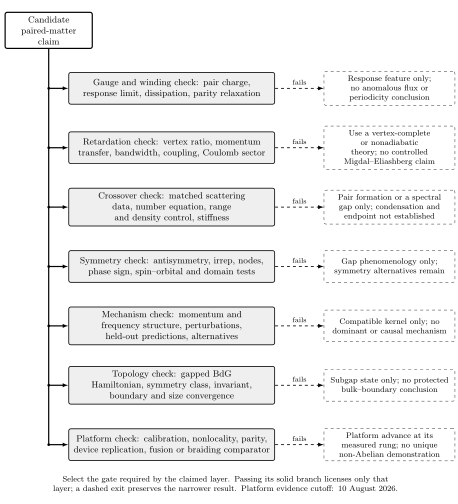
The gauge-and-winding branch licenses a flux or Josephson conclusion only after charge normalization, screening, circuit dynamics, and parity relaxation are fixed. Failure preserves the measured response feature but not an anomalous-flux or topological-periodicity interpretation. The other branches are independent claim-specific tests, not later stages of the Josephson derivation. Original schematic, not to scale.
The paired-matter claim test matrix supplies the semantic comparison with the other branches.
Common pitfalls
Section titled “Common pitfalls”Quantizing bare flux in every ring. Winding quantizes the fluxoid. Bare flux approaches an integer multiple of only when the contour current is negligible; kinetic inductance and screening can be essential.
Dropping the signed charge halfway through. The signed relation uses , while the positive spacing is . Mixing these statements creates an apparent sign contradiction.
Calling every junction sinusoidal. A single cosine is the leading tunnel limit. Transparency, length, channels, symmetry, and nonequilibrium occupations determine the actual current–phase relation.
Treating missing Shapiro steps as a topology measurement. A parity-protected branch is one hypothesis. Landau–Zener motion, conventional harmonics, heating, poisoning, and the environment must be tested independently.
Exercises
Section titled “Exercises”Ring inductance and orientation
Section titled “Ring inductance and orientation”A uniform ring has kinetic inductance , geometric inductance , and applied flux . Derive its allowed current in winding sector . Then reverse the contour orientation and verify that the physical current is unchanged.
Solution
The fluxoid and self-flux relations give
so
Reversing reverses the oriented quantities , , and the positive direction assigned to . The numerical component therefore changes sign, exactly because its basis direction changed; the physical current vector does not. The spacing between adjacent fluxoid sectors remains .
Asymmetric SQUID
Section titled “Asymmetric SQUID”Maximize subject to . Derive the critical current and its minimum.
Solution
Write and use :
The maximum of is . Hence
At half-integer flux, , so the minimum is . A true node requires equal junctions in addition to negligible self-inductance and sinusoidal current–phase relations.
Plasma oscillation and phase-slip area
Section titled “Plasma oscillation and phase-slip area”For a dc bias with , linearize the lossless RCSJ equation about a stable phase and find the plasma frequency. Then integrate the Josephson voltage relation through a slip.
Solution
The static phase satisfies . Put and keep terms linear in :
Since on the stable branch,
For the slip,
The pulse shape depends on damping and noise; its signed area follows only from the completed phase change.
References
Section titled “References”- Ambegaokar, V., and Baratoff, A. (1963). “Tunneling between superconductors.” Physical Review Letters 10, 486–489; erratum 11, 104. doi:10.1103/PhysRevLett.10.486.
- Byers, N., and Yang, C. N. (1961). “Theoretical considerations concerning quantized magnetic flux in superconducting cylinders.” Physical Review Letters 7, 46–49. doi:10.1103/PhysRevLett.7.46.
- Deaver, B. S., Jr., and Fairbank, W. M. (1961). “Experimental evidence for quantized flux in superconducting cylinders.” Physical Review Letters 7, 43–46. doi:10.1103/PhysRevLett.7.43.
- Fu, L., and Kane, C. L. (2009). “Josephson current and noise at a superconductor/quantum-spin-Hall-insulator/superconductor junction.” Physical Review B 79, 161408(R). doi:10.1103/PhysRevB.79.161408.
- Jaklevic, R. C., Lambe, J., Silver, A. H., and Mercereau, J. E. (1964). “Quantum interference effects in Josephson tunneling.” Physical Review Letters 12, 159–160. doi:10.1103/PhysRevLett.12.159.
- Josephson, B. D. (1962). “Possible new effects in superconductive tunnelling.” Physics Letters 1, 251–253. doi:10.1016/0031-9163(62)91369-0.
- McCumber, D. E. (1968). “Effect of ac impedance on dc voltage-current characteristics of superconductor weak-link junctions.” Journal of Applied Physics 39, 3113–3118. doi:10.1063/1.1656743.
- Sau, J. D., and Setiawan, F. (2017). “Detecting topological superconductivity using low-frequency doubled Shapiro steps.” Physical Review B 95, 060501(R). doi:10.1103/PhysRevB.95.060501.
- Shapiro, S. (1963). “Josephson currents in superconducting tunneling: The effect of microwaves and other observations.” Physical Review Letters 11, 80–82. doi:10.1103/PhysRevLett.11.80.
- Stewart, W. C. (1968). “Current-voltage characteristics of Josephson junctions.” Applied Physics Letters 12, 277–280. doi:10.1063/1.1651991.
- Tinkham, M. (2004). Introduction to Superconductivity, 2nd ed. Dover. Publisher record.