

Fermi-Liquid Response and Zero Sound
In a neutral or screened three-dimensional Fermi liquid, the same forward-scattering parameters that set the equilibrium compressibility and spin susceptibility also reshape the dynamical particle–hole response. A sufficiently repulsive density interaction pulls a collective pole above the particle–hole continuum: zero sound. The result is simple only after the route toward , the response convention, and the collision hierarchy have all been specified.
Required background. Use Landau theory for the quasiparticle interaction and total-density-of-states convention, and the Kubo-response framework for retarded correlators. Helpful background. The Ward-consistent response and diffusion, conductivity, and susceptibility pages explain why conservation laws distinguish the limits below.
Four paths to the origin give four observables
Section titled “Four paths to the origin give four observables”Assume an isotropic, spin-rotation-invariant normal Fermi liquid at low temperature. Let be the total two-spin quasiparticle density of states at the Fermi surface, the quasiparticle Fermi velocity, and the relaxation time of the nonconserved angular distortions relevant to the longitudinal mode. The small-, small- plane contains several physically different experiments:
| Probe | Limiting path or hierarchy | Leading density result |
|---|---|---|
| Equilibrium compression | before | |
| Spatially uniform drive | at nonzero | by number conservation |
| Collisionless ray | at fixed and | Particle–hole continuum and possible zero-sound pole |
| Hydrodynamic ray | with | First sound in a clean neutral fluid |
Thus zero sound is neither of the two iterated limits. At any fixed nonzero temperature, taking along eventually makes ; the strict infrared mode is then hydrodynamic. The collisionless limit instead keeps
with . One may reach this window by lowering the temperature before taking the long-wavelength limit.
The two panels below separate collisionless spectral kinematics from the paths used to approach the origin. In panel (a), inspect the narrow gap between the one-pair edge and the zero-sound ray. In panel (b), notice that at fixed finite the collisionless route stops before the crossover, whereas the hydrodynamic route reaches the origin.
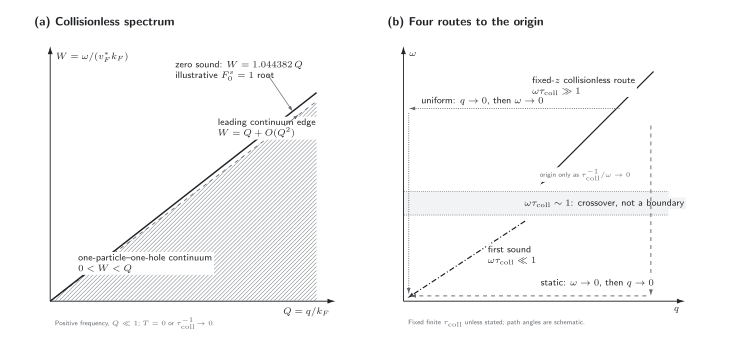
Small- response of a neutral or statically screened, isotropic three-dimensional Fermi liquid. The hatched region in panel (a) is the leading collisionless one-particle–one-hole continuum, ; the displayed zero-sound root is and lies just above its edge. More generally, the -only kernel has a separated real root for in the collisionless hierarchy . Panel (b) shows why static, uniform, collisionless, and hydrodynamic approaches to are inequivalent. First sound belongs to and is not a pole of the collisionless kernel; its possible location inside the collisionless one-pair wedge does not by itself imply collisionless Landau damping. The figure is schematic apart from the equation-checked slope ratio in panel (a), and it omits recoil, thermal and multipair broadening, lattice anisotropy, and the unscreened Coulomb plasmon.
Hatching denotes continuum support, the heavy solid ray denotes zero sound, dash–dot denotes first sound, and the pale dotted band denotes a collision crossover rather than a phase boundary. The downloadable SVG and machine-readable semantic record preserve the visual and scientific distinctions.
The chapter comparison states the assumptions behind the principal Fermi-liquid formulas and places this response calculation among its microscopic inputs and instabilities.
Sources and static response fix the signs
Section titled “Sources and static response fix the signs”Define density and spin-number channels by
and couple sources through
With the site’s convention
the physical response is . This minus sign is worth making explicit: the static physical response is positive. In the total-DOS convention,
If and , then . A convention using instead has the corresponding factor of . The divergences at and mark density and ferromagnetic Pomeranchuk instabilities, respectively. These thermodynamic relations follow from varying the Landau energy functional; see Dupuis 2025, § 4.2.2–4.2.3, pp. 296–297.
The kinetic equation transports a surface deformation
Section titled “The kinetic equation transports a surface deformation”Choose as the polar axis, write , and parametrize a Fermi-surface displacement by
The dimensionless Landau functions are
Keeping only is a solvable truncation, not a claim that higher harmonics vanish in a real liquid. In this model the quasiparticle-energy shift is
The linearized Landau–Boltzmann equation is
Dropping its collision integral in the hierarchy above reduces it to one equation per channel,
This equation says something geometrically simple: quasiparticles with velocity component stream the angular distortion, while the mean field tries to make the whole Fermi surface move coherently. Landau’s original derivation proceeds from the full kinetic equation to this angular eigenproblem in Landau 1957, printed pp. 102–103, Eqs. (4)–(14).
The angular integral exposes the continuum and the pole
Section titled “The angular integral exposes the continuum and the pole”Solving for and averaging once gives
where
The retarded logarithm is analytic for and is real for . Since , the correlator and physical response are
Two immediate checks recover the first table: gives the static susceptibility, whereas makes the uniform finite-frequency density response vanish.
For , the upper rim of the retarded branch cut is
This cut is the linearized particle–hole continuum, at positive frequency. The leading edge is universal at small , but its correction depends on the curvature of the quasiparticle dispersion; for a strictly quadratic dispersion it is . The Lindhard-response page displays this recoil explicitly. At and positive frequency, use the same spectral normalization as that page:
The continuum weight is manifestly positive:
At fixed , a density probe therefore sees a broad particle–hole continuum plus, when it is separated, the sharp collective peak derived next. At finite temperature, remains the spectral density, but the unsymmetrized structure factor contains detailed balance:
The response function, continuum, and collective contribution are derived together in Dupuis 2025, § 4.3.4.1, printed pp. 305–307, Eqs. (4.100)–(4.108).
The zero-sound pole has a computable residue
Section titled “The zero-sound pole has a computable residue”A source-free density oscillation requires the denominator to vanish:
For every , decreases monotonically from at to at infinity, so there is one real root above the one-pair continuum. It is undamped only within the collisionless, linearized, single-pair theory. Collisions, thermally excited quasiparticles, multipair states, and finite- curvature can all broaden or obscure it.
The pole’s weight is not determined by its speed. Since
the pole part of the correlator is
with positive collective-response residue
This derivative formula is the long-wavelength form of Dupuis 2025, printed pp. 306–307, Eq. (4.108).
This is not the one-particle quasiparticle residue conventionally called . At and positive frequency the pole contributes
For example, gives
The limiting forms provide strong diagnostic checks:
At weak coupling the pole exists but is exponentially close to the continuum and has exponentially small weight. Resolving it requires the separation to exceed collision broadening, thermal smearing, and the recoil correction. Landau 1957, printed pp. 103–104 and Dupuis 2025, p. 302, Eqs. (4.83)–(4.84) give the pole equation and leading weak- and strong-coupling limits; the subleading above follows by expanding the same equation one order further.
For a stable attractive channel, , there is no separated real pole above the continuum in this truncation. Any pole obtained by continuing through the branch cut lies on an unphysical sheet and is damped; it must not be described as a real undamped mode “inside” the continuum. At , an upper-half-plane mode instead diagnoses instability of the assumed normal state. See Dupuis 2025, § 4.3.3.1, printed p. 302.
Spin modes and higher harmonics change the eigenproblem
Section titled “Spin modes and higher harmonics change the eigenproblem”In an exactly spin-rotation-invariant liquid, the same derivation applies to the spin-number response after . An undamped -only spin-zero-sound pole therefore requires . The common range enhances the static spin response but leaves the collective feature in the particle–hole continuum; approaches a ferromagnetic instability. Spin–orbit, dipolar, and other spin-relaxation processes add decay, and the hydrodynamic spin mode is generally diffusive rather than ordinary first sound. Landau gives the corresponding spin kinetic equation in Landau 1957, printed p. 107, Eqs. (25)–(29).
When is retained, must be expanded in angular harmonics and the kinetic equation becomes a matrix eigenvalue problem. Higher harmonics can shift the mode speed, redistribute spectral weight, and create additional angular collective modes. The one-line pole equation is then no longer the complete dispersion relation.
Conservation requires the matching current vertex
Section titled “Conservation requires the matching current vertex”At large , the response has
so
The explicit verifies that a spatially uniform scalar drive cannot change a conserved total particle number. For a spherical Fermi surface, however, the displayed coefficient is . A Galilean-invariant system must instead have and obey
The missing factor is supplied by the current vertex and quasiparticle backflow. The Galilean Ward identity
restores the bare-mass coefficient. Thus the model is a controlled illustration of the density pole, but it is not a complete Galilean-invariant current response when . On a lattice, the corresponding optical or stress sum rule replaces , and interband or incoherent weight may be essential. The Ward-response page develops this vertex logic in general.
Collisions turn zero sound into first sound
Section titled “Collisions turn zero sound into first sound”The collisionless equation discarded from the Landau–Boltzmann equation. In a clean neutral fluid, a usable collision operator must conserve particle number, momentum, and energy:
A naive replacement does not enforce these constraints and cannot be trusted to produce the hydrodynamic limit. A relaxation-time model must project out the local-equilibrium density, momentum, and energy modes. This issue is explicit in Abrikosov and Khalatnikov 1958, § 9, printed p. 79.
When , collisions establish local equilibrium and the longitudinal density mode becomes first sound. Its speed is , where is the adiabatic compressibility. Using the thermodynamic coefficients of a clean, neutral, Galilean-invariant liquid—while retaining a small nonzero temperature or another momentum-conserving equilibration mechanism so that the hydrodynamic hierarchy still holds—gives
and, before dissipative corrections,
At strictly in a clean normal Fermi liquid, and this hydrodynamic window closes; is the hydrodynamic extrapolation.
First and zero sound solve different eigenproblems, so their speeds need not agree. For example, and give
There is no contradiction in the first-sound speed lying inside the collisionless one-pair wedge: frequent collisions have already reorganized the dynamics into local equilibrium, and hydrodynamic attenuation is controlled by transport coefficients rather than collisionless Landau damping.
Viscosity and thermal conduction add sound attenuation. The intermediate regime is often strongly damped and requires the full collision integral. The relevant angular-harmonic relaxation rates scale as at low temperature, with probe-frequency corrections of order and channel-dependent coefficients; they need not equal the on-shell one-particle lifetime. Cooling at fixed probe frequency can therefore drive first sound into zero sound, although pairing may intervene first. Landau 1957, printed p. 105 separates the hydrodynamic, crossover, and collisionless regimes, while Dupuis 2025, § 4.3.3.2, printed pp. 303–304 gives the first-sound speed in the present convention.
Where the acoustic pole survives
Section titled “Where the acoustic pole survives”The derivation above assumes short-range or statically screened interactions, a smooth three-dimensional Fermi surface, a normal state, and a probe inside the Landau window. Several changes alter the conclusion:
- In a three-dimensional charged fluid with unscreened Coulomb interactions, the longitudinal density oscillation is lifted to a gapped plasmon; see Silin 1959, printed p. 872, Eqs. (18)–(20) and the plasmon page. In two dimensions with three-dimensional Coulomb fields, the long-wavelength plasmon instead scales as .
- On a lattice, momentum relaxation, Umklapp, and anisotropy can make the hydrodynamic density mode diffusive and turn the angular equation into a Fermi-surface integral rather than a Legendre problem.
- At finite temperature or disorder, a collisionless pole must be separated from both the continuum and its finite width. “Above the continuum” is not by itself an experimental visibility criterion.
- Near pairing, density-wave, or Pomeranchuk instabilities, the normal-state Landau parameters and collision kernel acquire strong scale dependence; the assumed normal Fermi liquid may fail before the formal pole is reached.
Common pitfalls
Section titled “Common pitfalls”Taking limits without naming the path. Compressibility, a uniform dynamic response, zero sound, and first sound approach the same origin in the plane but are not interchangeable. State the order of limits and the size of before interpreting a formula.
Calling every denominator zero an undamped mode. A real pole on the physical sheet above the one-pair continuum is different from a resonance reached through a branch cut. Also compare its separation and residue with all sources of broadening.
Using when the theory needs . The kinetic equation transports quasiparticles, so its velocity is the interacting Fermi velocity. The bare mass reappears in a Galilean sum rule only after the matching current vertex and backflow are included.
Adding without conserving slow densities. This shortcut can erase the hydrodynamic zero modes of the collision operator. Projecting out the conserved local-equilibrium distortions is part of the approximation, not an optional refinement.
Exercises
Section titled “Exercises”- Starting from , derive the response . Check both iterated limits at the origin.
Solution
Solve for the angular distortion and average:
Therefore and . For first, and , giving . For at fixed nonzero , and , giving .
- Derive the weak- and strong-coupling limits of the zero-sound speed through the first nontrivial term.
Solution
For with ,
Setting gives . For , use
Writing in yields .
- For , verify the quoted speed and residue numerically, and explain why the residue is positive.
Solution
Solving for gives . At this point , so
The sign is also required by the positive-frequency spectral weight
- Show why an -only model with misses the Galilean density -sum coefficient, and identify the missing ingredient.
Solution
At large , the model gives
The Galilean commutator sum rule requires . The interaction dresses the current through quasiparticle backflow; using restores the required bare-mass coefficient and hence the -sum rule.
- Take , , and . Classify the response when (a) and (b) . In case (b), use as a broadening estimate and decide whether the zero-sound peak is cleanly separated from the continuum.
Solution
In case (a), the first-sound estimate gives
The probe is hydrodynamic, so first sound is the appropriate mode. In case (b), the collisionless zero-sound root gives
so the kinetic regime is collisionless. Nevertheless, its separation from the leading continuum edge is only
whereas the assumed broadening scale is . The response can satisfy without showing a cleanly resolved peak; regime classification and experimental visibility are separate tests.
Continue
Section titled “Continue”- Return to Landau theory for thermodynamics and stability.
- Compare the free particle–hole continuum on the Lindhard-response page.
- Connect the phenomenological parameters to the microscopic quasiparticle self-energy.
- Continue to plasmons and collective charge modes or to ideal hydrodynamic modes.
References
Section titled “References”- A. A. Abrikosov and I. M. Khalatnikov, “Theory of the Fermi Fluid (The Properties of Liquid He³ at Low Temperatures),” Soviet Physics Uspekhi 1, 68–90 (1958), doi:10.1070/PU1958v001n01ABEH003086, Open PDF.
- Nicolas Dupuis, Field Theory of Condensed Matter and Ultracold Gases, Vol. 1 (World Scientific, 2023), ch. 4; updated chapter PDF, January 16, 2025, doi:10.1142/q0409, author PDF.
- L. D. Landau, “Oscillations in a Fermi Liquid,” Soviet Physics JETP 5, 101–108 (1957), official article, official PDF.
- V. P. Silin, “The Oscillations of a Degenerate Electron Fluid,” Soviet Physics JETP 8, 870–875 (1959), official PDF.
Further reading
Section titled “Further reading”- Gordon Baym and Christopher Pethick, Landau Fermi-Liquid Theory: Concepts and Applications, Wiley, New York (1991), ch. 1, doi:10.1002/9783527617159.