

Long-Range, Dipolar, and Molecular Quantum Gases
Long-range quantum gases are controlled by more than an interaction tail. Dipole orientation, short-distance regularization, transverse confinement, molecular internal states, shielding, loss, and the preparation protocol determine the effective Hamiltonian. A roton minimum, density modulation, self-bound cloud, or condensate fraction is then an observable-specific statement rather than an automatic phase identification.
Required background. Ultracold platforms, scales, and traps supplies density, confinement, LDA, loss, and observation scales. Beyond-Bogoliubov dilute-gas expansion supplies the fluctuation expansion and its gas-parameter limit.
Helpful background. Self-bound quantum droplets develops fluctuation stabilization and finite-droplet diagnostics.
Dipolar interaction and momentum-space stability
Section titled “Dipolar interaction and momentum-space stability”For identical polarized dipoles aligned along unit vector ,
The singular expression is a long-distance potential; its distributional contact part and short-range boundary condition must be matched consistently. Define
In a homogeneous three-dimensional convention with the contact piece assigned as above,
The Bogoliubov spectrum is
At long wavelength the most attractive direction has , so the uniform mean-field gas requires . This criterion is not a universal collapse boundary: confinement changes the momentum dependence, fluctuations shift stability, losses alter the sampled density, and a finite trap can support metastable states. Lahaye et al. 2009, §§2–5 review these Fourier, geometry, and stability conventions.
In quasi-two-dimensional confinement, integrating over a transverse oscillator wave function gives
where the nonconstant form factor can soften a finite wave number and create a roton minimum. The roton condition is therefore found from the complete confined dispersion, not from alone.
The validity diagram separates this Hamiltonian construction from the phase claim. Inspect the loss branch: shielding that lengthens lifetime changes the collision problem and must be included in the same effective interaction used to interpret the state.
On a narrow screen, swipe or use the Left and Right arrow keys to pan across the figure. Home and End move to its edges. A full-size link is also available.
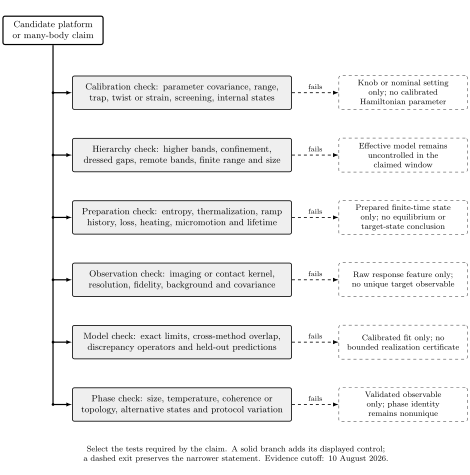
Validity map for dipolar and molecular gases. A calibrated anisotropic interaction can support a roton or instability calculation, but phase identification additionally requires equilibrium, coherence, finite-size, loss, and observation controls. Original schematic, not to scale; platform evidence is bounded through 10 August 2026.
Text description of this diagram · Figure data (JSON)
Fluctuation stabilization and its boundary
Section titled “Fluctuation stabilization and its boundary”For a dilute dipolar Bose gas, a local-density Lee–Huang–Yang correction is often written
where is an angular average of the Bogoliubov branches in the chosen stable continuation. Lima and Pelster 2011, main text derive the dipolar fluctuation correction in the homogeneous dilute regime. The control parameter is , together with a separation between the healing, confinement, range, and droplet-surface scales. Near a mean-field instability, simply retaining the real part of a formally complex local expression is a modeling prescription, not a derivation. Nonlocal fluctuation terms, finite-range physics, three-body correlations, and density-dependent losses can compete.
A self-bound droplet requires negative bulk pressure balanced by repulsive corrections and positive surface energy; the fluctuation-stabilized mixture mechanism of Petrov 2015, main text provides a clean example of this balance outside the dipolar setting. A density-modulated supersolid requires both translational order and global phase coherence. A single in-situ modulation can also arise from trap modes, interference, fragmentation, or imaging transfer; a long-lived compact cloud can be dynamically arrested rather than an equilibrium droplet.
Molecules, internal states, and present evidence
Section titled “Molecules, internal states, and present evidence”Polar molecules add rotational and hyperfine states. Microwave or electric dressing can generate a tunable effective dipole while suppressing short-range loss, but the effective interaction depends on detunings, Rabi frequencies, polarization impurities, avoided crossings, and collision energy. A scalar is insufficient when several dressed channels are nearby.
Shi et al. 2026, main text and Methods reported Bose–Einstein condensation of ground-state sodium–rubidium molecules under dual microwave shielding, together with tunable dipolar behavior and a gas-to-droplet observation. The experiment establishes a platform and bounded observables; it does not by itself certify every equilibrium phase assignment in other species, dimensionalities, or dressing regimes. Condensate number, lifetime, expansion dynamics, internal-state purity, and interaction calibration remain part of the claim.
The source and platform assessment here is current through 10 August 2026. Later lifetime records, molecular phase evidence, revised collision models, and corrections belong in the Quantum Matter and Emergence Research synthesis. The canonical cold-atom and synthetic-matter claim test matrix places interaction, scale hierarchy, preparation, resolution, loss, discrepancy, and limit on the conclusion together. A reproducible verification workflow propagates these quantities through a selected stability or observable calculation.
Exercise
Section titled “Exercise”Angular stability of a homogeneous dipolar gas. For with , find its minimum over and the long-wavelength mean-field stability condition. What changes if the polarization is tilted in a quasi-two-dimensional trap?
Solution
Since ranges from at to at , for the minimum is
The sound-speed squared in that direction is proportional to , so the homogeneous long-wavelength mean-field condition is . With transverse confinement and tilt, the effective interaction contains a momentum-dependent form factor and in-plane angular dependence. The first unstable mode can occur at finite and depends on , tilt, contact coupling, and density; the three-dimensional criterion is no longer sufficient.
References
Section titled “References”- Lahaye, T., Menotti, C., Santos, L., Lewenstein, M., and Pfau, T. (2009). “The physics of dipolar bosonic quantum gases.” Reports on Progress in Physics 72, 126401. doi:10.1088/0034-4885/72/12/126401.
- Lima, A. R. P., and Pelster, A. (2011). “Quantum fluctuations in dipolar Bose gases.” Physical Review A 84, 041604(R). doi:10.1103/PhysRevA.84.041604.
- Petrov, D. S. (2015). “Quantum mechanical stabilization of a collapsing Bose–Bose mixture.” Physical Review Letters 115, 155302. doi:10.1103/PhysRevLett.115.155302.
- Shi, Z., Huang, Z., Deng, F., Jin, W.-J., Yi, S., Shi, T., and Wang, D. (2026). “Bose–Einstein condensate of ultracold sodium–rubidium molecules with tunable dipolar interactions.” Nature Physics, published 9 July 2026. doi:10.1038/s41567-026-03362-9.