

Unconventional Pairing Mechanisms and Competing Evidence
A pairing mechanism is a model-qualified causal account of which part of the particle-particle irreducible vertex drives pair formation in a stated material and regime. The measured gap symmetry constrains that vertex, but it does not identify a unique cause: distinct interactions can favor the same symmetry, and one interaction can favor different symmetries on different Fermi surfaces. Nor must the interaction that forms pairs alone determine the observed ; phase stiffness, disorder, dimensionality, and competing order can set a lower coherence scale.
Required background. Pairing symmetry diagnostics establishes what the order parameter does. Eliashberg theory supplies a controlled example of a frequency-dependent pairing problem.
Helpful background. Evidence triangulation explains conditional independence and shared covariance. Model selection and parameter inference supplies the likelihood language used below.
Evidence cutoff. The scientific examples and status assessment include sources public through 23 August 2026. Later measurements, corrections, and withdrawals must be re-evaluated rather than appended as extra votes.
The linearized particle-particle problem
Section titled “The linearized particle-particle problem”Write for momentum and fermionic Matsubara frequency. For a homogeneous, zero-center-of-mass instability in one chosen single-particle basis, let Greek indices collect the retained internal labels—for example spin and orbital, or band and pseudospin after projection. A matrix form of the linearized gap equation is
Here is the normal-state dressed propagator, is the antisymmetrized particle-particle irreducible vertex in a declared sign convention, and repeated ordered internal indices are summed. The factor removes the double count of the antisymmetric pair and ; in a basis of independent antisymmetric pair channels that factor is conventionally absorbed into the vertex. On a lattice, is the number of sampled momenta; in the continuum it is replaced by the chosen integration measure. Fermionic antisymmetry requires
With the normalization above, the normal state first becomes unstable when
The leading eigenfunction is therefore a prediction conditional on the adopted , vertex, basis, cutoff, and numerical approximation. It is not a mechanism certificate. If symmetry makes several leading eigenfunctions exactly degenerate, the quadratic problem identifies their degenerate subspace; quartic terms and fluctuations then decide whether the combination is real—often nematic—or complex and time-reversal breaking. If the eigenvalues are only close, the largest one selects the first instability; the remaining quadratic splitting and the quartic couplings determine whether a second component appears in a lower-temperature transition. Scalapino 2012, §§ II–V and Appendix, pp. 1384–1412 develops this connection between momentum-dependent vertices and pairing eigenfunctions.
A two-patch model makes the sign logic transparent. Let two Fermi-surface patches be connected by , let be repulsive scattering between them, and let denote their equal pair susceptibility. Then
The same-sign vector has eigenvalue , whereas the sign-changing vector has eigenvalue . The interaction has not become attractive. Rather, its repulsive transfer at , together with the minus sign in the gap equation, contributes constructively when . Reproducing that sign structure establishes compatibility with this projected kernel, not that spin fluctuations or any other named mediator are uniquely responsible.
Mechanism labels require a declared decomposition
Section titled “Mechanism labels require a declared decomposition”The full vertex is the object entering the eigenproblem; a label such as “spin glue” describes a decomposition of that vertex. An exact Fierz rearrangement can rewrite one four-fermion interaction in different bilinear channels. Parquet and renormalization-group flows transfer spectral weight among crossed particle-particle and particle-hole channels as the scale changes. Downfolding changes the retained orbitals, screening, and cutoff. Consequently, a percentage assigned to “spin,” “charge,” or “orbital” pairing is meaningful only after fixing the low-energy Hamiltonian, basis, scale, diagram set, and double-counting prescription. Metzner et al. 2012, §§ II–IV explains scale-dependent competing channels, while Chang et al. 2024, pp. 1–12 demonstrates the basis, screening, and double-counting sensitivity of downfolded interactions.
The first compact comparison records what each label means before data are fitted.
| Candidate | Kernel signature | Conditional gap tendency | Control and double-counting question |
|---|---|---|---|
| Phonon | Lattice propagator and electron–phonon matrix element, schematically in a stated convention | Often even parity; anisotropic or forward-focused coupling can produce strongly anisotropic gaps and can assist a sign-changing state | Are Coulomb screening, anharmonicity, nonadiabaticity, multiband structure, and the same phonon contribution to the self-energy treated consistently? |
| Spin fluctuation | Spin-dependent electronic vertex, often enhanced near a wavevector | Repulsive singlet scattering at favors a sign reversal between strongly connected regions; triplet factors and favored harmonics differ | Does the calculation reproduce normal-state , its spectral weight, and feedback below without omitting important vertex corrections? |
| Charge or nematic fluctuation | Density or multipolar susceptibility, at finite wavevector for charge order or often small wavevector for nematicity | Can enhance several symmetry channels; the momentum form factor, not the word “charge,” selects the gap | Does the same incipient order reconstruct the Fermi surface, remove spectral weight, or compete with superconductivity? |
| Orbital or multipolar fluctuation | Matrix vertex in a chosen local-orbital basis | May favor same-sign or sign-changing multiband states depending on orbital content and vertices | Is the orbital basis stated, and is this contribution already contained in the charge channel or in a vertex-corrected electronic interaction? |
| Exciton or plasmon | Interband electron-hole polarization or a collective pole of the screened Coulomb interaction | Retarded electronic attraction is possible in restricted geometries and scale hierarchies | Is it distinct from the charge-screening calculation, and are Landau damping, Coulomb repulsion, and the low-energy validity window controlled? |
| Mixed channels | Coupled phonon and electronic vertices, including cross effects in and | Cooperation can enhance ; competition can suppress it or rotate the leading eigenfunction | Were all channels solved in one convention, rather than adding separately fitted eigenvalues or counting the same screening process twice? |
Phonon pairing is therefore not synonymous with an isotropic -wave gap, and a sign-changing gap is not by itself proof of spin exchange. Giustino 2017, § XI, pp. 015003-47–015003-49 reviews anisotropic electron–phonon and Migdal–Eliashberg calculations. Monthoux, Pines, and Lonzarich 2007, pp. 1177–1183 and Scalapino 2012, §§ II–V give the magnetic comparison. The orbital proposal in Tazai et al. 2016, pp. 115155-1–115155-9 depends strongly on electron-boson vertex corrections and should be presented as a model result, not a material identification. “Excitonic pairing” in Allender, Bray, and Bardeen 1973, pp. 1020–1029 means virtual interband electron-hole excitations; it must not be confused with the spin-exciton resonance that can appear after superconductivity forms.
Retardation, vertices, and competing order
Section titled “Retardation, vertices, and competing order”Retardation is not unique to phonons. Any dynamic phonon, spin, charge, nematic, orbital, excitonic, or plasmonic mode gives a frequency-dependent kernel. What differs is the available control. Conventional Migdal–Eliashberg theory relies on an adiabatic or related kinematic hierarchy that suppresses selected electron–phonon vertex corrections. Low carrier density, comparable boson and Fermi energies, strong forward scattering, or strong coupling can invalidate a naïve estimate. The Migdal-validity analysis states those tests explicitly. Quantum-critical electronic modes often have no direct analogue of the phonon mass hierarchy; an Eliashberg-like treatment then needs a separate large-, patch, dimensional, numerical, or other controlled limit.
The same mode enters both the pairing vertex and the normal self-energy. Increasing its spectral weight can strengthen the anomalous kernel while also reducing quasiparticle coherence. The instantaneous and retarded Coulomb pieces must be matched at a declared scale; importing a Coulomb pseudopotential from one model into another can count screening twice. These issues are especially sharp in dilute SrTiO, where phonon, plasmon, ferroelectric, and defect proposals occupy overlapping frequency windows Gastiasoro, Ruhman, and Fernandes 2020, §§ 4–5.
Finally, an observed mode below may be an effect of superconductivity rather than its prior cause. A neutron spin resonance can be a spin exciton pulled below a gapped continuum by superconducting coherence factors; it supports a structured interaction and can constrain gap sign, but its existence alone does not show that the same mode created the pairs Eschrig 2006, §§ 2–4. Likewise, approaching a charge, magnetic, or nematic transition can soften fluctuations while the associated static order reconstructs the Fermi surface and competes for the same low-energy states. A dome beside an ordered phase is therefore a hypothesis generator, not a causal test.
Observables and their limits of interpretation
Section titled “Observables and their limits of interpretation”For isotope substitution, define the partial isotope exponent of species by
The textbook value follows only in a harmonic, effectively one-scale weak-coupling limit with mass-independent electronic parameters. The second compact table maps common observables to both discriminating information and failure modes.
| Observable or intervention | Discriminating prediction | Shared nuisance or covariance | Strongest licensed conclusion |
|---|---|---|---|
| Isotope substitution | Correlated shift of a lattice mode, electronic self-energy feature, gap, and | Exchange fraction, stoichiometry, zero-point structural shift, volume, disorder, anharmonicity, Coulomb matching, and multiband redistribution | A null or inverse exponent can reject a specified harmonic model, not phonons as a class; a positive exponent shows lattice involvement, not dominance |
| Controlled disorder | Pair-breaking curve versus calibrated magnetic or nonmagnetic, intra- or interband scattering | Defect annealing, phase shift, carrier-density and strain changes, local moments, spatial inhomogeneity | Suppression can constrain gap sign and anisotropy; it rarely identifies a unique mediator |
| Pressure or strain | Co-evolution of , gap, candidate spectrum, Fermi surface, and competing order | Several band, lattice, magnetic, and charge parameters move together; phase coexistence and first-order jumps | A dome or coincident anomaly is insufficient unless alternatives predict a different full response |
| Gap magnitude or phase | Momentum dependence, nodes, relative signs, and near-degenerate components | Surface selection, junction orientation, tunnelling matrix elements, domains, reconstruction, and resolution | Agreement licenses an eigenfunction or symmetry claim, not a microscopic mechanism |
| Spectroscopy | A common momentum- and frequency-dependent interaction accounts for neutron, Raman, ARPES, tunnelling, or optical responses and the electronic self-energy | Background subtraction, matrix elements, analytic continuation, resolution, shared samples, and nonunique inversion | One kink, replica, resonance, or fitted peak establishes neither pairing relevance nor causation |
The isotope caveat is concrete rather than philosophical: anharmonic phonons produce the inverse isotope effect of palladium hydrides even though the calculated pairing is phonon mediated Errea, Calandra, and Mauri 2013, pp. 177002-1–177002-5. The Anderson theorem protects an ideal isotropic -wave state from nonmagnetic elastic disorder; it does not generally protect anisotropic gaps or sign-changing multiband states. Chemical substitution, irradiation, and native defects are not interchangeable because their carrier, structural, magnetic, and scattering changes differ Hirschfeld 2016, pp. 197–231. ARPES normally measures gap magnitude and anisotropy, not its sign directly; phase-sensitive Josephson experiments, quasiparticle interference, and neutron coherence factors each infer sign through a different forward model.
A covariance-aware mechanism comparison
Section titled “A covariance-aware mechanism comparison”A mechanism test must compare predictions in the space of measured observables, not compare separately extracted “glue functions” as though they were independent data. For candidate model , parameters , shared nuisance variables , and data vector , define residuals . If the covariance can differ among models, the normalized Gaussian likelihood is
The determinant term prevents a model from improving its apparent fit merely by inflating its discrepancy covariance. Parameters and shared nuisances must be profiled or marginalized consistently. If every model uses one fixed , only varies and it may be reported as a residual diagnostic. The covariance terms need not be Gaussian in the final analysis, but they make the bookkeeping visible. A calibration offset shared by ARPES and tunnelling on one specimen is one nuisance variable, not two independent uncertainties. Two inversions of the same spectrum are robustness checks, not two replications.
Use the following workflow.
- Freeze the claim and alternatives. State the material, doping, temperature and field window, Hamiltonian, basis, cutoff, candidate kernels, and maximum claim sought. Include a mixed-channel model and a phenomenological discrepancy term when either is plausible.
- Build one data genealogy. Connect specimens, raw records, calibrations, preprocessing, inferred gaps or spectra, and theoretical inputs. This exposes shared ancestors, selection bias, and duplicated evidence.
- Predict raw or minimally processed observables. Fit full lineshapes, momentum regions, temperature dependence, and null regions—not selected peak positions. Propagate inhomogeneity and resolution through the forward model.
- Fit once with shared nuisances. Compare candidates with the same data window, covariance, priors or penalties, and discrepancy model. Examine parameter degeneracy and sensitivity to basis, cutoff, background, and vertex approximation.
- Test held-out consequences. Reserve a probe, isotope, pressure, strain, disorder dose, doping, or momentum-frequency region before fitting. A useful intervention changes the proposed mediator more selectively than its competitors.
- Record negative and superseding evidence. A null result is decisive only when the candidate predicts a resolvable nonzero response and the experiment has adequate power. Corrections and replacement datasets must alter the claim rather than disappear into a larger citation count.
Posterior-predictive checks, frequentist coverage tests, and leave-one-probe or leave-one-material-out analyses answer different questions; agreement among them is useful when their assumptions genuinely differ. The linked evidence-triangulation method gives the shared-nuisance integral explicitly.
Three calibration cases
Section titled “Three calibration cases”Lead: a high-confidence conventional benchmark
Section titled “Lead: a high-confidence conventional benchmark”McMillan and Rowell inverted superconducting tunnelling structure in lead to obtain an effective phonon spectrum and compared its features with independently measured lattice information McMillan and Rowell 1965, pp. 108–112. The strength of this case is not a single isotope exponent or a successful fit. A frequency-resolved kernel accounts jointly for tunnelling fine structure, phonon energies, electronic renormalization, and thermodynamic scales within a quantitatively successful Eliashberg framework. The inference remains conditional on that forward model, but it illustrates the multi-probe standard an unconventional claim should approach.
FeSe₁₋ₓSₓ: preference within a restricted comparison
Section titled “FeSe₁₋ₓSₓ: preference within a restricted comparison”Scanning-tunnelling quasiparticle interference near the nematic endpoint of FeSeS found a highly anisotropic gap whose orientation and deep minima agree naturally with a simple nematic-fluctuation calculation and disagree with the spin-fluctuation gap shapes included in that comparison Nag et al. 2025, pp. 89–96. That is substantial evidence: it predicts a detailed momentum pattern rather than only . It is nevertheless a preference claim within a restricted model set. The low-energy model omits some band complexity, spin fluctuations may still determine relative signs on other pockets, and earlier thermodynamic and transport synthesis did not find an enhanced or divergent masses at the nematic endpoint and emphasized spin and lattice effects Coldea 2021, § 6 and Conclusion. Strain data additionally support evolution among competing - and -wave instabilities without uniquely selecting a mediator Liu et al. 2025, Abstract. A causal claim therefore requires held-out predictions of the gap, nematic and spin spectra, band structure, and lattice response under a common intervention; strain is useful but is not intrinsically mediator selective.
FeSe/SrTiO₃: coupling and cooperation are not sole causation
Section titled “FeSe/SrTiO₃: coupling and cooperation are not sole causation”Oxygen-isotope substitution, electron-energy-loss spectroscopy, and ARPES at the FeSe/SrTiO interface connect replica-band energy shifts to substrate phonons and support electron coupling to those modes; the correlated gap response supports a cooperative enhancement scenario Song et al. 2019, Results and Methods. Ultrafast and atomic-resolution spectroscopy later identified a coherent interfacial oxygen mode whose amplitude is enhanced by the FeSe electronic environment, independently strengthening the coupling claim Zhang et al. 2025, Abstract. A self-consistent model combining forward phonons with spin fluctuations shows why cooperation can enhance or suppress depending on relative strengths Rademaker et al. 2021, Abstract. These results license “interfacial phonons couple to FeSe electrons, participate, and can enhance pairing” more strongly than “interfacial phonons are the sole origin of pairing.” They also show why adding separately optimized phonon and spin eigenvalues would be an invalid substitute for one coupled calculation.
Claim levels and the 2026 stopping rule
Section titled “Claim levels and the 2026 stopping rule”As of 23 August 2026, unconventional mechanism assignments remain material-, regime-, and model-specific. Even within cuprates, a current Perspective argues that an overdoped low-energy regime may admit a BCS-like description once disorder is included, while not extending that claim to the underdoped regime Ramshaw and Kivelson 2026, Abstract. This is an example of a live, falsifiable reinterpretation—not a universal glue determination.
Use the following claim ladder.
- Compatibility: a declared kernel reproduces selected observables with stated parameters.
- Preference: under a frozen candidate set and common likelihood, it predicts held-out data better than serious alternatives.
- Dominant contribution: within a fixed basis, scale, and decomposition, independent probes and perturbations isolate most of the relevant momentum-frequency weight and reproduce its self-energy cost.
- Causal contribution: selective interventions and independent methods show that the candidate changes pair formation in the predicted way while discriminating serious specified alternatives. A stronger claim of unique or sole causation must additionally exclude cooperative explanations throughout the claimed regime.
A candidate can also be excluded under a declared model when it makes a powered, failed prediction. That excludes the specified kernel and parameter window, not every interaction carrying the same informal label. Stop at the highest rung that survives alternative decompositions, covariance, negative tests, and model discrepancy. A mixed mechanism is a physical conclusion, not a classification failure.
The chapter map below makes the gates visible. Inspect the failure branch: a correct symmetry or a compatible kernel stops before dominance or causation unless frequency structure, controlled perturbations, held-out predictions, and alternatives also pass.
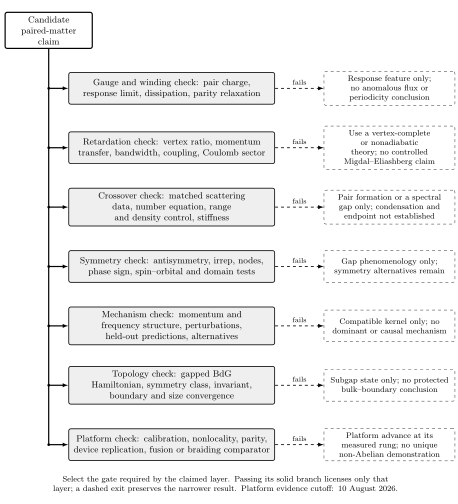
Mechanism inference is stronger than finding a gap or a compatible kernel. Momentum, frequency, controlled perturbations, and alternatives must be tested with a common observable convention and uncertainty model. Original schematic, not to scale.
The canonical paired-matter claim test matrix summarizes the same stopping rule. For developments after the cutoff, use the dated Quantum Matter and Emergence Research synthesis and reapply this workflow to the material-specific primary record.
Mechanism inference also stops before topology. Once symmetry diagnostics and a microscopic or phenomenological gap are accepted, pass the explicit Bogoliubov–de Gennes Hamiltonian and protecting symmetries to topological superconductors and boundary modes. Then apply the separate Majorana-platform evidence standard to nonunique boundary signatures. A topological invariant or boundary mode does not retroactively identify the interaction that formed the pairs.
Exercises
Section titled “Exercises”1. Intra-patch repulsion in the two-patch model
Section titled “1. Intra-patch repulsion in the two-patch model”Add equal intra-patch repulsion to the two-patch example:
Find both eigenvalues. When can the sign-changing channel reach an instability?
Solution
For , the eigenvalue is . For , it is
The sign-changing channel is enhanced only when the inter-patch repulsion exceeds the intra-patch repulsion, . It reaches the transition when . This conclusion belongs to the projected two-patch model; additional patches, frequency dependence, self-energy, and competing channels can change it.
2. An isotope exponent is not a mechanism label
Section titled “2. An isotope exponent is not a mechanism label”Two otherwise matched samples have and . Estimate the finite-difference oxygen isotope exponent. What must be checked before interpreting it causally?
Solution
The estimate is
This differs from the one-scale harmonic value , but it neither excludes nor proves phonon pairing. One must measure isotope exchange fraction and mode shifts and propagate changes in stoichiometry, carrier density, lattice constants, zero-point structure, disorder, anharmonicity, Coulomb matching, and competing order. The most discriminating result would connect the isotope-induced mode shift to a predicted change in electronic self-energy, gap structure, and within one forward model.
3. Shared calibration and apparent replication
Section titled “3. Shared calibration and apparent replication”Two residuals are both and have covariance
Compare the correct with the value obtained by discarding the off-diagonal covariance.
Solution
For ,
The diagonal approximation overstates the information by the factor . At , two apparently separate residuals carry only about of the naïvely assigned weight. The same error occurs when two probes share a sample calibration or when two papers invert the same spectrum but are counted as independent confirmations.
4. Place the evidence on the ladder
Section titled “4. Place the evidence on the ladder”Classify these claims: (a) a Hubbard calculation reproduces the observed gap symmetry; (b) the FeSeS gap anisotropy agrees with a nematic model better than the tested spin models; (c) isotope-dependent FeSe/SrTiO replicas identify coupling to an interfacial phonon and a coupled calculation enhances . Name one held-out test that could raise each claim.
Solution
(a) is compatibility. A held-out momentum- and frequency-resolved susceptibility together with the associated electronic self-energy would test more of the kernel. (b) is preference within a restricted model set. A preregistered strain or tuning experiment that predicts the full gap, normal-state nematic and spin spectra, band structure, and lattice response before measurement could strengthen it; because strain changes several sectors at once, the joint prediction is essential. (c) identifies phonon participation and supports cooperative enhancement, but not sole causation. A preregistered isotope or interface intervention that changes the phonon while holding doping, structure, disorder, and the intrinsic FeSe channel fixed would be more causal. None of the three cases licenses a universal mechanism claim.
References
Section titled “References”- Allender, D., Bray, J., and Bardeen, J. (1973). “Model for an Exciton Mechanism of Superconductivity.” Physical Review B 7, 1020–1029. doi:10.1103/PhysRevB.7.1020.
- Chang, Y., van Loon, E. G. C. P., Eskridge, B., Busemeyer, B., Morales, M. A., Dreyer, C. E., Millis, A. J., Zhang, S., Wehling, T. O., Wagner, L. K., and Rösner, M. (2024). “Downfolding from ab initio to Interacting Model Hamiltonians: Comprehensive Analysis and Benchmarking of the DFT+cRPA Approach.” npj Computational Materials 10, 129. doi:10.1038/s41524-024-01314-6.
- Coldea, A. I. (2021). “Electronic Nematic States Tuned by Isoelectronic Substitution in Bulk FeSeS.” Frontiers in Physics 8, 594500. doi:10.3389/fphy.2020.594500.
- Errea, I., Calandra, M., and Mauri, F. (2013). “First-Principles Theory of Anharmonicity and the Inverse Isotope Effect in Superconducting Palladium-Hydride Compounds.” Physical Review Letters 111, 177002. doi:10.1103/PhysRevLett.111.177002.
- Eschrig, M. (2006). “The Effect of Collective Spin-1 Excitations on Electronic Spectra in High- Superconductors.” Advances in Physics 55, 47–183. doi:10.1080/00018730600645636.
- Gastiasoro, M. N., Ruhman, J., and Fernandes, R. M. (2020). “Superconductivity in Dilute SrTiO: A Review.” Annals of Physics 417, 168107. doi:10.1016/j.aop.2020.168107.
- Giustino, F. (2017). “Electron–Phonon Interactions from First Principles.” Reviews of Modern Physics 89, 015003. doi:10.1103/RevModPhys.89.015003.
- Hirschfeld, P. J. (2016). “Using Gap Symmetry and Structure to Reveal the Pairing Mechanism in Fe-Based Superconductors.” Comptes Rendus Physique 17, 197–231. doi:10.1016/j.crhy.2015.10.002.
- Liu, R., Tang, Q., Liu, C., Zhang, W., Li, C., Zhou, K., Wang, Q., and Lu, X. (2025). “Evolution of Pairing Symmetry in FeSeS as Probed by In-Plane Strain Tuning of .” Physical Review B 112, 094514. doi:10.1103/f6jb-yvyj.
- McMillan, W. L., and Rowell, J. M. (1965). “Lead Phonon Spectrum Calculated from Superconducting Density of States.” Physical Review Letters 14, 108–112. doi:10.1103/PhysRevLett.14.108.
- Metzner, W., Salmhofer, M., Honerkamp, C., Meden, V., and Schönhammer, K. (2012). “Functional Renormalization Group Approach to Correlated Fermion Systems.” Reviews of Modern Physics 84, 299–352. doi:10.1103/RevModPhys.84.299.
- Monthoux, P., Pines, D., and Lonzarich, G. G. (2007). “Superconductivity without Phonons.” Nature 450, 1177–1183. doi:10.1038/nature06480.
- Nag, P. K., Scott, K., de Carvalho, V. S., Byland, J. K., Yang, X., Walker, M., Greenberg, A. G., Klavins, P., Miranda, E., Gozar, A., Taufour, V., Fernandes, R. M., and da Silva Neto, E. H. (2025). “Highly Anisotropic Superconducting Gap near the Nematic Quantum Critical Point of FeSeS.” Nature Physics 21, 89–96. doi:10.1038/s41567-024-02683-x.
- Rademaker, L., Alvarez-Suchini, G., Nakatsukasa, K., Wang, Y., and Johnston, S. (2021). “Enhanced Superconductivity in FeSe/SrTiO from the Combination of Forward Scattering Phonons and Spin Fluctuations.” Physical Review B 103, 144504. doi:10.1103/PhysRevB.103.144504.
- Ramshaw, B. J., and Kivelson, S. A. (2026). “Emergence of Fermi-Liquid and BCS Physics in Overdoped Cuprates.” Nature Reviews Physics, version of record published 16 July 2026. doi:10.1038/s42254-026-00960-7.
- Scalapino, D. J. (2012). “A Common Thread: The Pairing Interaction for Unconventional Superconductors.” Reviews of Modern Physics 84, 1383–1417. doi:10.1103/RevModPhys.84.1383.
- Song, Q., Yu, T. L., Lou, X., Xie, B. P., Xu, H. C., Wen, C. H. P., Yao, Q., Zhang, S. Y., Zhu, X. T., Guo, J. D., Peng, R., and Feng, D. L. (2019). “Evidence of Cooperative Effect on the Enhanced Superconducting Transition Temperature at the FeSe/SrTiO Interface.” Nature Communications 10, 758. doi:10.1038/s41467-019-08560-z.
- Tazai, R., Yamakawa, Y., Tsuchiizu, M., and Kontani, H. (2016). “Functional Renormalization Group Study of Orbital Fluctuation Mediated Superconductivity: Impact of the Electron-Boson Coupling Vertex Corrections.” Physical Review B 94, 115155. doi:10.1103/PhysRevB.94.115155.
- Zhang, M., Shi, R., Wu, R., Jiao, X., Shi, M., Liu, J., Wang, Y., Dong, W., Ding, C., Qin, T., Liu, H., Wang, L., Zhang, Z., Gao, P., Xue, Q.-K., and Xiong, Q. (2025). “Direct Evidence of Interfacial Coherent Electron-Phonon Coupling in Single-Unit-Cell FeSe Film on Nb-Doped SrTiO.” Physical Review Letters 135, 126903. doi:10.1103/qxfc-khzf.