

Quench Action and Integrable Steady States
The quench action determines an integrable steady macrostate directly from overlaps between the initial state and post-quench Bethe eigenstates. It combines the exponentially small weight of an individual eigenstate with the exponentially large number of states sharing a root density. The saddle describes stationary local observables under dephasing assumptions; it does not turn the diagonal ensemble into an ordinary thermal ensemble.
Required background. Integrable charges and generalized-ensemble tests supplies macrostate completeness and the comparison with a GGE.
Helpful background. Equilibration, thermalization, and dephasing supplies the time-averaging and local-observable limits.
Overlap large deviations and Yang–Yang entropy
Section titled “Overlap large deviations and Yang–Yang entropy”Expand the initial state in energy eigenstates,
The diagonal expectation of an observable is
For Bethe states with macrostate , suppose the overlap has the thermodynamic large-deviation form
The number of microscopic states near grows as , possibly reduced by initial-state selection rules. Therefore the leading functional in the diagonal sum is
subject to Bethe root-density constraints and any exactly fixed charges. The stationary macrostate satisfies
The factor two comes from . Omitting it changes the saddle. If only parity-invariant Bethe states have nonzero overlap, the entropy term must count that restricted set rather than all microscopic states.
Caux and Essler 2013, main text introduced this saddle-point construction for interacting integrable quenches. Exact overlap formulas, their normalization, zero modes, and string selection rules are model and initial-state data.
The structure figure shows how the overlap route and charge route meet at the same macrostate when both are complete. Inspect the entropy label: the quench action includes state counting explicitly, whereas matching a few charges does not reconstruct it by itself.
On a narrow screen, swipe or use the Left and Right arrow keys to pan across the figure. Home and End move to its edges. A full-size link is also available.
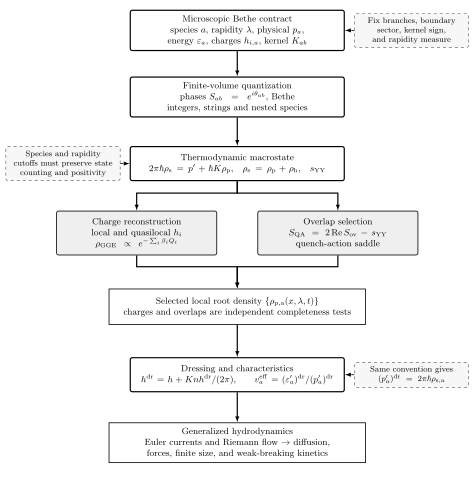
Quench-action dictionary. Overlap normalization, allowed species and symmetries, entropy counting, thermodynamic limit, and dephasing are all required to turn microscopic coefficients into a stationary local macrostate. Original schematic, not to scale.
Text description of this diagram · Figure data (JSON)
Explicit free-fermion saddle
Section titled “Explicit free-fermion saddle”For independent post-quench modes , let the initial Gaussian state have occupation probability , with no unresolved anomalous coherence in the stationary basis. A macrostate with occupation has relative-entropy quench action per unit length
Varying gives
so the unique interior saddle is . This simple result already contains both overlap probabilities and binomial entropy. It is also a GGE with mode-dependent multiplier
For an interacting Bethe gas, the occupation modes are coupled through root-density constraints and the overlap functional, so the saddle becomes a nonlinear integral equation rather than a pointwise identity.
Limits, excitations, and steady-state claims
Section titled “Limits, excitations, and steady-state claims”The leading extensive saddle fixes stationary local one-point functions. Subextensive overlap terms, determinants, and nearby particle–hole excitations control normalization, finite-size corrections, and time-dependent correlation functions. Degenerate eigenstates can retain off-diagonal coherences; selection rules or bound-state strings omitted from the overlap formula can change the saddle itself.
Order of limits matters:
need not equal the reverse order because finite systems recur. A steady local macrostate can emerge for microscopic times without the global pure state converging in norm.
A quench-action saddle agrees with a GGE only if the latter’s charges are complete on the relevant state class. Agreement on energy and particle number is not a completeness test. Direct time evolution, exact finite-size diagonal sums, charge reconstruction, and sum rules provide independent checks.
Brockmann et al. 2014, §§3–5 derive normalized overlaps and the quench action for a Néel-to-XXZ quench, illustrating the importance of parity restrictions and strings. Pozsgay et al. 2014, main text compare steady-state constructions and expose the failure of an incomplete GGE.
The canonical integrable-matter claim test matrix retains the initial-state input, entropy, charge completeness, and finite-size ceiling. A reproducible verification workflow checks overlap saddle equations and charge reconstruction.
Exercise
Section titled “Exercise”Convexity of the free-mode quench action. Verify the saddle above and compute the second functional derivative for .
Solution
The first derivative vanishes only when
which gives . The local second derivative is
It is positive for , so the saddle is a minimum. Modes with or lie on the boundary and are fixed rather than varied as interior degrees of freedom.
References
Section titled “References”- Brockmann, M., Wouters, B., Fioretto, D., De Nardis, J., Vlijm, R., and Caux, J.-S. (2014). “Quench action approach for releasing the Néel state into the spin- XXZ chain.” Journal of Statistical Mechanics: Theory and Experiment 2014, P12009. doi:10.1088/1742-5468/2014/12/P12009.
- Caux, J.-S., and Essler, F. H. L. (2013). “Time evolution of local observables after quenching to an integrable model.” Physical Review Letters 110, 257203. doi:10.1103/PhysRevLett.110.257203.
- Pozsgay, B., Mestyán, M., Werner, M. A., Kormos, M., Zaránd, G., and Takács, G. (2014). “Correlations after quantum quenches in the XXZ spin chain: Failure of the generalized Gibbs ensemble.” Physical Review Letters 113, 117203. doi:10.1103/PhysRevLett.113.117203.