

Quantum Oscillations and Thermodynamic Fermi-Surface Inference
Quantum oscillations arise when Landau levels sweep through the chemical potential as magnetic field changes. Their frequencies measure extremal momentum-space orbit areas under semiclassical conditions; temperature, disorder, spin splitting, magnetic breakdown, and curvature control amplitudes and phases. An observed frequency is strong Fermi-surface evidence, but an absent frequency or fitted phase is rarely unique.
Required background. The measurement-to-claim map supplies covariance and competing-model standards. Fermi-surface kinematics supplies momentum-space geometry.
Helpful background. Luttinger’s theorem and failure modes supplies the distinction between measured pockets and a total volume count.
Evidence cutoff. This method and evidence account covers primary and official sources available through 10 August 2026. Later calibrations, corrections, datasets, and changing assessments belong in the dated Quantum Matter and Emergence Research synthesis.
Onsager frequency and cyclotron mass
Section titled “Onsager frequency and cyclotron mass”For a closed extremal orbit normal to , the Onsager 1952 quantization relation is
where has magnetic-field units and is the oscillation frequency with respect to inverse field , while is the extremal -space area. Rotating maps extremal sections, not the full three-dimensional surface without a geometric model. The positive cyclotron-mass magnitude entering the thermal damping follows from
For the fundamental harmonic, the Lifshitz–Kosevich 1956 theory gives damping factors including
with Dingle temperature . Spin damping, orbit curvature, harmonics, torque geometry, and field-dependent background multiply these terms. Mass extraction fits the temperature dependence at a common effective-field window; changing the window with temperature can manufacture a mass trend.
The chapter’s validity figure places oscillations at the boundary between a calibrated probe and model comparison. Inspect the missing-orbit branch: nonobservation is a bound on amplitude, not proof that a pocket is absent.
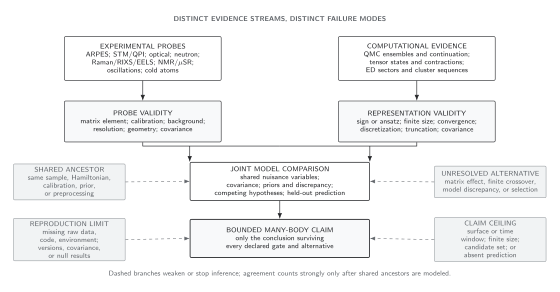
Oscillation inference within the chapter’s evidence comparison. Frequency, mass, phase, and nonobservation have different nuisance parameters and limits of interpretation; agreement with a band or many-body model is tested with independent observables. Schematic.
Phase is not Berry phase alone
Section titled “Phase is not Berry phase alone”A measured oscillatory component can be written schematically as
where is a three-dimensional curvature phase and contains the Berry phase together with orbital-moment and other semiclassical corrections; Xiao, Chang, and Niu 2010 derive those semiclassical corrections. Zeeman splitting, chemical-potential oscillations, multiple close frequencies, magnetic breakdown, and the distinction between conductivity and resistivity oscillations can shift a Landau-fan intercept. A linear fan over a short index interval therefore does not directly measure a topological Berry phase.
Magnetic breakdown creates sum and difference orbits with amplitudes controlled by a field-dependent tunneling probability. Harmonics and waveform distortion can mimic extra pockets. Fourier resolution in is set by the window; apodization correlates neighboring bins. Fit the time-domain-in- signal jointly when close frequencies cannot be resolved robustly. Shoenberg 1984, chs. 2–8 treats these amplitude, phase, and breakdown effects in one convention.
Thermodynamic and transport cross-checks
Section titled “Thermodynamic and transport cross-checks”de Haas–van Alphen oscillations in magnetization are thermodynamic; Shubnikov–de Haas oscillations in conductivity or resistivity include the transport tensor and scattering weights. Their frequency agreement is valuable, while amplitude disagreement need not be a contradiction. Specific heat constrains the total mass-weighted density of states, Hall response constrains carriers only within a transport model, and ARPES sees surface-projected occupied weight. Combining them requires shared band multiplicities, field-induced reconstruction, and magnetic order.
Report the raw field range, background family, window, apodization, noise floor, frequency covariance, harmonic and breakdown alternatives, angle calibration, temperature uncertainty, and field evolution. The probe and computation claim test matrix distinguishes an extremal area, a reconstructed Fermi-surface model, and a topological phase assignment.
Exercise
Section titled “Exercise”Thermal mass ratio. At fixed effective field, two temperatures give amplitudes and after temperature-independent factors cancel. Write the equation that determines .
Solution
With ,
This nonlinear equation is solved for . The extraction is valid only if the same orbit, field weighting, background procedure, and temperature-independent damping factors apply to both amplitudes.
References
Section titled “References”- I. M. Lifshitz and A. M. Kosevich, “Theory of Magnetic Susceptibility in Metals at Low Temperatures,” Soviet Physics JETP 2 (1956) 636–645. JETP archive
- Lars Onsager, “Interpretation of the de Haas–van Alphen Effect,” Philosophical Magazine 43 (1952) 1006–1008. DOI
- David Shoenberg, Magnetic Oscillations in Metals, Cambridge University Press, 1984. DOI
- Di Xiao, Ming-Che Chang, and Qian Niu, “Berry Phase Effects on Electronic Properties,” Reviews of Modern Physics 82 (2010) 1959–2007. DOI