

Bethe-Integrable Quantum Gases and Spin Chains
Bethe integrability replaces generic many-body scattering by stable quasiparticles whose multiparticle amplitudes factorize into two-body phases. Every later thermodynamic or hydrodynamic formula depends on the rapidity, phase, measure, species, boundary, and branch conventions fixed here. This page uses the repulsive Lieb–Liniger gas as an explicit normalization and then explains what changes for spin chains and string species.
Required background. Bethe quantization in finite volume supplies factorized scattering and periodic quantization. One-dimensional Bose fluids supplies the physical gas and Luttinger-liquid limits.
Helpful background. Spin chains and Haldane physics supplies lattice-spin conventions and the distinction between integer- and half-integer-spin infrared behavior.
Lieb–Liniger scattering and Bethe equations
Section titled “Lieb–Liniger scattering and Bethe equations”For identical bosons on a ring of length ,
The rapidities are physical wave numbers. Define the ordered two-body scattering phase by
on a branch chosen continuously away from . Periodicity gives the convention
or
Changing the branch of shifts the integer or half-integer quantum numbers ; changing only one side of the equation changes the spectrum. For this convention the derivative kernel is
Energy and momentum are
The rapidity measure is only after it has been stated; some sources absorb into root densities or kernels. The interaction parameter has inverse-length units, while the common dimensionless coupling is . Neither should be imported into a relativistic rapidity formula without matching energy, momentum, and phase conventions.
The chapter structure figure follows this data into thermodynamics. Inspect the first arrow: a quasiparticle species is defined by its bare momentum, energy, charges, and scattering kernel together, not by a rapidity label alone.
On a narrow screen, swipe or use the Left and Right arrow keys to pan across the figure. Home and End move to its edges. A full-size link is also available.
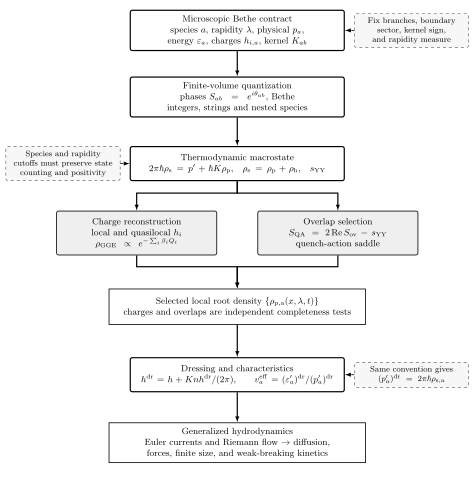
Bethe-data dictionary. The rapidity variable, measure, phase branch, particle species, and boundary condition jointly determine the finite-volume spectrum and every later dressing equation. Original schematic, not to scale.
Text description of this diagram · Figure data (JSON)
Spin chains, nested species, and strings
Section titled “Spin chains, nested species, and strings”For the spin- XXZ chain,
Bethe rapidities parameterize overturned spins relative to a chosen reference vacuum. Their bare energy and momentum are nonlinear functions of rapidity and depend on whether , , or another parameterization is used. Magnetization fixes particle number, and twisted or open boundaries change the quantization equations. Bethe 1931, pp. 205–226 gives the original coordinate construction for the isotropic chain.
In regimes with bound states, complex roots organize into string families labeled by length and parity in the thermodynamic limit. The string hypothesis has exponentially small finite-size deviations for many regular states but can have exceptional solutions and nonuniform corrections. A thermodynamic calculation must state which string species are included and show convergence of observables as the species cutoff is increased.
Nested models add flavor rapidities and coupled kernels. Degeneracies and internal symmetry multiplets can make a set of roots incomplete without descendant states. The safe workflow is to verify finite-size counting, energy, momentum, and conserved charges against exact diagonalization before taking a thermodynamic limit.
Lieb and Liniger 1963, §§I–III derive the repulsive gas equations and thermodynamic limit. Takahashi 1971, §§2–3, pp. 402–407 develops the string thermodynamics of the Heisenberg chain. These models share factorization but not a universal rapidity normalization.
The canonical integrable-matter claim test matrix keeps species, charge, dressing, finite-size, and validation data aligned. A reproducible verification workflow checks finite-volume equations and thermodynamic discretizations.
Exercise
Section titled “Exercise”Quantization of total momentum. Multiply all Lieb–Liniger Bethe equations and show that the total momentum is quantized independently of .
Solution
Multiplying gives
Every unordered pair contributes
so the scattering product cancels. Hence
Interactions redistribute the individual rapidities but translation invariance fixes the total-momentum lattice. A twist would add its phase to this quantization condition.
Nonvisual description of the Bethe-to-GHD structure figure
Section titled “Nonvisual description of the Bethe-to-GHD structure figure”This table states the relationships and qualifications shown in the figure above.
| Figure element or arrow | Relation encoded | Condition or resulting statement |
|---|---|---|
| Bethe-model input | Specify species , rapidity , physical , energy , charges , and kernel . | The displayed state counting is positive-oriented; signed species require translation. The dashed side condition fixes phase branches, boundary sector, kernel sign, and rapidity measure. |
| Bethe-model input → finite-volume quantization | The same data determine phases , Bethe integers, string families, and nested species. | Changing one convention without the others changes the spectrum. |
| Finite volume → thermodynamic macrostate | The thermodynamic limit gives , , and Yang–Yang entropy. | The factors and kernel sign are inherited from the Bethe-model input. |
| Thermodynamic side condition | Species and rapidity cutoffs must preserve state counting and positivity. | A nonconverged species truncation is not a complete macrostate. |
| Macrostate → charge-reconstruction branch | Local and quasilocal charge eigenvalues define . | Charge completeness is tested by whether the chosen family reconstructs the root density. |
| Macrostate → overlap-selection branch | Initial-state overlaps and Yang–Yang entropy form . | The quench-action saddle requires normalized overlaps and entropy counting restricted to overlap-allowed states. |
| Charge and overlap branches → selected local root density | Independent charge and overlap descriptions converge on when both are complete. | Agreement is a completeness test; the two inputs are not interchangeable assumptions. |
| Local root density → dressing and characteristics | Dressing gives and . | The dashed identity must hold in the same convention. |
| Dressing → generalized hydrodynamics | The dressed characteristics determine Euler currents and Riemann flow, followed by separately controlled diffusion, forces, finite-size effects, and weak-breaking kinetics. | Each later correction has its own gradient, positivity, rate, or platform window. |
References
Section titled “References”- Bethe, H. (1931). “Zur Theorie der Metalle. I. Eigenwerte und Eigenfunktionen der linearen Atomkette.” Zeitschrift für Physik 71, 205–226. doi:10.1007/BF01341708.
- Lieb, E. H., and Liniger, W. (1963). “Exact analysis of an interacting Bose gas. I. The general solution and the ground state.” Physical Review 130, 1605–1616. doi:10.1103/PhysRev.130.1605.
- Takahashi, M. (1971). “One-dimensional Heisenberg model at finite temperature.” Progress of Theoretical Physics 46, 401–415. doi:10.1143/PTP.46.401.