

The Cooper Instability and Pairing Channels
The zero-total-momentum pair channel of a Fermi liquid is special: if a codimension-one set of partner states remains degenerate and has a finite density of states, repeated pair scattering produces a logarithm, . An arbitrarily weak attractive eigenvalue then drives the normal-state expansion to strong coupling at an exponentially small scale. This page derives that logarithm, classifies the independent pairing channels, and separates the resulting instability from a transition temperature, an ordered-state solution, or a microscopic mechanism.
Required background. Fermi-surface kinematics supplies the shell phase space and density-of-states convention. Momentum-shell RG supplies the elimination-and-rescaling argument.
Helpful background. Fermi-surface patch theory, especially its exceptional-channel diagram explains why the Cooper family retains angular phase space while a generic four-fermion process does not.
What becomes unstable?
Section titled “What becomes unstable?”Work in a normal Fermi liquid in with a smooth Fermi surface, coherent quasiparticles, a nonsingular short-range interaction, and an energy shell . The label may include band and internal quantum numbers. Zero-momentum pairing requires a partner such that
on an extended part of the Fermi surface. Time-reversal symmetry supplies equal-energy partners related by ; at a time-reversal-invariant momentum they form a Kramers pair when . Inversion can instead supply the same energy degeneracy even when the two states are not literally time reverses. A mismatch from population imbalance, orbital splitting, or a pair-breaking field stops the argument at that mismatch scale.
After matching onto quasiparticles and absorbing their residues into the interaction vertex, write
The singular object is the normal-state pair susceptibility. Its growth says that perturbation theory around the unpaired state is losing control; it does not yet say which ordered saddle is realized.
Deriving the Cooper logarithm
Section titled “Deriving the Cooper logarithm”For one degenerate pair of states, the static zero-momentum bubble is
Here counts one member of the pair; for a two-spin-degenerate band it is half the spin-summed density of states. The fermionic Matsubara sum is
so
For a constant density of states and a sharp symmetric energy cutoff, this becomes
The exact factor belongs to that cutoff model. A smooth energy-dependent density of states leaves the leading unchanged but adds finite, matching-dependent terms. This distinction matters whenever a quoted transition scale is compared across regulators or microscopic models. The weak-coupling finite-temperature integral is the same one that enters the BCS linearized gap equation; Bardeen, Cooper, and Schrieffer 1957, §II, pp. 1179–1183.
The geometry explains the logarithm. At total momentum zero, choosing any on the pair-degenerate surface automatically places its partner at , so the full surface label survives while the radial integral gives . At generic total momentum , the conditions and intersect in lower dimension, and the full logarithmic phase space is lost unless nesting or another special degeneracy restores it. Shankar 1994, §IX, pp. 181–183 extends the argument to time-reversal-invariant noncircular Fermi surfaces.
Ladder resummation and the breakdown scale
Section titled “Ladder resummation and the breakdown scale”In a separable channel with signed interaction , repeated pair scattering forms a geometric series,
The denominator vanishes at
This pole is the scale where the normal-state weak-coupling expansion fails. In the ideal instantaneous BCS model it tracks the mean-field transition scale up to a regulator-dependent prefactor, but in general it is not a calculation of , the zero-temperature gap, or the phase stiffness. The original two-particle bound-state argument is Cooper 1956, pp. 1189–1190; the many-body saddle is the next step on the BCS page.
Pairing as an eigenvalue problem
Section titled “Pairing as an eigenvalue problem”For an anisotropic or multiband Fermi surface, define the weighted surface measure on sheet by
The antisymmetrized interaction is diagonalized through
If equilibrium reciprocity gives , this operator is self-adjoint in the inner product
so the eigenvalues are real and the eigenfunctions can be chosen orthonormal. A positive is attractive because of the explicit minus sign. To connect with the signed RG convention below, define
In a single static weak-coupling channel, . On a three-dimensional sphere the eigenfunctions are spherical harmonics ; on a two-dimensional circle they are Fourier harmonics . A crystal instead organizes them into irreducible representations of its point group. In simple settings, wave is fully symmetric, wave is odd under , and wave changes sign in a quadrupolar pattern. These names are shorthand for transformation laws, not evidence for a mediator.
The universal exchange condition includes momentum, internal labels, and relative frequency:
The familiar singlet-even and triplet-odd rule further assumes even-frequency pairing, inversion symmetry, one symmetric orbital sector, and spin—or a valid Kramers pseudospin—as a good label. Without inversion, even- and odd-parity components can mix; orbital or odd-frequency antisymmetry also changes the mnemonic. The linearized equation fixes the critical subspace but not a direction within a multidimensional representation. Quartic terms generally select a real, chiral, or other combination immediately below the transition, while strain or disorder can split the degeneracy. Sigrist and Ueda 1991, §II, pp. 240–252 develops the crystal-symmetry classification and multicomponent Ginzburg–Landau selection.
Shell flow and physical stopping scales
Section titled “Shell flow and physical stopping scales”Let and use the signed dimensionless eigenvalue . The autonomous leading-log Cooper flow is
Thus decreases toward zero, while reaches a pole at . The identity is the differential form of the ladder denominator. In the separable normalization drawn below, . The figure puts the two ingredients side by side vertically: the pair-degenerate shell supplies the logarithm, and the sign of one normalized eigenchannel determines its one-loop fate.
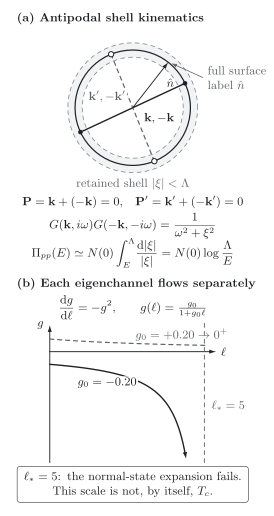
The Cooper channel combines a full surface of degenerate partner states with the radial integral ; the figure abbreviates as . Representative signed eigenvalues and then flow toward zero and a pole at , respectively. The pole marks failure of the normal-state expansion, not . Original schematic for a regular pair-degenerate two-dimensional Fermi liquid; not to scale.
The machine-readable figure record gives the assumptions, equations, encodings, and failure cases without relying on the image.
The displayed beta function is not a theorem that every repulsive interaction becomes harmless. Particle–hole corrections can generate attractive high-angular-momentum components—the Kohn–Luttinger mechanism—and nested or van-Hove systems generally require coupled parquet or functional-RG flows whose eigenvectors can rotate. Shankar 1994, §§VI.C–VI.E and Appendix B, pp. 171–173 and 190–191 derives the autonomous flow and its qualification; Kohn and Luttinger 1965 gives the classic repulsion-induced route.
Physical scales can stop the flow before its pole. Temperature, pair-breaking mismatch, finite system size, or loss of quasiparticle coherence replaces by the largest applicable infrared cutoff. Retardation requires a second matching step: a static eigenproblem is only the low-energy limit of a frequency-dependent kernel. In the elementary two-window model with electronic scale and screened dimensionless Coulomb repulsion ,
This Morel–Anderson reduction is a scale-separated constant-channel approximation, not a general replacement for the momentum–Matsubara eigenproblem. A general retarded calculation determines together with normal-state renormalization and identifies by an eigenvalue crossing. Morel and Anderson 1962 gives the original retardation matching; Migdal control and Eliashberg theory develop its domain of validity.
What the instability establishes—and what it does not
Section titled “What the instability establishes—and what it does not”- Finite density of states is part of the result. At zero temperature, . If , the ordinary logarithm occurs for , a finite threshold replaces it for , and the divergence is stronger for . A logarithmic van-Hove density of states yields a enhancement, but particle–hole channels are then often singular as well.
- Pair degeneracy can fail. Population imbalance, orbital mismatch, or a pair-breaking field cuts off the zero-momentum logarithm. Finite-momentum pairing may become competitive, but it is a separate eigenproblem rather than an automatic continuation of this one.
- Pairing is not phase coherence. A growing pair susceptibility says nothing by itself about the stiffness. In two dimensions, pair formation can lie above the vortex-unbinding transition discussed on the order, stiffness, and vortices page.
- A leading eigenfunction is not a mechanism. Self-energy and vertex corrections can reorder channels, and the same symmetry may arise from different microscopic interactions. Mechanism claims require discriminating observables, not merely a calculated gap shape.
The chapter-wide structure diagram locates this conclusion before the saddle, response, and evidence layers. In the convention used here, its “leading ” is the positive attractive eigenvalue .
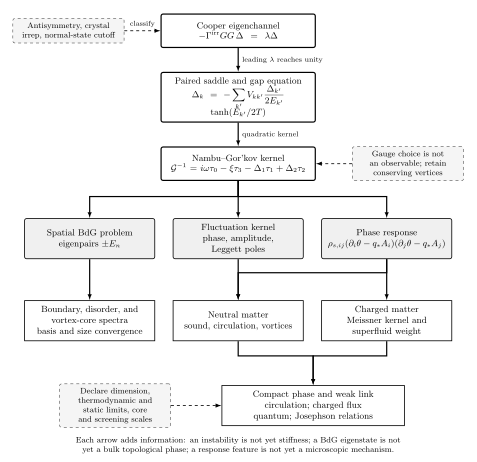
An attractive eigenchannel licenses a normal-state pairing instability, not a microscopic mechanism, phase stiffness, or gauge-invariant observable. Those conclusions enter only at later, separately tested stages. Original schematic, not to scale.
The machine-readable structure record preserves every dependency, and the paired-matter claim test matrix gives the corresponding controls and decisive negative tests.
Common pitfalls
Section titled “Common pitfalls”Calling the transition temperature. is a normal-state stopping scale. A controlled requires the matched finite-temperature kernel and, beyond mean field, the relevant phase fluctuations.
Equating symmetry with mechanism. An -, -, or -wave eigenfunction describes how a pair transforms. It does not identify the boson, fluctuation, or electronic process that produced the kernel.
Treating as automatically equal to the bandwidth. is the upper scale of the effective channel after matching. For a retarded attraction it may be a boson scale, while electronic repulsion has already flowed over a wider window.
Dropping the hypotheses behind “arbitrarily weak.” The statement needs a finite pair density of states, coherent partners, and no larger infrared cutoff. Dirac points, pseudogaps, mismatch, or strong incoherence can replace the weak-coupling instability by a finite threshold.
Exercises
Section titled “Exercises”Recover the logarithm. Starting from the pair bubble with a constant , perform the Matsubara sum and identify the interval of that produces the logarithm.
Solution
The standard fermionic sum gives
Combining positive and negative energies therefore yields
For , removes the infrared singularity. For , the hyperbolic tangent is approximately one, so that interval gives . Evaluating the smooth crossover produces the hard-cutoff constant .
Project two angular channels. On a circular Fermi surface with normalized measure , let
Find the eigenvalues of the constant function and of and . Which channel is leading when ?
Solution
The constant function is an eigenfunction of with eigenvalue . Orthogonality of the circular harmonics gives eigenvalue for both and ; they form the two components of the sector. Because the gap equation diagonalizes , its attractive eigenvalues are and . Thus gives a two-component attractive -wave subspace and a repulsive -wave channel. Quartic terms are needed to choose a real or chiral combination below the transition.
Add a pair-breaking cutoff. An attractive channel starts at and . First find its uncut stopping scale. Then suppose mismatch stops the Cooper logarithm at . Does the one-loop pole occur before the flow stops?
Solution
The uncut pole is at , hence
The mismatch stops the logarithm at . Therefore the pole is not reached. The running value is , already outside a comfortable weak-coupling regime, so the safe conclusion is only that this leading-log flow is strongly enhanced but cut off before its formal divergence.
Find the threshold for a vanishing density of states. Let with . Evaluate the zero-temperature pair bubble and find the ladder threshold for a constant attractive .
Solution
At ,
The susceptibility is finite. The denominator can vanish only when . The phrase “arbitrarily weak attraction” therefore does not apply when .
Estimate retardation of repulsion. In the two-window model, take and . Compute and state why the number is not yet a prediction of .
Solution
Using ,
High-energy flow has reduced the effective low-energy repulsion, but a transition still depends on the attractive frequency-dependent kernel, its momentum and band structure, quasiparticle renormalization, and the infrared solution. The pseudopotential alone neither establishes attraction nor fixes .
Continue
Section titled “Continue”The BCS saddle and gap equation continue from the normal-state instability to a self-consistent ordered solution. Migdal control and Eliashberg theory replace the static kernel by a retarded one. Unconventional and topological pairing develops crystal, multiorbital, and frequency-dependent symmetry beyond the simplest mnemonic.
References
Section titled “References”- Bardeen, J., Cooper, L. N., and Schrieffer, J. R. (1957). “Theory of superconductivity.” Physical Review 108, 1175–1204. doi:10.1103/PhysRev.108.1175.
- Cooper, L. N. (1956). “Bound electron pairs in a degenerate Fermi gas.” Physical Review 104, 1189–1190. doi:10.1103/PhysRev.104.1189.
- Kohn, W., and Luttinger, J. M. (1965). “New mechanism for superconductivity.” Physical Review Letters 15, 524–526. doi:10.1103/PhysRevLett.15.524.
- Morel, P., and Anderson, P. W. (1962). “Calculation of the superconducting state parameters with retarded electron-phonon interaction.” Physical Review 125, 1263–1271. doi:10.1103/PhysRev.125.1263.
- Shankar, R. (1994). “Renormalization-group approach to interacting fermions.” Reviews of Modern Physics 66, 129–192. doi:10.1103/RevModPhys.66.129.
- Sigrist, M., and Ueda, K. (1991). “Phenomenological theory of unconventional superconductivity.” Reviews of Modern Physics 63, 239–311. doi:10.1103/RevModPhys.63.239.