

Photoemission and ARPES Spectral Inference
Angle-resolved photoemission spectroscopy measures the energy and emission angle of electrons removed by photons. Under controlled approximations it is momentum-resolved access to the occupied electron-removal spectrum, but the recorded intensity is also shaped by a dipole matrix element, escape depth, surface potential, final state, background, and finite resolution. ARPES therefore constrains a spectral function or self-energy only through a declared photoemission model.
Required background. The measurement-to-claim map supplies the forward-model and covariance standard. Lehmann spectral functions fixes the removal spectrum and normalization.
Helpful background. Quasiparticle poles and lifetimes supplies the pole interpretation used below.
Evidence cutoff. This method and evidence account covers primary and official sources available through 10 August 2026. Later calibrations, corrections, datasets, and changing assessments belong in the dated Quantum Matter and Emergence Research synthesis.
Intensity and the occupied spectral function
Section titled “Intensity and the occupied spectral function”In the sudden approximation, with a single dominant outgoing-electron channel, a common equilibrium model is
followed by convolution with the energy and momentum resolution. The factorized equilibrium form and its practical interpretation are developed by Damascelli, Hussain, and Shen 2003. Here is the chemical potential, is the Fermi function, and
The overall scale absorbs convention-dependent factors of . The formula is not exact for arbitrary photon energy: extrinsic losses, interference between excitation and escape, multiple final states, and strong surface sensitivity can invalidate factorization. Photon-energy and polarization scans are therefore part of identification, not decorative replication. The modern experimental scope and these matrix-element limitations are reviewed by Sobota, He, and Shen 2021.
The chapter diagram locates ARPES within the shared inference chain. Inspect the matrix-element stage: a dark band in one geometry need not be absent from .
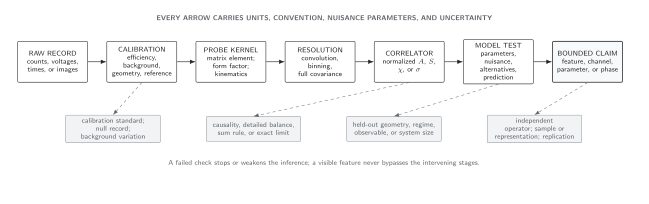
ARPES as a measurement-to-correlator map. Momentum, photon energy, polarization, temperature, surface condition, background, and resolution accompany the inferred occupied spectral weight. The diagram is schematic.
Quasiparticle dispersion and width
Section titled “Quasiparticle dispersion and width”For a single-band Green function
a narrow pole at satisfies . If the self-energy is smooth near the pole,
An energy-distribution-curve width estimates only for a locally Lorentzian line with controlled background and resolution. A positive momentum-distribution-curve half-width obeys approximately only if the bare dispersion is locally linear, is nearly momentum independent normal to the Fermi surface, and the matrix element varies slowly. Norman et al. 1998 provides a widely used causal lineshape construction. Bilayer splitting, broadening, overlapping bands, gaps, and non-Lorentzian continua break that shortcut.
Fermi-function division or symmetrization can expose weight near the chemical potential, but each encodes assumptions. Symmetrization uses approximate particle–hole symmetry over the chosen window; division amplifies noise where is small and must convolve before comparing with data. Neither creates direct access to unoccupied weight.
Surfaces, final states, and bounded claims
Section titled “Surfaces, final states, and bounded claims”The in-plane crystal momentum is conserved modulo a reciprocal lattice vector at an ordered surface. The perpendicular momentum is reconstructed through a final-state model and is broadened by the finite escape depth. Cleavage can change termination, polarity, doping, reconstruction, or band bending. A state that changes with photon energy, aging, or termination must be separated from a bulk feature before being used in a phase claim.
A robust ARPES conclusion therefore reports raw and processed intensity; photon energy and polarization; sample orientation and termination; chemical-potential reference; temperature; energy and angular resolution; background family; matrix-element alternatives; fit covariance; and sum-rule or cross-probe checks. The probe and computation claim test matrix distinguishes observing a dispersing feature, extracting an effective self-energy, and assigning a microscopic mechanism.
Exercise
Section titled “Exercise”Why an intensity zero is inconclusive. Suppose a band has , but reflection symmetry makes the dipole matrix element vanish for one polarization. What changes when the polarization is rotated, and what may be concluded from the original dark point?
Solution
The measured coherent term is proportional to . It vanishes at the symmetry-forbidden geometry even though is nonzero. Rotating polarization can change the dipole representation and make , revealing the band. The original intensity zero establishes only a selection-rule-compatible suppression in that geometry; it does not establish a spectral gap or absence of a state.
References
Section titled “References”- Andrea Damascelli, Zahid Hussain, and Zhi-Xun Shen, “Angle-Resolved Photoemission Studies of the Cuprate Superconductors,” Reviews of Modern Physics 75 (2003) 473–541. DOI
- Michael R. Norman, M. Randeria, H. Ding, and J. C. Campuzano, “Phenomenology of the Low-Energy Spectral Function in High- Superconductors,” Physical Review B 57 (1998) R11093–R11096. DOI
- Jonathan A. Sobota, Yu He, and Zhi-Xun Shen, “Angle-Resolved Photoemission Studies of Quantum Materials,” Reviews of Modern Physics 93 (2021) 025006. DOI