

Optical Conductivity and Spectral-Weight Diagnostics
Optical experiments measure reflected, transmitted, or ellipsometric electromagnetic fields; optical conductivity is inferred through Maxwell boundary conditions and a material model. Once that inversion is controlled, causality and spectral-weight sum rules make optics unusually stringent: missing low-frequency weight must reappear elsewhere within the degrees of freedom included in the model. A Drude fit, a mid-infrared band, or a transferred weight is nevertheless a response feature, not a unique microscopic mechanism.
Required background. The measurement-to-claim map supplies the inverse-problem standard. Kubo response fixes the conductivity convention. Spectral moments and sum rules supplies moment checks.
Helpful background. Gauge-invariant Meissner response distinguishes a superconducting delta weight from ordinary low-frequency conductivity.
Evidence cutoff. This method and evidence account covers primary and official sources available through 10 August 2026. Later calibrations, corrections, datasets, and changing assessments belong in the dated Quantum Matter and Emergence Research synthesis.
From fields to complex conductivity
Section titled “From fields to complex conductivity”For a local isotropic bulk response in SI units,
At normal incidence from vacuum into a semi-infinite sample,
Reflectivity alone loses the phase of . Kramers–Kronig analysis reconstructs it only with causal data and low- and high-frequency extrapolations; multilayers, finite thickness, anisotropy, roughness, and nonlocality require the corresponding transfer matrix or electrodynamic model. Tanner 2019, chs. 3–5 gives a unified electrodynamic treatment. Ellipsometry measures a phase ratio but still needs geometry and calibration. The convolved reflectivity or transmission—not a post-inversion curve with forgotten covariance—should be compared to the forward model.
The common chapter diagram places those electrodynamic steps before the conductivity. Inspect the resolution and covariance stage: spectral points produced by a global Kramers–Kronig transform are correlated.
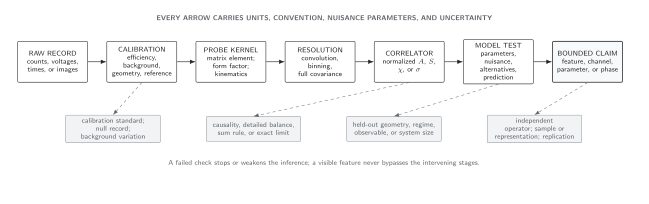
Optical measurement to conductivity. Geometry, extrapolation, phase reconstruction, units, tensor component, and spectral window accompany every spectral-weight conclusion. Schematic.
Causality and exact weight checks
Section titled “Causality and exact weight checks”Causality relates the two components of conductivity. After isolating any zero-frequency distribution carefully,
In a continuum of charge density and bare mass ,
For an isolated tight-binding model coupled by Peierls substitution, the corresponding directional sum is
provided the chosen band subspace and current operator are complete for that model. Consistency of current- and density-response formulations is discussed by Onida, Reining, and Rubio 2002. A partial integral
depends on the cutoff and on interband leakage. Calling a carrier density requires an explicit mass and band model. Basov and collaborators review how correlations redistribute optical weight across widely separated scales Basov et al. 2011.
Drude weight, gaps, and condensate response
Section titled “Drude weight, gaps, and condensate response”A Drude form
summarizes a coherent low-frequency component with weight and rate only when one relaxation scale is adequate. Multiband systems, localization, frequency-dependent memory functions, and incoherent continua can fit over a narrow range while changing the inferred dc limit.
In a superconductor,
The missing-area construction for requires normal and superconducting spectra on a common absolute scale and a cutoff high enough to recover the transferred weight. A low-frequency suppression without the inductive response does not by itself establish phase stiffness.
The probe and computation claim test matrix keeps extrapolation, tensor geometry, spectral window, sum rule, and alternative electrodynamic models adjacent to the conclusion.
Exercise
Section titled “Exercise”Continuum sum-rule check. Evaluate the positive-frequency weight of the Drude conductivity .
Solution
Using ,
The scattering time changes the width and height but not the total continuum weight. A fitted Drude component that loses weight as changes must transfer it to another component or reflect an inconsistent spectral window or normalization.
References
Section titled “References”- D. N. Basov, Richard D. Averitt, Dirk van der Marel, Martin Dressel, and Kristjan Haule, “Electrodynamics of Correlated Electron Materials,” Reviews of Modern Physics 83 (2011) 471–541. DOI
- Giovanni Onida, Lucia Reining, and Angel Rubio, “Electronic Excitations: Density-Functional versus Many-Body Green’s-Function Approaches,” Reviews of Modern Physics 74 (2002) 601–659. DOI
- David B. Tanner, Optical Effects in Solids, Cambridge University Press, 2019. DOI