

Neutron Scattering and Dynamical Structure Factors
Inelastic neutron scattering transfers a known momentum and energy to a sample and measures a polarization-projected correlation function. For magnetic scattering, the basic observable is the dynamical spin structure factor, multiplied by the ionic form factor, tensor, instrumental resolution, sample geometry, and population factors. The technique can identify dispersing modes and continua, but a continuum alone does not identify fractionalization.
Required background. The measurement-to-claim map supplies calibration and covariance standards. Spin correlations and structure factors supplies the magnetic operator and sum rules.
Helpful background. Spin-liquid evidence supplies competing explanations for broad magnetic spectra.
Evidence cutoff. This method and evidence account covers primary and official sources available through 10 August 2026. Later calibrations, corrections, datasets, and changing assessments belong in the dated Quantum Matter and Emergence Research synthesis.
Cross section and transverse projection
Section titled “Cross section and transverse projection”Let the sample gain energy and momentum . Define
With this convention, integrating over gives the equal-time correlator divided by . For an isotropic ionic form factor and unpolarized neutrons, the magnetic part of the cross section has the structure
before absorption, Debye–Waller, multiple-scattering, and resolution corrections. Only magnetization perpendicular to contributes. An anisotropic tensor and covalent magnetization density replace the scalar by the corresponding tensor form factor. Standard derivations with consistent cross-section normalization are given by Lovesey 1984, vol. 2 and Squires 2012, chs. 5–6.
Detailed balance provides a strong sign check. In a reciprocal diagonal channel,
Energy-gain and energy-loss data that violate this after detector and background correction signal a convention, normalization, or nonequilibrium-state problem.
The chapter diagram shows where polarization and form factors enter. Inspect that stage before treating a missing branch as absent spectral weight.
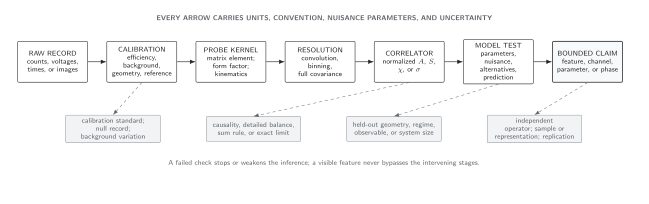
Neutron intensity to spin correlations. Reciprocal-space coverage, sample orientation, polarization, absorption, background, and the full resolution ellipsoid accompany every inferred mode or continuum. Schematic.
Resolution is four-dimensional
Section titled “Resolution is four-dimensional”The measured intensity at nominal is
where contains kinematic and form-factor terms. The resolution kernel is generally tilted in momentum–energy space. A steep dispersion can therefore appear broadened or split depending on scan direction. A defensible fit convolves the model with the measured or simulated resolution and sample mosaic rather than subtracting a scalar linewidth in quadrature; Shirane, Shapiro, and Tranquada 2002, chs. 4–6 develop this procedure for triple-axis instruments.
Polarized neutrons and multiple Brillouin zones help separate magnetic, nuclear, phonon, and incoherent backgrounds. Magnetic weight normally follows and the transverse projector, while phonon intensity has different temperature and momentum dependence. These are discriminants, not perfect labels: magnetoelastic hybridization mixes the channels.
Modes, continua, and sum rules
Section titled “Modes, continua, and sum rules”A sharp pole with resolution-corrected linewidth constrains an excitation energy and lifetime. A broad continuum can arise from multi-magnon scattering, disorder, damping into itinerant particles, unresolved dispersions, phonons, or fractionalized excitations. Fractionalization becomes a stronger interpretation only when the continuum’s boundaries, polarization, integrated weight, field and temperature evolution, and agreement with other probes fit a controlled model better than those alternatives.
Moment checks include
followed by integration over the Brillouin zone to recover the declared local moment, including elastic weight and covalency corrections. The probe and computation claim test matrix keeps these normalization and alternative-explanation checks adjacent to the conclusion.
Exercise
Section titled “Exercise”Polarization zero. For a collinear fluctuation polarized parallel to , evaluate its unpolarized magnetic cross-section factor.
Solution
If the fluctuating moment is , then
The mode can be present in the spin correlator yet dark in that scattering geometry. Rotating the crystal or measuring another reciprocal-lattice equivalent can restore sensitivity.
References
Section titled “References”- Stephen W. Lovesey, Theory of Neutron Scattering from Condensed Matter, Clarendon Press, 1984. WorldCat
- Gen Shirane, Stephen M. Shapiro, and John M. Tranquada, Neutron Scattering with a Triple-Axis Spectrometer, Cambridge University Press, 2002. DOI
- Gordon L. Squires, Introduction to the Theory of Thermal Neutron Scattering, third edition, Cambridge University Press, 2012. DOI