

Unconventional Pairing Symmetries and Diagnostics
On this page, unconventional is an operational description: the gap cannot be represented by one everywhere-positive, fully symmetric scalar on the relevant Fermi surfaces, or the condensate breaks an additional symmetry. The central task is to classify the full pairing matrix, project it onto the measured bands only when that approximation is controlled, and demand one forward model that explains all available diagnostics. A symmetry label does not by itself identify the attractive interaction, and neither a sign change nor a node by itself establishes bulk topology.
The discussion assumes a spatially uniform, zero-center-of-mass, even-frequency condensate unless stated otherwise. The more general Pauli constraint is given first so that the scope of the familiar singlet-even and triplet-odd rule is explicit.
Required background. Nambu–Gor’kov notation supplies the gap matrix. Discrete and antiunitary symmetries supplies the transformation rules. Invertible background responses supplies the distinction between symmetry labels and topology.
Helpful background. Band topology and symmetry protection provides the normal-state geometric setting.
Fermion exchange fixes the pairing matrix
Section titled “Fermion exchange fixes the pairing matrix”Let be a column of annihilation operators carrying every spin, orbital, sublattice, and band-basis index retained in the model. We use
With this sign and Nambu convention, exchanging the two fermions gives
for a static even-frequency gap. A dynamical anomalous self-energy obeys the more general relation
Thus the exchange parities of spin, relative momentum, orbital or sublattice label, and relative frequency multiply to . This is sometimes summarized as the SPOT rule, but it is the displayed matrix equation—not the mnemonic—that remains valid when the factors do not separate. Odd-frequency pairing reverses the usual momentum-parity assignment, and finite-momentum pairing requires writing the two momenta as before performing the exchange. Geilhufe and Balatsky 2018, §§II–III develops the even- and odd-frequency symmetry classification.
For a single spin- orbital with negligible spin–orbit coupling,
Because is antisymmetric while each is symmetric, Pauli antisymmetry makes even and odd in . In a centrosymmetric, time-reversal-invariant normal state with spin–orbit coupling, inversion and time reversal produce a Kramers pair at each momentum. If an isolated pair admits the standard pseudospin transformation law, the same formula holds with pseudospin matrices in place of the physical-spin matrices . It then classifies pseudospin singlet and triplet, not directly the laboratory spin polarization.
That replacement is not automatic. Some spin–orbit-coupled doublets transform as non-pseudospin bands, and a multiorbital gap carries independent orbital exchange parity. In those cases one must retain the full internal matrix and its symmetry sewing matrices; a physical-spin label alone does not determine spatial parity. Samokhin 2019, Introduction and §§II–III gives the band-basis qualifications, while Ramires and Sigrist 2019, §§II–III shows why orbital content changes the admissible multiband structures.
Crystal symmetry classifies the order parameter
Section titled “Crystal symmetry classifies the order parameter”Fix the Bloch-basis convention
for a unitary space-group operation . A chosen set of gap basis matrices belongs to an irreducible representation when the active transformation
Here is defined by this equation; choosing a different Bloch gauge conjugates the sewing matrices and gap basis together without changing spectra or representation content. For a nonsymmorphic operation, the fractional translation is included in the momentum-dependent , and is understood modulo a reciprocal-lattice vector. Dropping those phases can give a wrong node prediction on a Brillouin-zone face.
For time reversal we choose
with the complex conjugation of scalar coefficients supplied by the antiunitary operator. The transformed gap is
A state preserves time reversal when for one momentum-independent condensate phase . The allowance for matters: a minus sign under a crystal operation can likewise be compensated by a gauge rotation and need not imply that a gauge-invariant observable breaks that crystal symmetry.
The linearized gap equation selects an irrep but does not, by itself, select a direction inside a multidimensional irrep. If multiplies its basis matrices, symmetry-allowed quartic and higher-order terms decide whether the minimum is real and nematic, complex and time-reversal breaking, or split by strain. Distinct minima create domains, so a macroscopic measurement may average responses that a single-domain calculation predicts to be anisotropic. Sigrist and Ueda 1991, §II, pp. 240–252 gives the representation and Ginzburg–Landau construction.
A worked square-lattice example
Section titled “A worked square-lattice example”Take a two-dimensional tetragonal crystal with point group , lattice constant one, and one isolated Kramers doublet with the standard pseudospin basis. The even-parity gap
has the form factor
It is even under inversion, changes sign under a rotation, and changes sign under reflection across a diagonal. Those characters identify . Its symmetry-fixed zero set is
The zero set is not yet a quasiparticle node: it must intersect a Fermi surface. The figure asks the reader to compare two Fermi-surface geometries for exactly the same form factor. A -centered sheet crosses both diagonals four times, whereas small pockets around and can avoid them. On those pockets the leading signs are opposite because and .
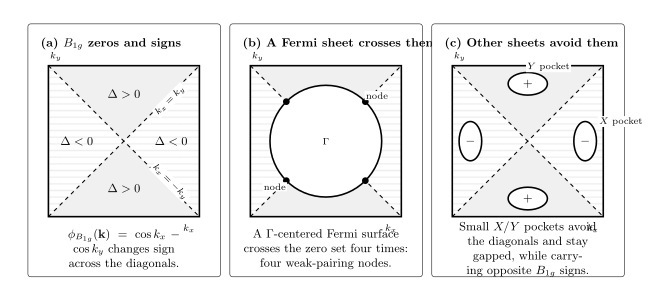
The representation fixes diagonal zero loci, but the illustrated weak-pairing quasiparticle nodes occur only where those loci meet a Fermi surface. Small pockets avoid the zeros and carry opposite signs. Original square-lattice schematic in an isolated-band weak-pairing limit; not to scale.
The same information is available without the image:
| Pairing input | Symmetry-zero locus | Illustrated Fermi surface | Intersection | Weak-pairing conclusion |
|---|---|---|---|---|
| with | Simple -centered sheet | Four crossings | Four nodal quasiparticle points in two dimensions | |
| The same form factor | The same diagonal loci | Small separate and pockets | No crossings | Each pocket is fully gapped; the signs at and are opposite |
This example separates three statements that are often conflated: the irrep fixes how the gap transforms, the basis function fixes a possible zero locus, and the normal-state Fermi surface decides whether that locus produces low-energy quasiparticles.
Nodes belong to the BdG spectrum
Section titled “Nodes belong to the BdG spectrum”In the convention above, the full Bogoliubov–de Gennes matrix is
A quasiparticle node is a momentum at which its smallest nonnegative eigenvalue vanishes. This definition remains valid at band crossings, for interband pairing, and when a projected scalar gap is not meaningful.
The familiar Fermi-surface rule is a controlled weak-pairing reduction. Let the columns of span a normal-state band or degenerate band subspace, and define
If the pairing scale is much smaller than the separation to omitted bands,
then interband mixing is perturbative. On the th Fermi surface, the smallest singular value of is the leading excitation gap. A projected zero gives a physical node only if the projection is controlled; near a normal-state degeneracy or for appreciable interband pairing, diagonalize the full BdG matrix instead.
Node statements fall into three different, partly overlapping classes:
- A symmetry-enforced node occurs when little-group representations forbid a nonzero projected pairing matrix on an invariant line or plane. It persists under symmetry-preserving changes, provided the Fermi surface continues to intersect that locus.
- An accidental node is a cancellation among allowed basis functions or band components within the same symmetry class. It can move, merge, or gap out without a phase transition that breaks an additional symmetry.
- A topological node is surrounded by a nonzero invariant. For example, when a chiral symmetry puts the flattened BdG Hamiltonian in off-diagonal form with block , a loop on which can carry
It cannot disappear alone while that symmetry and the loop gap remain intact; it must meet a node of compensating charge or encounter a boundary where the invariant ceases to be defined. A node can be both symmetry-enforced and topological, so these labels are not mutually exclusive. Kobayashi et al. 2014, Abstract and §§II–III makes this distinction precise for odd-parity line nodes.
Blount’s result should not be read as a universal prohibition. In the standard strong-spin–orbit, symmorphic setting, an odd-parity line node is not generically symmetry-enforced, although an accidental line zero can still occur. On glide- or screw-invariant Brillouin-zone faces, nonsymmorphic phases and band sticking change the allowed pair representations and can protect odd-parity line nodes. Blount 1985, pp. 2935–2944 gives the classic argument; Sumita and Yanase 2018, Introduction and §§II–III gives the space-group qualification.
For a clean node with linear dispersion in transverse momentum directions, phase-space counting gives
Thus a line node in three dimensions and a point node in two dimensions both have and give , while a simple point node in three dimensions has and gives . Disorder, a small minimum gap, multiple bands, nonlinear dispersion, and a finite fitting window all modify these asymptotes. A measured power law is evidence about low-energy phase space, not a representation label by itself.
Spin–orbit coupling, bands, and domains
Section titled “Spin–orbit coupling, bands, and domains”In a noncentrosymmetric but time-reversal-invariant metal, a minimal normal-state Hamiltonian is
The spin–orbit field splits the two helicity bands. In the intraband weak-pairing limit, a mixed-parity gap with has helicity-gap magnitudes
The omitted helicity-basis phase depends on how the time-reversed Bloch partners are chosen and does not change the excitation energy. A zero of one helicity gap can therefore arise from cancellation between two symmetry-allowed components; unless a symmetry fixes that cancellation, it is accidental. If the spin–orbit splitting is not large compared with pairing, the intraband formula is insufficient and the full BdG problem is required. Frigeri et al. 2004, pp. 097001-1–097001-4 and Erratum derives the protected intraband structure in the simplest noncentrosymmetric model.
In a multiorbital material, projection also folds the momentum-dependent orbital texture of into . Consequently, a gap that is momentum independent in an orbital basis can become strongly anisotropic in the band basis, and an orbital-antisymmetric spin-triplet matrix can be even in momentum without violating Pauli antisymmetry. Near avoided crossings, the same orbital texture can enhance interband pairing. Classification should therefore begin in a declared microscopic basis and end with the observable band-resolved gap, rather than switching between them silently.
Multicomponent order adds a second layer. Strain may select one component, quartic terms may favor a real or complex combination, and cooling can produce multiple domains. Domain averaging can hide a predicted anisotropy; domain walls can add low-energy states or local fields absent from a uniform calculation. A serious comparison with experiment must state whether it models one domain, a weighted domain ensemble, or a wall-containing sample.
Every diagnostic needs a forward model
Section titled “Every diagnostic needs a forward model”The classification becomes falsifiable only after the candidate gap is propagated through the measurement geometry, matrix elements, resolution, disorder model, and domain population. The tricrystal experiment of Tsuei et al. 1994, pp. 593–596 is a useful model: its force came from a junction geometry designed to compare phase signs, not from treating flux as a direct picture of the bulk gap.
| Probe | Candidate-specific prediction | Controls and alternatives to include | Strongest licensed conclusion |
|---|---|---|---|
| Heat capacity, penetration depth, and thermal transport | Low-energy density of states, field-angle dependence, and clean-limit exponent | Impurity bandwidth, phonons, nonlocal response, multiple gaps, vortex scattering, and fitting range | Constrains nodal phase space and anisotropy; does not alone fix the irrep or phase sign |
| Phase-sensitive Josephson junction or ring | Junction coupling signs and flux minima for the actual face orientations | Faceting, tunnelling matrix elements, trapped flux, junction transparency, and subdominant surface order | Tests a specified relative phase pattern within the junction model |
| Knight shift or polarized susceptibility | Field- and temperature-dependent spin response after spin–orbit and band projection | Hyperfine and orbital shifts, diamagnetism, field-induced order-parameter rotation, and Van Vleck response | Constrains physical-spin response; does not directly read off pseudospin parity |
| Controlled disorder | Joint evolution of , residual resistivity, low-energy density of states, and gap anisotropy | Interband versus intraband scattering, impurity potential, local moments, carrier-density changes, and irradiation damage | Tests sign structure only relative to a quantified scattering model |
| ARPES, tunnelling, and quasiparticle interference | Band-resolved gap minima, zero loci, and coherence-factor patterns | Energy and momentum resolution, surface termination, tunnelling or photoemission matrix elements, and averaging | Locates projected gap structure on the bands that the probe can see |
| Strain, ultrasound, Kerr response, and local-field probes | Degeneracy splitting, collective-mode coupling, or onset expected for a multicomponent state | Domain repopulation, trapped flux, magnetic inclusions, structural transitions, and extrinsic chirality | Constrains component degeneracy or additional symmetry breaking after alternatives are bounded |
Controlled disorder is especially model dependent: even for a two-band sign-changing state, the rate of suppression varies strongly with the impurity scattering matrix. Wang et al. 2013, Abstract and §§II–IV illustrates why a disorder series should fit several observables together rather than use a single residual-resistivity slope.
A persuasive assignment is the intersection of surviving tests. A null result is decisive only if the forward model predicts a resolvable nonzero coupling, and a positive signal is decisive only after realistic alternatives have been bounded.
What symmetry establishes—and what it does not
Section titled “What symmetry establishes—and what it does not”The shared validity map keeps three inference branches separate. Follow the symmetry branch through Pauli antisymmetry, crystal covariance, and band-resolved diagnostics; do not jump from agreement on that branch to a microscopic interaction or boundary quasiparticle.
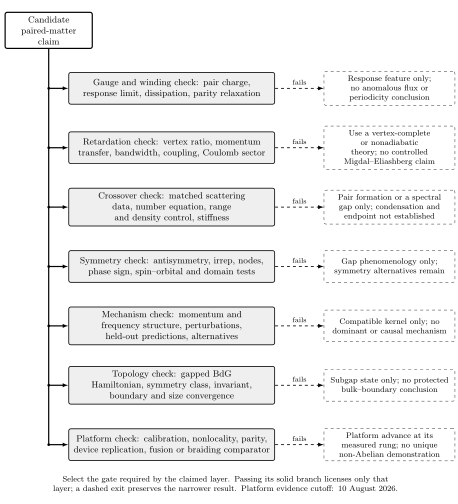
Symmetry classification predicts a linked set of falsifiable observables. Agreement licenses a representation within the tested model; it does not identify the pairing interaction or a topological boundary mode. Original schematic, not to scale.
Use the paired-matter claim test matrix to compare the tests needed for each conclusion. Continue with the following questions:
- For why a channel becomes attractive and how alternatives are discriminated, continue to unconventional pairing mechanisms and evidence.
- For a bulk BdG invariant, its protecting symmetries, and the boundary hypotheses needed for Majorana modes, continue to topological superconductors and Majorana boundaries.
Common pitfalls
Section titled “Common pitfalls”Inferring parity from a spin label. Singlet-even and triplet-odd follows only after specifying even frequency and a symmetric single-orbital sector. Orbital antisymmetry, odd-frequency pairing, or non-pseudospin spin–orbit-coupled bands change the inference.
Equating an irrep with a node pattern. An irrep constrains allowed gap matrices. Actual nodes also depend on coefficients within the irrep, Fermi-surface intersections, band projection, and interband pairing.
Calling every sign under rotation a broken symmetry. A one-dimensional superconducting order parameter may acquire an irrep character such as under a rotation while the state remains invariant after a global gauge transformation. Test gauge-invariant observables before claiming rotational symmetry breaking.
Promoting one diagnostic to mechanism or topology. A phase-sensitive sign change constrains the order parameter, not the pairing glue. A nodal power law does not supply a bulk invariant, and a zero-bias boundary feature needs a boundary forward model before it can be called a Majorana mode.
Exercises
Section titled “Exercises”1. Recover the full exchange-parity rule
Section titled “1. Recover the full exchange-parity rule”Suppose a separable pair matrix has spin, orbital, momentum, and frequency factors with exchange parities , , , and . Derive their constraint. Then determine the momentum parity of (a) an even-frequency spin singlet with an orbital-symmetric matrix and (b) an even-frequency spin triplet with an orbital-antisymmetric matrix.
Solution
Write
with , , , and . Substitution into the Pauli relation gives
For (a), , , and , so : the momentum dependence is even. For (b), , , and , so again . The second case is an even-momentum spin triplet made possible by orbital antisymmetry; it is why the one-orbital rule must not be applied to a multiorbital matrix.
2. Follow the B₁g example to its low-energy thermodynamics
Section titled “2. Follow the B₁g example to its low-energy thermodynamics”For , verify its inversion and -rotation characters. Find its intersections with a circular Fermi surface centered at . Linearize the BdG spectrum near one crossing and infer the clean two-dimensional low-temperature heat capacity. Finally evaluate at and .
Solution
Inversion gives
while gives
The zeros are the two diagonals modulo reciprocal vectors. A simple -centered circle crosses them at four points. Resolving momentum into normal to the Fermi surface and tangent to it, the generic linearization is
This two-dimensional Dirac cone has , hence in the clean asymptotic regime. At the pocket centers,
Small pockets about and can therefore be fully gapped yet have opposite signs.
3. Project a mixed-parity gap onto helicity bands
Section titled “3. Project a mixed-parity gap onto helicity bands”For
use to project
Find the two excitation-gap magnitudes and state when a zero is accidental.
Solution
Since
pairing between time-reversed states on helicity sheet has magnitude
A helicity-basis phase multiplying this result depends on the gauge for the Bloch states and drops out of the energy. A zero on the Fermi surface occurs when . It is accidental if symmetry allows either component to vary independently, because a symmetry-preserving change then moves or removes the cancellation. It is symmetry-enforced only if the little group requires the projected matrix to vanish there.
4. Let quartic terms choose a two-component state
Section titled “4. Let quartic terms choose a two-component state”Consider a two-dimensional irrep with
For fixed , find the minima when and when . State the quartic stability conditions and whether time reversal is broken.
Solution
The triangle inequality gives
For , the minimum sets , which requires equal magnitudes and relative phase . Up to a global phase,
The two choices are exchanged by time reversal, so this complex or chiral state breaks it. Its quartic stability requires .
For , the minimum maximizes the last factor to . The components have a common phase and can be chosen real, giving a time-reversal-preserving nematic family at quartic order. Higher-order crystal anisotropy can select discrete domain directions. Stability along this direction requires .
References
Section titled “References”- Blount, E. I. (1985). “Symmetry properties of triplet superconductors.” Physical Review B 32, 2935–2944. doi:10.1103/PhysRevB.32.2935.
- Frigeri, P. A., Agterberg, D. F., Koga, A., and Sigrist, M. (2004). “Superconductivity without inversion symmetry: MnSi versus CePtSi.” Physical Review Letters 92, 097001; Erratum 93, 099903. doi:10.1103/PhysRevLett.92.097001; Erratum doi:10.1103/PhysRevLett.93.099903.
- Geilhufe, R. M., and Balatsky, A. V. (2018). “Symmetry analysis of odd- and even-frequency superconducting gap symmetries for time-reversal symmetric interactions.” Physical Review B 97, 024507. doi:10.1103/PhysRevB.97.024507.
- Kobayashi, S., Shiozaki, K., Tanaka, Y., and Sato, M. (2014). “Topological Blount’s theorem of odd-parity superconductors.” Physical Review B 90, 024516. doi:10.1103/PhysRevB.90.024516.
- Ramires, A., and Sigrist, M. (2019). “Superconducting order parameter of SrRuO: A microscopic perspective.” Physical Review B 100, 104501. doi:10.1103/PhysRevB.100.104501.
- Samokhin, K. V. (2019). “Symmetry of superconducting pairing in non-pseudospin electron bands.” Physical Review B 100, 054501. doi:10.1103/PhysRevB.100.054501.
- Sigrist, M., and Ueda, K. (1991). “Phenomenological theory of unconventional superconductivity.” Reviews of Modern Physics 63, 239–311. doi:10.1103/RevModPhys.63.239.
- Sumita, S., and Yanase, Y. (2018). “Unconventional superconducting gap structure protected by space group symmetry.” Physical Review B 97, 134512. doi:10.1103/PhysRevB.97.134512.
- Tsuei, C. C., Kirtley, J. R., Chi, C. C., Yu-Jahnes, L. S., Gupta, A., Shaw, T., Sun, J. Z., and Ketchen, M. B. (1994). “Pairing symmetry and flux quantization in a tricrystal superconducting ring of YBaCuO.” Physical Review Letters 73, 593–596. doi:10.1103/PhysRevLett.73.593.
- Wang, Y., Kreisel, A., Hirschfeld, P. J., and Mishra, V. (2013). “Using controlled disorder to distinguish and gap structure in Fe-based superconductors.” Physical Review B 87, 094504. doi:10.1103/PhysRevB.87.094504.