

The BCS–BEC Crossover
The BCS–BEC crossover is the smooth zero-temperature evolution from a superfluid of large, overlapping Cooper pairs to a dilute gas of tightly bound fermion dimers. This page constructs the canonical Leggett saddle point for a uniform, balanced, equal-mass, two-component Fermi gas in three dimensions with short-range -wave interactions. It is a controlled endpoint interpolation, not an exact solution at unitarity and not a complete finite-temperature theory. Its central lesson is that chemical potential, pair size, pairing amplitude, excitation gap, and phase coherence are distinct diagnostics; no single “gap” locates the crossover.
Required background. BCS gap and number equations provide the weak-coupling saddle point, contact interactions and scattering length provide the ultraviolet matching, and the weakly interacting Bose gas supplies the composite-boson endpoint.
The regulated zero-range saddle point
Section titled “The regulated zero-range saddle point”Let be the total fermion density and define
Here is the physical two-body scattering length, is the mass of either fermion species, and , , and label the BCS side, unitarity, and the bound-state side, respectively. The zero-temperature, real-gap saddle point uses
At fixed and , the unknowns and solve
The subtraction is not an arbitrary convergence trick: it replaces the bare contact coupling by the measured scattering length. The displayed equations assume a broad resonance and zero effective range, a homogeneous balanced gas, one isotropic pairing channel, and a stable saddle point. Their derivation and domain are reviewed in Giorgini, Pitaevskii, and Stringari 2008, § V.A, pp. 1229–1231.
Dimensionless equations and a reproducible solution
Section titled “Dimensionless equations and a reproducible solution”Write
The two equations become
These forms expose both the normalization and the ultraviolet checks. At large , the first displayed integrand behaves as , while the number integrand behaves as . A reliable solver should therefore control both the finite quadrature and its analytic tail.
The data below solve for by damped Newton iteration while continuing in . The production calculation uses composite Gauss–Legendre quadrature through with analytic tails through ; an independent calculation increases both quadrature order and cutoff to . Across , the maximum equation residual is below , the two quadratures agree below for the reported observables, and forward and reverse continuation agree below . These are checks of this deterministic zero-range saddle-point calculation, not an uncertainty estimate for real many-body matter.
Endpoint tests and what mean field misses
Section titled “Endpoint tests and what mean field misses”Any interpolation should reproduce the analytically understood limits:
| Regime | Zero-range saddle-point result | Interpretation and limitation |
|---|---|---|
| BCS, | and | Large overlapping pairs; medium polarization changes the weak-coupling gap prefactor beyond mean field. |
| Unitarity, | and | These are Leggett mean-field landmarks, not precision benchmark values. |
| BEC, | , , and | The leading dimer binding is correct, but mean field gives the wrong dimer–dimer interaction. |
Current benchmark determinations at unitarity belong to Unitary Fermi-Gas Platforms and Benchmark Evidence. Keeping those numbers there prevents a stable method page from silently presenting a dated experimental or many-body-method snapshot as exact.
The BEC correction makes the mean-field limitation especially transparent. A dimer has density , mass , and coupling . Matching the dimer chemical potential gives
and therefore
The saddle point implies , whereas the universal four-body result is Petrov, Salomon, and Shlyapnikov 2004, pp. 090404-1–090404-3. Thus the leading two-body binding can be right while the interaction between composite bosons is wrong. The universal deep-BEC window requires both and ; it cannot be extended arbitrarily at fixed nonzero effective range.
Chemical potential and the spectral minimum
Section titled “Chemical potential and the spectral minimum”The fermionic spectrum supplies a particularly clean crossover marker. Differentiating gives
Consequently,
The branches join continuously at . In this saddle point, that happens at : it relocates the minimum from finite momentum to without closing the gap or changing a symmetry. It is therefore a model-dependent spectral landmark, not a phase transition.
In the figure, first follow the smooth fall of and growth of . Then compare the three spectra: the minimum lies near on the BCS side, moves inward at unitarity, and sits at on the BEC side.
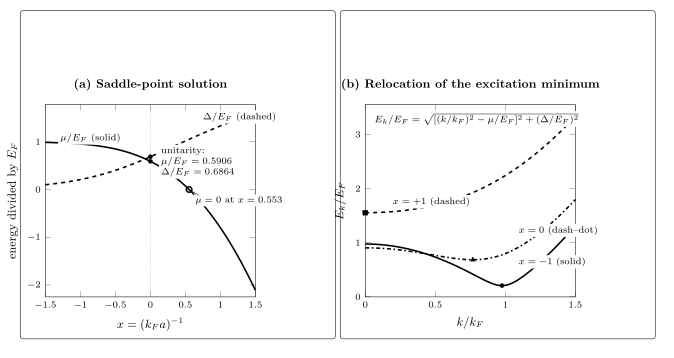
Zero-temperature Leggett mean field for a uniform, balanced, three-dimensional zero-range gas. The chemical potential falls smoothly and changes sign on the BEC side, relocating the Bogoliubov-spectrum minimum from finite momentum to while remains nonzero. The curves are interpolation diagnostics, not benchmark values at unitarity; is not a phase transition.
The plotted values are available as crossover data (CSV), representative dispersions (CSV), and named landmarks (CSV). A compact semantic equivalent is:
| Landmark | |||||
|---|---|---|---|---|---|
| BCS-side sample | |||||
| Unitarity | |||||
| Mean-field | |||||
| BEC-side sample |
Pair size is not a unique coherence length
Section titled “Pair size is not a unique coherence length”A useful fermion-pair size can be built from the equal-time anomalous amplitude
through
It is better to call an anomalous pair amplitude than an unqualified wavefunction: the number-projected BCS pair orbital is a different object. This is also distinct from a Ginzburg–Landau coherence length, a healing length, and a phase-correlation length.
The endpoint checks are
The first is large when pairs overlap strongly; the second is the root-mean-square size of a shallow dimer. Definitions and asymptotics are compared in Marini, Pistolesi, and Strinati 1998, § II, pp. 152–154.
Phase mode, stiffness, and sound
Section titled “Phase mode, stiffness, and sound”The static gap and number equations do not by themselves derive the collective mode. Gaussian or time-dependent phase fluctuations supply the Anderson–Bogoliubov mode,
On the BEC side it becomes the Bogoliubov phonon of dimers. On the BCS side it can eventually enter the pair-breaking continuum. The critical velocity therefore crosses from being pair-breaking-limited to being sound-limited.
There is an important simplification at zero temperature: in a uniform Galilean-invariant continuum,
At fixed density, the zero-temperature superfluid number density is therefore not a nontrivial crossover curve. The strongly evolving quantity is the compressibility, and hence . At unitarity, writing gives
The saddle-point value gives ; a benchmark equation of state changes this number. Superfluid Order, Stiffness, Vortices, and Phase Slips develops phase coherence, and Phase and Amplitude Collective Modes develops the fluctuation spectrum.
Pair formation is not condensation
Section titled “Pair formation is not condensation”In weak-coupling BCS theory, pair formation and phase coherence occur at parametrically similar temperatures. In the BEC regime, the binding scale can be far above the dimer-condensation temperature. Extending the saddle point to then identifies a pairing scale, not the true condensation temperature; number and phase fluctuations are essential.
Nozières–Schmitt-Rink and related Gaussian methods restore the ideal-dimer condensation limit but do not define one universal pseudogap boundary Nozières and Schmitt-Rink 1985, pp. 195–211. Near unitarity, a reported pseudogap depends on the approximation and probe. Analytic continuation, final-state interactions, trap averaging, resolution, and ordinary normal-state self-energies must be separated from genuine pairing. A single-particle gap or preformed pairs above do not establish superfluidity; phase stiffness, off-diagonal long-range order, vortices, or another coherence diagnostic is still required. Randeria and Taylor 2014, §§ 3–4 and 6–7 reviews this evidence boundary.
Where the zero-range saddle point stops
Section titled “Where the zero-range saddle point stops”-
Finite range and resonance width. The universal continuum reduction requires ; the shallow-dimer formula additionally needs . Use Effective Range, Shallow Poles, and Universality Windows and Two-Channel Resonance Models when these conditions fail.
-
Population or mass imbalance. Distinct chemical potentials or masses can produce normal, phase-separated, polarized-superfluid, or finite-momentum-pairing regimes. They are separate problems, not small substitutions in the balanced equations.
-
Traps. Local-density theory uses only when the potential varies slowly on the relevant correlation lengths. Trap-integrated spectra smear local crossover features; inhomogeneous Bogoliubov–de Gennes theory or another spatial method is needed when the local approximation fails.
-
Dimension and lattice structure. In two dimensions any attraction supports a bound state and finite-temperature coherence is BKT-controlled Randeria, Duan, and Shieh 1990, §§ II–IV. On a lattice, the band dispersion, filling, density of states, and competing order replace the continuum universality assumptions.
-
Lifetime and temperature. Three-body loss and other inelastic processes constrain the observation window but are not equilibrium universal parameters. A complete finite-temperature strong-coupling theory and current experimental benchmarks lie beyond this page’s stable scope.
The shared validity map is not a second plot of crossover observables. Follow the crossover branch: the scattering input and number equation must be matched, range and density must remain controlled, and a coherence diagnostic must be added before a spectral gap can support a superfluid claim.
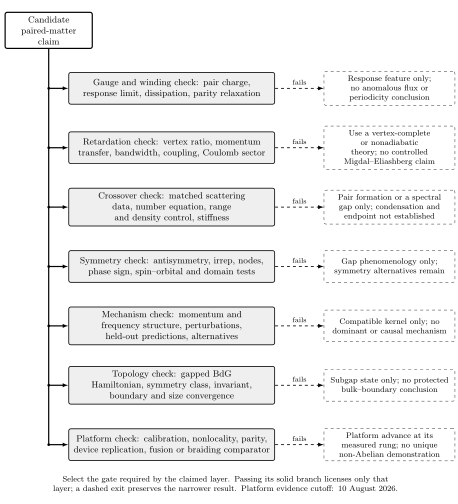
The crossover branch separates a solved interpolation from a demonstrated superfluid: scattering data, number conservation, range and density control, and phase coherence are independent checks. The other branches govern flux, Migdal–Eliashberg, symmetry, mechanism, topology, and platform claims. Original schematic, not to scale.
See the paired-matter claim test matrix for the corresponding endpoint and pseudogap tests.
Common pitfalls
Section titled “Common pitfalls”Calling the excitation gap everywhere. When , the minimum quasiparticle energy is . When , the minimum is at and equals , which approaches half the dimer binding energy in the deep BEC regime.
Treating as a phase transition. The spectral minimum relocates smoothly and remains gapped. No symmetry changes at the mean-field zero crossing.
Quoting saddle-point unitarity values as benchmarks. The values and test this particular solver. They are not exact constants of the unitary gas.
Drawing a varying superfluid density in the uniform continuum. Galilean invariance fixes . Compressibility, sound velocity, pair size, condensate fraction, and spectral quantities still evolve.
Using “coherence length” without a definition. Pair size, healing length, Ginzburg–Landau coherence length, and phase-correlation length answer different questions and coincide only in special limits.
Exercises
Section titled “Exercises”Derive the dimensionless equations
Section titled “Derive the dimensionless equations”Starting from the regulated gap and number equations, derive the two integrals for , , and . Then find the leading large- tail of each integrand.
Solution
Spherical integration gives
Using in the gap equation yields
Using in the number equation yields
Expanding gives . Rationalizing the number factor,
shows that its full integrand is . Both tails are integrable but must be included in a finite-cutoff calculation.
Locate the quasiparticle minimum
Section titled “Locate the quasiparticle minimum”Minimize for and show that the two expressions for meet continuously at .
Solution
Because , it is enough to minimize . Its derivative is
If , the allowed stationary point gives and . If , has no positive solution, so the minimum is at and equals . Both give at .
Match the composite-boson interaction
Section titled “Match the composite-boson interaction”Use , , , and to derive the first BEC correction to . Compare mean-field and exact few-body matching.
Solution
Substitution gives
so
Since and ,
Mean field inserts ; exact zero-range four-body matching gives . The leading binding term agrees because it is a two-body result, while the subleading interaction term probes four-body physics absent from the saddle point.
Derive the unitary sound speed
Section titled “Derive the unitary sound speed”At unitarity, suppose . Use scale invariance and hydrodynamics to derive .
Solution
Because ,
The hydrodynamic relation therefore gives
Using and ,
The Leggett saddle point gives . Replacing its equation-of-state coefficient by a benchmark value changes the sound speed without changing the derivation.
References
Section titled “References”- Giorgini, S., Pitaevskii, L. P., and Stringari, S. (2008). “Theory of ultracold atomic Fermi gases.” Reviews of Modern Physics 80, 1215–1274. doi:10.1103/RevModPhys.80.1215. Open PDF.
- Leggett, A. J. (1980). “Diatomic molecules and Cooper pairs.” In A. Pekalski and R. Przystawa (eds.), Modern Trends in the Theory of Condensed Matter, Lecture Notes in Physics 115, 13–27. Springer. doi:10.1007/978-3-642-81409-5_1.
- Marini, M., Pistolesi, F., and Strinati, G. C. (1998). “Evolution from BCS superconductivity to Bose condensation: Analytic results for the crossover in three dimensions.” European Physical Journal B 1, 151–159. doi:10.1007/s100510050165. Open PDF.
- Nozières, P., and Schmitt-Rink, S. (1985). “Bose condensation in an attractive fermion gas: From weak to strong coupling superconductivity.” Journal of Low Temperature Physics 59, 195–211. doi:10.1007/BF00683774.
- Petrov, D. S., Salomon, C., and Shlyapnikov, G. V. (2004). “Weakly bound dimers of fermionic atoms.” Physical Review Letters 93, 090404. doi:10.1103/PhysRevLett.93.090404. Open PDF.
- Randeria, M., Duan, J.-M., and Shieh, L.-Y. (1990). “Superconductivity in a two-dimensional Fermi gas: Evolution from Cooper pairing to Bose condensation.” Physical Review B 41, 327–343. doi:10.1103/PhysRevB.41.327.
- Randeria, M., and Taylor, E. (2014). “Crossover from Bardeen–Cooper–Schrieffer to Bose–Einstein condensation and the unitary Fermi gas.” Annual Review of Condensed Matter Physics 5, 209–232. doi:10.1146/annurev-conmatphys-031113-133829. Open PDF.
Further reading
Section titled “Further reading”- Strinati, G. C., Pieri, P., Röpke, G., Schuck, P., and Urban, M. (2018). “The BCS–BEC crossover: From ultra-cold Fermi gases to nuclear systems.” Physics Reports 738, 1–76. doi:10.1016/j.physrep.2018.02.004. Open PDF.