

Raman, RIXS, and EELS Response
Raman scattering, resonant inelastic x-ray scattering, and electron energy-loss spectroscopy all measure energy transferred to matter, but they couple through different operators. Nonresonant Raman response selects stress-tensor-like symmetry channels, RIXS is a second-order resonant process involving a core-hole intermediate state, and EELS commonly measures a screened charge-loss function. Treating all three as the same dynamical structure factor erases the matrix elements that make them useful.
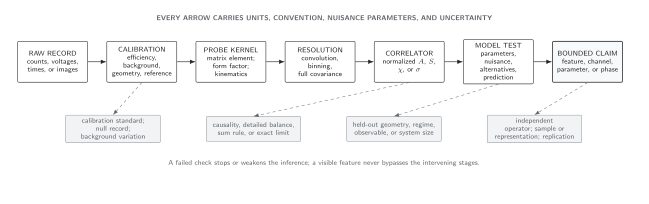
Required background. The measurement-to-claim map supplies the forward-model standard.
Helpful background. Irreducible vertices and Bethe–Salpeter equations supplies the vertex corrections required beyond a bare bubble.
Evidence cutoff. This method and evidence account covers primary and official sources available through 10 August 2026. Later calibrations, corrections, datasets, and changing assessments belong in the dated Quantum Matter and Emergence Research synthesis.
Three scattering operators
Section titled “Three scattering operators”In a nonresonant effective-mass treatment, electronic Raman scattering probes
and the Stokes intensity obeys
Crystal symmetry and polarization select irreducible representations. Long-range screening suppresses the uniform charge component in fully symmetric channels, and resonant denominators can invalidate the simple effective-mass vertex. Devereaux and Hackl 2007 develop these distinctions.
For RIXS, the Kramers–Heisenberg amplitude is
is the core-hole energy broadening, of order for lifetime (with a convention-dependent factor of two). Only in controlled limits—such as an ultrashort core-hole expansion or a specified low-energy projection—does this reduce to a simple spin, density, orbital, or phonon correlator. Incident energy, edge, polarization, self-absorption, and intermediate-state multiplets remain part of the operator Ament et al. 2011.
In transmission EELS at small momentum transfer, a common bulk quantity is the loss function
The cross section also contains a strongly momentum-dependent Coulomb factor and experimental geometry. Surface losses, multiple scattering, finite thickness, and relativistic effects must be modeled before identifying a bulk plasmon or continuum; Egerton 2011, chs. 3–4 gives the quantitative corrections.
The chapter diagram emphasizes that the effective operator differs even when the horizontal axes look identical.
Three energy-loss probes, three operator maps. A common peak energy does not imply a common matrix element or mechanism; polarization, momentum, incident energy, and screening determine what was measured. Schematic.
Identification by controlled variation
Section titled “Identification by controlled variation”Useful discriminants are probe specific. Raman symmetry channels can separate nodal and antinodal electronic vertices but depend on the band and resonance regime. RIXS incident-energy and polarization scans test intermediate-state assignments; momentum dependence separates local from dispersive excitations only after self-absorption and geometry corrections. EELS thickness and momentum scans distinguish bulk and surface losses and expose multiple scattering.
The anti-Stokes/Stokes ratio is a temperature and equilibrium check. Sum rules and Kramers–Kronig relations constrain the charge response. Comparing an effective low-energy operator with an exact local cluster calculation can test a RIXS projection before it is exported across the Brillouin zone.
A peak can identify an energy scale while leaving its spin, charge, orbital, or lattice character ambiguous. A continuum can reflect damping, multiparticle response, unresolved branches, or background. The probe and computation claim test matrix keeps the intermediate state, screening, self-absorption, resolution, and competing operators in the comparison.
Exercise
Section titled “Exercise”Raman detailed balance. If a mode of energy is in equilibrium at temperature , show that the anti-Stokes to Stokes intensity ratio is when matrix elements are equal.
Solution
The Stokes process creates a bosonic excitation and is weighted by ; the anti-Stokes process removes one and is weighted by . Therefore
A disagreement after correcting detector response and optical throughput can indicate local heating, nonequilibrium occupation, fluorescence background, or unequal resonant matrix elements.
References
Section titled “References”- Luuk J. P. Ament, Michel van Veenendaal, Thomas P. Devereaux, John P. Hill, and Jeroen van den Brink, “Resonant Inelastic X-Ray Scattering Studies of Elementary Excitations,” Reviews of Modern Physics 83 (2011) 705–767. DOI
- Thomas P. Devereaux and Rudi Hackl, “Inelastic Light Scattering from Correlated Electrons,” Reviews of Modern Physics 79 (2007) 175–233. DOI
- Ray F. Egerton, Electron Energy-Loss Spectroscopy in the Electron Microscope, third edition, Springer, 2011. DOI