

Mobile Impurities and Polarons
A mobile impurity in a quantum medium can dress into an attractive polaron, a metastable repulsive polaron, a molecule, or an incoherent continuum. Within a ladder or one-particle–hole variational approximation, a polaron is identified by a pole of the impurity Green function with separately computed energy, residue, effective mass, and width. A spectral maximum is not automatically a stable quasiparticle, and a crossing of approximate energies is not by itself a phase transition in a finite-impurity problem.
Required background. Matched short-range interactions supplies and effective-range control. Quasiparticle poles and lifetimes supplies the pole criteria.
Helpful background. Two-channel resonance models supplies narrow-resonance and effective-range corrections.
Ladder self-energy
Section titled “Ladder self-energy”For one impurity of mass in a spin-polarized Fermi sea of particles of mass , take a short-range interaction matched to scattering length . The in-medium pair vertex may be written
where and . The subtraction is the vacuum matching; conventions that place a minus sign elsewhere must reproduce the same two-body pole.
The non-self-consistent ladder self-energy is
A polaron pole satisfies
with
The quasiparticle interpretation requires within the spectral convention and smaller than the energy scales being resolved.
Variational interpretation and competing molecule
Section titled “Variational interpretation and competing molecule”The Chevy ansatz retains the bare impurity plus one particle–hole excitation,
Its stationary equation is equivalent to a non-self-consistent ladder treatment in the same regulator. The smallness of higher particle–hole sectors is empirical and kinematic for important three-dimensional cases, not a universal theorem for every dimension, mass ratio, temperature, or bath.
On the positive- side, a dressed molecule competes with the attractive polaron. Compare energies, residues, and continua in the same approximation and particle-number convention. At finite impurity density the crossing may become a many-body transition or phase separation; for one impurity it is a change in the lowest branch.
The repulsive polaron is metastable because decay into lower branches is allowed. Its peak position without its width and preparation lifetime is incomplete. Mass imbalance can open few-body bound states, and three-body loss can end the quasiparticle window.
Chevy 2006 gives the variational construction; Massignan, Zaccanti, and Bruun 2014, §§2–4 reviews ladder, molecule, mass, and lifetime physics.
Platform inference and current results
Section titled “Platform inference and current results”Radio-frequency injection/ejection, Ramsey interferometry, momentum-resolved spectroscopy, and density profiles couple to different spectral convolutions. The forward model must include interactions in the initial and final states, pulse duration, trap averaging, temperature, impurity concentration, and loss. A fitted peak establishes a branch only if the same model accounts for weight, width, sum rules, and the competing molecular continuum. Schirotzek et al. 2009 gives an early radio-frequency measurement of the attractive-polaron energy and residue.
This page states the stable theory and validity tests through 10 August 2026. Dated platform comparisons and superseding experimental records belong in the Quantum Matter and Emergence Research map.
Polaron identity requires a pole with controlled residue and width plus an explicit competing molecule branch. Platform spectra add preparation, final-state, trap, temperature, and loss effects. Original schematic, not to scale.
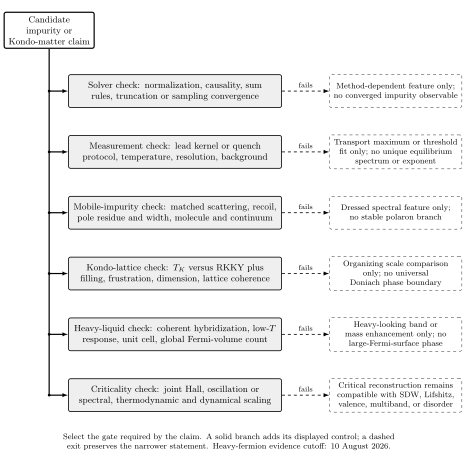
See the impurity claim test matrix for the branch and lifetime checks.
Exercise
Section titled “Exercise”Residue check. If near a pole with , find .
Solution
, which exceeds one. For a canonical impurity spectral function this signals that the assumed local linear form, pole assignment, or approximation is not physically consistent over the relevant interval; one must inspect the full frequency dependence and sum rule rather than accepting the algebraic root.
References
Section titled “References”- Chevy, F. (2006). “Universal phase diagram of a strongly interacting Fermi gas with unbalanced spin populations.” Physical Review A 74, 063628. doi:10.1103/PhysRevA.74.063628.
- Massignan, P., Zaccanti, M., and Bruun, G. M. (2014). “Polarons, dressed molecules and itinerant ferromagnetism in ultracold Fermi gases.” Reports on Progress in Physics 77, 034401. doi:10.1088/0034-4885/77/3/034401.
- Schirotzek, A., Wu, C.-H., Sommer, A., and Zwierlein, M. W. (2009). “Observation of Fermi polarons in a tunable Fermi liquid of ultracold atoms.” Physical Review Letters 102, 230402. doi:10.1103/PhysRevLett.102.230402.